Amg Hyper-suv Driven: 1153bhp Cayenne Chaser Breaks The Rules Of Physics
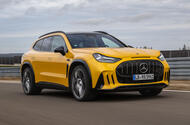
The new GT 63 SUV is Mercedes-AMG's most powerful road car yet, but can it hide its 2.7-tonne weight?
With 1153bhp from three electric motors, Mercedes-AMG’s first independently developed SUV has the straight-line performance of a top-flight supercar.
And there's a point when driving the new GT 63 SUV where you begin to wonder whether its engineers had been having a good laugh during its development.
For me it comes towards the end of a preview drive at Mercedes-Benz’s Immendingen proving ground in Germany, on a section meant to replicate the characteristic cambers and undulations of a typical German country road.
The surface is terrifically smooth, I'm carrying a decent amount of speed and the steering is loaded up as I head into a long right-hander. The forces build, but the 2695kg SUV seems almost indifferent. There’s very little roll: the body stays resolutely flat, with barely any perceptible weight transfer as the corner tightens and an appetite for lateral forces completely at odds with its size and weight.
This is a five-seat SUV with a raised seating position and up to 607 litres of nominal luggage space measuring 5084mm in length, not a low-slung compact sports saloon.
It’s the second model to use the EV-dedicated AMG.EA platform after the new GT 4-Door Coupé, with which it shares its 800V electrical architecture, axial-flux motors, oil-cooled cylindrical battery cells and much more.
In the ultimate 63 variant, three axial-flux motors deliver 1153bhp and 1475lb ft of torque for 63sec bursts (appropriately).
That exceeds the Lamborghini Urus SE, whose twin-turbocharged 4.0-litre V8 engine and electric motor produce a combined 789bhp and 701lb ft, by 364bhp and 774lb ft.
The Porsche Cayenne Turbo Electric is the closer fight, with 1140bhp and 1106lb ft on launch-control overboost, but AMG's Stuttgart neighbour is still 13bhp and an entire 369lb ft down.
Obviously the GT 63 SUV ever feels short of any given reserve. Acceleration is ferocious, the response instantaneous and the thrust relentless. AMG claims 0-62mph in 2.7sec and 0-124mph in 7.2sec, with an electronically limited top speed of 168mph when the optional AMG Driver’s Package is specified.
More striking is how rapidly it continues gathering speed beyond the initial burst.
Yet it’s the cornering that leaves the stronger impression during our first brief acquaintance. The steering is direct, accurately weighted and, by performsnce SUV standards, exceptionally responsive, with rear-wheel steering helping disguise the length through more challenging sections.
Two independently controlled rear motors distribute torque between each of the rear wheels, encouraging the GT 63 SUV to rotate into corners. There’s genuine eagerness to change direction.
The suspension is arguably the greater achievement. AMG Active Ride Control+ combines air springs with hydraulically interconnected dampers to counter roll and pitch. Through successive bends the body remains exceptionally level without feeling excessively stiff.
The routes taken in Immendingen undoubtedly flatter it. Whether the same control comes with comparable comfort over broken Tarmac out on the open road remains to be seen.
Then there’s AMG Race Engineer, which takes driver adjustability to almost obsessive lengths. Three rotary controls allow individual nine-stage adjustment of throttle response, handling agility and traction-control intervention. Together they provide an enormous number of possible combinations, allowing the driver to fine-tune the GT 63 SUV’s handling to an extraordinary degree.
It’s an impressively developed system and one that genuinely adds to the experience. But is it overkill? In the lower, more overtly sporting GT 4-Door Coupé, such fine adjustments seem entirely appropriate. In a five-seat SUV, however capable, I wonder how many owners will ever venture beyond a handful of preferred settings.
Earlier I'd explored the Drift mode on a giant skidpan. With stability control disengaged on a dampened surface, the GT 63 SUV willingly breaks traction and turns doughnuts at will. Entertaining, certainly, although hardly an essential SUV attribute.
AMGForce, a synthetic sound system developed using over 1600 soundbites from the twin-turbocharged 4.0-litre petrol V8 of the earlier GT R coupé, by contrast, proves surprisingly useful.
The thundering soundtrack, simulated gearchanges and seat vibrations unleashed when you turn the rotary controller to Sport+ mode provide a sensory reference point often missing from powerful EVs.
As the sound of the V8, played over a series of speakers, rises and falls, it helps convey acceleration, deceleration and the demands being placed on the new EV when driven swiftly. The simulated shifts lend rhythm to what would otherwise be one hugely elastic, uninterrupted surge. Artificial, certainly, but genuinely effective.
Battery choices are 106kWh and 128kWh, with up to 435 miles of claimed range from the larger pack and charging at up to 710kW, topping the 600kW peak of the GT 4-Door Coupé and more than double what even the fastest charger in the UK can provide at present.
The 128kWh battery is claimed to be able to gain 280 miles of range within 10 minutes under optimal conditions.
My brief drive leaves questions about everyday comfort, braking behaviour and public road handling unanswered. However, the GT 63 SUV’s ability to combine such enormous performance with such a degree of agility is deeply impressive.
And those engineers? They’ve taken a car that, by all conventional standards, ought to be compromised by its sheer size, height and weight and made it behave in ways that seem to defy all three. I not only suspect that they've been having a good laugh but also that somewhere along the way they decided the laws of physics were less a set of rules than a challenge to be taken personally. The astonishing thing is just how close they’ve come to winning the argument.
And they’re not finished yet. A sleeker Coupé version of the GT SUV is also in the works, with an unveiling expected by the middle of next year.
Orders for the GT 53 SUV, which uses two radial-flux motors developing 544bhp and 590lb ft, rather than the three axial-flux motors of the GT 63 SUV, opened in the UK last month at a price of £113,775.
The more powerful GT 55 SUV and GT 63 SUV variants aren't expected to arrive until here until April 2027, with pricing of around £135,000 and £165,000 respectively.
Mercedes-AMG GT 63 SUV
A towering achievement of engineering that disguises its mass with astonishing agility. Whether it makes sense as an SUV is another question entirely.
| Engine | Three permanent magnet synchronous electric motors |
| Power | 1153 bhp (on overboost; 711bhp continuous) |
| Torque | 1475 lb ft (on overboost) |
| Gearbox | 1-spd reduction, 4WD |
| 0–62 mph | 2.7sec |
| Top Speed | 168mph (with Driver’s Package) |
| Battery | 106kWh or 128 kWh |
| Range | 364 miles (106kWh) or 435 miles (128kWh) |
| Peak charging | 600kW (106kWh) or 710kW (128kWh) |
| Kerb weight | 2585–2695 kg |
| CO2, tax band | 0g/km, 4% |
| Rivals | BMW XM Label, Porsche Cayenne Turbo Electric, Lamborghini Urus SE |