Britain's Best Driver's Car: Ferrari 296 Speciale Beats Porsche, Bmw
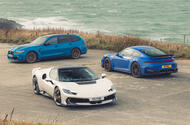
The final of our annual performance car showdown features three heavyweight contenders – and one emphatic winner
Autocar's annual Britain's Best Driver's Car contest pitches 10 of the year's finest newcomers against each other, with our five judges evaluating them on both road and track.
This year we split the contenders up into three groups for evaluation: everyday heroes, supercars and British lightweight sports cars.
But every car is scored against each other, with the judges votes combined to determine a top three that then duke it out for one final run at glory.
So read on discover the top three – and which car scored an emphatic BBDC victory.
BBDC 2026 part 4: The top three
While we have tweaked the format elsewhere in our annual BBDC shootout, the end goal remains the same.
After tearing up Tarmac, exploring performance envelopes, logging lap times and dissecting dynamics, we ultimately need to pick an overall champion, the contestant that can proudly call itself Britain's Best Driver's Car.
So after all of the driving, the judges follow the time-honoured process of hunching over a spreadsheet and diligently divvying up the points that seal the fate of each of our tremendous 10.
To dust off a cliché, there are no real losers here, because every one of our adrenaline-pumping attendees will lift your spirits after even the shortest sortie.
Yet, once again, our top three enjoyed a handy margin over most of the rest. And while the winner's score was emphatic, each podium finisher racked up an impressive haul of more than 200 points. That they also set the quickest lap times only burnishes their achievements.
We've had more disparate top-three finishers in the past, but there's still a certain incongruity to 2026's triumvirate of the BMW M3 CS Touring, Ferrari 296 Speciale and Porsche 911 Turbo S. We've got front-, mid-and rear-engined layouts, plus a selection of either four- or rear-wheel drive (and one car even gives you the option of both). Moreover, while each car packs six cylinders, they offer different configurations (would sir or madam like their pistons arranged in a vee, straight or flat formation?), while two of the contenders back internal combustion with a bit of hybrid heave-ho. You can say the modern high-performance car scene lacks a few things, but variety ain't one of them.
So, where to begin? The 911 Turbo S is as good a place as any, because in many respects it's the car that's defending the honour of our absent reigning champion, the 911 GT3 Touring. On paper this 701bhp technical tour de force couldn't be further removed from its stripped-out, track-tweaked cousin, but it doesn't take long to appreciate that the inimitable 911 spirit comes in many forms.
One thing is certain: the Turbo S isn't short of straight-line pace. On the road you get glimpses of the 911's potential, but it's only on track that you can fully uncork its atom-splitting display of power. In the dry, only the Ferrari has its measure. Throw in a damp, greasy or wet surface, however, and the all-paw Porsche is uncatchable, allowing you to put down its ample muscle with impunity.
It's a quieter character than the 296 or M3, with the turbochargers muffling some of the classic flat-six wail as it trails along in your wake. Yet with Sport Plus mode selected via the rotary controller on the steering wheel, you get eager throttle response, aided by the 81hhp electric motor doing its bit to eliminate lag, and the eight-speed PDK gearbox zips through ratios with a speed and smoothness that neither the BMW nor the Ferrari can match.
As with the powertrain, the chassis feels muted at first, but dig deeper and the Porsche's poise and panache are quickly revealed. After a few hot laps, Prior stepped out of it suitably 'whelmed': "I think it's massively impressive and not without fun. I know some people say that 911 Turbos are unengaging or sterile but this does move around, it has superb control weights, and it's very easy to feel natural with it."
He's not wrong. Ramp up the drive modes and the 911 offers uncanny accuracy, letting you revel in picking out the perfect line and shaving tenths from a target time. The steering is beautifully paced and weighted, while the trick-steered rear axle chimes in so intuitively that you're rarely aware it's at work (Audi take note).
Yet the 911 can play the fool too, and it's easily cajoled into revealing its playful side as you use the pendulous effect of that outrigger engine to exit corners at increasingly silly angles. If there's a criticism, it's that the Turbo S feels like it's working hard to achieve these results, as Corstorphine noted: "All the performance but also adjustability and feel. The only downside is that it feels brutal doing it; how long will the components last?" Perhaps Porsche's attempt to deliver a supercar for all seasons and situations - a vehicle that also has to annihilate autobahns and cope with commuting duties - results in it just missing out on the laser focus necessary for true greatness.
A shortage of focus is certainly not a criticism you can level at the Ferrari, which feels every inch the dedicated driving machine from the moment you lower yourself into its carbonfibre-formed seat and tighten the four-point harness. If the 296 Speciale is bewitching but a bit hamstrung by its size (particularly its width across the hips) on the road, it becomes spine-tinglingly sensational on the track. For starters, it's so very fast. When the surface is dry, the 868bhp (once you've dialled in Qualifying mode for the full corral of cavallino) can be fully deployed to devastating effect. Ferrari's engineers are masters of torque delivery and, with the hybrid assist at work too, you would never know this engine had forced induction. It revs with the eagerness of a naturally aspirated unit-wang-wang-and, given its head, the V6 has the operatic quality of an engine with twice as many cylinders. And while the gearshifts are brutal in the racier modes, their jolting delivery adds to excitement as you scream down straights that seem half as long from behind the wheel of the Ferrari as they do in anything other than the 911.
Yet the Speciale combines this furious pace with a handling delicacy that has you exploring its limits with an abandon that really shouldn't be possible in a mid-engined Ferrari toting more than 850bhp. Steering that seems almost nervously fast on the road makes perfect sense on track and the smallest of inputs allows the 296 to change direction with a balletic agility as the driver places the nose with the sort of accuracy only an Ordnance Survey theodolite can match. The brakes are pretty special too, offering endless stopping power and, once past the initially sharp bite, a progression and feel that's rivalled only by the Porsche.
Then there are the perfectly judged driver modes that effortlessly ramp up the excitement and engagement. For young Sam Phillips, senior staff writer, the Speciale provided a first tango with a Fandango. Talk about diving in at the deep end, but such are the brilliance of its systems and the approachability of its chassis that he emerged elated: "868bhp is an intimidating power figure for someone with short road-testing trousers, but the prodigious stopping power, wonderful balance and abundance of grip meant I could drive it hard, building confidence lap after lap after lap."
Before long, you're switching everything off and letting your mind boggle at how communicative and biddable the Ferrari becomes. Steering, brakes and throttle can all be used to influence your trajectory, while it's possible to exit corners at an angle that would impress rallyists in Mk2 Ford Escorts. Saunders summed it up nicely: "Do the normal laws of physics apply to this car? It's just eye-poppingly fast, searingly precise and titanic on the brakes and it sticks like glue - until you would prefer that it didn't, and then it's the most flattering, playful-handling mid-engined sports car you could ever imagine."
You might expect the M3 to be a bit of a comedown after stints in the Speciale and Turbo S - but that would be to underestimate the brilliance of BMW's wunder-wagon. There's some cognitive dissonance here as your brain struggles to accept that something this fast, focused and free-spirited can also carry a wardrobe as effortlessly as a Volvo estate. "Epic fun," said Lane, laughing, as wisps of smoke curled from the CS's carbon discs. "Linear, expressive, a total riot once you've dialled into it."
At a whisker under 1900kg, the Touring is the tubbiest of our trio, but the efforts of M division's engineering boffins mean it never feels as hefty as the scales suggest. The 543bhp blown straight six isn't as keen as the units of the two pure-bred sportsters here, partly because there's no hybrid torque-fill, but the gravelly, growly unit is hardly laggy and there's no doubting its volcanic energy.
In many respects, the M3 has more Porsche GT3 energy than the 911 Turbo S: its hard-lapping character combines with an endlessly approachable handling balance that breeds huge confidence. All of our testers reckoned the steering could do with more feel, but the rack offers decent weighting and has an oily slickness to its action, plus it's connected to a front end that bites hard and allows you to exploit the car's natural balance.
Run in Sport 4WD mode with the leash loosened on the stability control and the BMW is effortless and friendly in its actions, offering a compelling blend of throttle adjustability and confidence-inspiring traction. Quick and precise, it allows you to quickly forget the extra bodywork hanging out over the back axle and inspires a trustworthiness in damp conditions that rivals the 911's.
Even so, the temptation is there to configure the transmission into 2WD for that classic BMW balance, as Prior admitted to doing after only a handful of laps: "You just know that when the snappers want a car to go sideways for the cameras, it will be this one that people choose to do it in."
If that all sounds a little frivolous, then so be it, but it tells the story of the naturally flamboyant rear-wheel-drive moves on offer in the M3, which rivals the big Bentley when it comes to Red Arrows-worthy smoke shows. It doesn't draw you into the action as fully as the Ferrari or encourage you to perfect your lines like the Porsche, but the BMW is exploitable, expressive and a natural born entertainer. The fact that you can bring four mates and a Labrador along for the ride merely adds to the fun.
Is that enough for the CS to take the overall spoils? Possibly. But against the sheer all-round brilliance of the Porsche and the intoxicating excitement of the Ferrari, it certainly has its work cut out.
James Disdale
The winner: Ferrari 296 Speciale
You have to go back a long way, and invest plenty of quality time in browsing through our digital magazine archive, to find a more emphatic BBDC victor than our 2026 champion.
The Ferrari 296 Speciale took this year's title by a margin of 17 voting points; not since the introduction of our current scoring system in 2016 has a winner had a bigger or more emphatic one.
In 2010, the 997.2-generation Porsche 911 GT3 RS was ranked a unanimous first by all seven voting judges – the only time that has happened (as far as your author can tell).
The year before that, the Lotus Evora was ranked top by nine jury members out of an even broader panel of 10. Further back in time (1991), the Honda NSX was placed first by seven of the eight judges, with the eighth ranking it second. But no winner other than those three can claim to have inspired more widely held praise than this year's champion (even if, during the 1990s, we didn't always publish scores or rankings).
For nearly 10 years, Autocar's 'Handling Day' has been about the democratic recognition of an inherently subjective question: what's the best-handling, most dynamically appealing new car of the year? Rarely have we had a more resounding champion.
It was the Ferrari's incredible, credible, playful, purposeful, pin-sharp and multi-faceted track handling that sealed its glory. In our on-road handling assessment the Porsche 911 Turbo S gave it a very close challenge on the slippery mountain roads of Eryri, on which plenty of judges had reservations about the wide, powerful, cup tyre-shod Italian.
But on-track handling credit accounted for 14 points out of the Ferrari's ultimate 17-point lead. There it was simply stellar: an unbelievable amalgamation of grippy precision and flattering, mid-engined, on-the-limit benignness. An ode to both rabid speed and outright indulgence played against the howling V6 rhythm of 868bhp. Illya Verpraet described it as "perfectly judged"; Richard Lane said "out of this world". James Disdale simply wrote: "Can I have another go?"
The outcome moves Maranello into a clear-air second place among the ranks of the best-performing, multiple-title-winning BBDC powers of the past 38 years, with six wins in all. That's ahead of Lotus (with four) and even further from the likes of McLaren, Mazda, Lamborghini, Honda and Ariel (two titles each).
Historically, Porsche's 14-title BBDC haul remains incomparable. But if Ferrari keeps coming back with driver's cars of the 296 Speciale's extraordinary calibre, Stuttgart's position may not look incomparable for long.
Matt Saunders
| Specification | 1 Ferrari 296 Speciale | 2 Porsche 911 Turbo S | 3 BMW M3 CS Touring | 4 Wells Vertige 2.0 R |
|---|---|---|---|---|
| Price | £360,921 (£458,593 as tested) | £205,245 (£224,941 as tested) | £126,275 (£134,748 as tested) | £74,995 (£82,993 as tested) |
| Engine | V6, 2992cc, twin-turbocharged, petrol, plus electric motor | 6 cyls horizontally opposed, 3591cc, twin-turbo, petrol, plus electric motor | 6 cyls in line, 2996cc, twin-turbocharged, petrol | 4 cyls in line, 1999cc, petrol |
| Power | 868bhp at 8000rpm | 701bhp at 6500-7000rpm | 543bhp at 6250rpm | 247bhp at 7750rpm |
| Torque | 557lb ft (engine), 232lb ft (motor) | 590lb ft at 2300-6000rpm | 479lb ft at 2750-5950rpm | 124lb ft at 5200rpm |
| Gearbox | 8-spd dual-clutch automatic, RWD | 8-spd dual-clutch automatic, 4WD | 8-spd automatic, 4WD | 6-spd manual, RWD |
| Kerb weight | 1629kg | 1725kg | 1850kg | 905kg |
| 0-62mph | 2.8sec | 2.5sec | 3.5sec | 5.5sec |
| Top speed | 205mph | 200mph | 186mph | 140mph |
| Fitted tyres | Michelin Pilot Sport Cup 2 | Pirelli P Zero R | Michelin Pilot Sport 4S | Michelin Pilot Sport 4 |
| Specification | 5 Volkswagen Golf GTI Edition 50 | 6 Lotus Emira 420 Sport with Lightweight Handling Pack | 7 Hyundai Ioniq 6 N |
|---|---|---|---|
| Price | £48,075 (£55,803 as tested) | £105,900 (£143,175 as tested) | £65,800 (£67,975 as tested) |
| Engine | 4 cyls in line, 1984cc, turbocharged, petrol | 4 cyls in line, 1991cc, turbocharged, petrol | Two permanent magnet synchronous motors |
| Power | 321bhp at 5500rpm | 416bhp at 6500rpm | 642bhp |
| Torque | 310lb ft at 2000-5500rpm | 369lb ft at 5000rpm | 568lb ft |
| Gearbox | 7-spd dual-clutch automatic, FWD | 8-spd dual-clutch automatic, RWD | 1-spd reduction gear, 4WD |
| Kerb weight | 1445kg | 1430kg | 2166kg |
| 0-62mph | 5.3sec | 3.9sec | 3.2sec |
| Top speed | 168mph | 186mph | 160mph |
| Fitted tyres | Bridgestone Potenza Race | Michelin Pilot Sport Cup 2 | Pirelli P Zero |
| Specification | 8 Morgan Supersport 400 | 9 Audi RS5 Avant Launch Edition | 10 Bentley Supersports |
|---|---|---|---|
| Price | £135,558 (£164,597 as tested) | £91,300 (£99,135 as tested) | £342,900 (£342,900 as tested) |
| Engine | 6 cyls in line, 2998cc, twin-turbocharged, petrol | V6, 2894cc, twin-turbocharged, petrol, plus electric motor | V8, 3996cc, twin-turbocharged, petrol |
| Power | 402bhp at 6000rpm | 630bhp at 6300-6800rpm | 658bhp at 6000rpm |
| Torque | 369lb ft at 1250rpm | 608lb ft at 2000-5000rpm | 590lb ft at 2000rpm |
| Gearbox | 8-spd automatic, RWD | 8-spd automatic, 4WD | 8-spd dual-clutch automatic, RWD |
| Kerb weight | 1170kg | 2370kg | 1999kg |
| 0-62mph | 3.6sec | 3.6sec | 3.7sec |
| Top speed | 180mph | 155mph | 193mph |
| Fitted tyres | Michelin Pilot Sport 5 | Bridgestone Potenza Sport | Pirelli P Zero/P Zero Trofeo RS |