Crossing Britain In A Model Y: Tesla Still Makes The Best Road-trip Evs
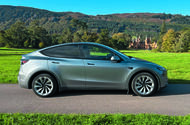
There’s nothing like a 1250-mile road trip to reveal a car’s true colours
After a good 15 years or so of writing about electric cars, the chance finally arrived for me, based in southern England, to drive one to Inverness. Not to see a sick granny at a moment's notice but to drive some electric Range Rovers. Similar-ish, then.
The stick once so frequently used to beat electric cars - an emergency, last-minute, country-long drive to aid a sick relative that either range or charging simply won't allow - isn't used quite so often these days. And after 1249 miles in five days in our Tesla Model Y, travelling from my home in Berkshire to the Highlands and back, I think it's one that can be put away for good.
Such is the availability and reliability of chargers, the size of batteries, the predictability of range and the sophistication of native in-car navigation route planners (don't use something like Waze) that you really don't have to worry about charging on a journey. Instead, the capacity of your bladder or the need to fill your stomach or simply to give your eyes and brain a break on such a long journey will always win out long before the battery gives up, as my trip proved.
The key is to ensure that every time you stop, the car takes on charge - a strategy I followed up the country and back down again largely without incident. The Model Y has done plenty of long runs for me already but typically they have only ever needed a single charge. I learned plenty more about it in this epic.
The route planner first. It can be daunting when you put in a destination so far away and the enormity of the journey can be deflating. The Tesla route planner puts your next charging stop as your next destination, which psychologically makes a huge difference. It felt I was never more than two hours or so away from where I was going and that helped to break up the journey.
The route is suggested by default with the charging points optimised for the fastest journey with the fewest stops at the fastest chargers or with the best amenities. You can then override that, as I frequently did, using the Grok AI voice control to inform it of your need for a closer stop to avoid you visiting a bush in a lay-by. It doesn't judge.
When I first got the car, I was perturbed about the lack of Apple CarPlay connectivity, and while greater control of your phone on the go to dictate messages and so on would be handy, not having access to third-party navigation like Waze is actually a blessing, because it forces you into using what is proving to be a superior product in Tesla's proprietary system.
The Grok AI voice control is also increasingly coming into its own the more time I spend in the car, and the longer the drive. Not just for practical things like charging or for controlling functions of the car but also for extra bits related to a journey: parking charges at the Inverness multi-storey car park in which the Tesla Superchargers are located (free so long as you use the left lane for entry and stay for less than an hour), what time the website of the hotel says they will stop serving dinner, finding the hotel phone number and calling it if such information is unavailable.
The word 'Grok' sounds horrible and 'AI voice control' has been given a bad name by all the AI voice assistants before it ('sorry, I didn't understand that command etc), so eyes can roll when I sing its praises to people, but this thing is brilliant and adds so much more to the car's usability and usefulness. When this Tesla goes back, it's perhaps the thing I'll miss the most.
Comfort and the Model Y's ability to relax you really impressed me too. If I were writing a road test of it, I'd say the Model Y isn't the best-riding car on uneven surfaces, firm rather than uncomfortable, with an excessive amount of head-toss when the going gets tough.
To that end, I'd put comfort fairly low on its list of qualities based on first impressions, but this longer-term test and in particular the mega-mileage I did on the Scottish trip made me think again. A combination of the driving position, the seat comfort and the lack of inputs needed to make the car go make it so relaxing - just what you need with so much time behind the wheel. It couldn't have all been down to the ginger shots I bought from Greggs up and down the country that made me feel so perky at the end of a drive.
There's just the right amount of power in the standard Chill mode too, enough to exploit gaps in the traffic but without the excessive force of the lunch-revisiting Sport mode. Simply, this is a well-judged car dynamically for mile-munching.
What was the range? The data shows that with almost exclusively motorway/fast A-roads, it averaged 228 miles from a full charge, using just under 400kWh of energy at an average of 3.1mpkWh. The energy cost was around £170. In a 40mpg petrol car, it would have cost just more than £240 in fuel.
But here's the point: without calculating it, I honestly didn't know what the range was. The route planner is so trustworthy and has such tolerance built in that at no point did I drive with the mindset of preserving range or trying to hit a specific range figure.
And that's as it should be, really. Does the range of a petrol car really matter? If it's running empty, you fill it up. It's a different process in an EV still, because you do need a bit more planning and a car with a battery that's able to give you more than 200 miles of motorway running to avoid 'unnecessary' charging stops over and above when you'd stop anyway.
But if you're able to trust a car's route planner and therefore its charging planner as much as I do with the Model Y on a journey like this, you can replicate the simplicity of using a petrol car over long distances.
However, an increasing bugbear is emerging around charging speed. The Model Y can charge at up to 250kW on the right charger, but it's rare, even with the battery preparing itself in advance to take a fast charge. At the fastest chargers, it might briefly touch 200kW but will soon be down to low 100s and often settle at 75-80kW quite quickly. This is typically the case regardless of variables such as temperature, pre-conditioning, battery capacity etc.
It's just how the car performs. Sure, it never reached the point where I was sat there with dead time, doing nothing, while it charged, but it still felt frustrating.
There was also a first for me on this trip, when I ignored a charging stop to make 9pm last orders for dinner, thinking I'd have the range to get to the next charger on the M6 the following morning. I hadn't factored in the colder weather in the morning that showed my predicted arrival battery capacity at minus 2% when I started again.
Rather than the car losing its cool and starting beeping and bonging and starving me of power, it simply said to adjust the maximum speed down (to 62mph in this instance) and after a few miles you're back in the green. And so reliable and trustworthy is the Tesla Supercharger network that I stuck to on the trip, I had no doubt there would be charge available for me when I did get there. There was.