No More Idling: The £200k Ev Ice Cream Van Making Summer Quieter And Cleaner
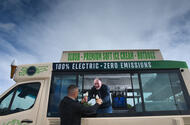
Whitby Morrison has been making ice cream vans since 1962, and now it's turning electric. Here's the scoop
Mr Whippy and Whitby Morrison: two great British institutions.
The former is a soft ice cream franchise launched in 1958 by British businessman Dominic Facchino; the latter was founded in 1962 by Bryan Whitby, a British engineer, after he developed a system for powering an ice cream van's soft-serve machinery directly by the vehicle's drive system.
There are lots of different soft ice cream brands now, but there is only one Whitby Morrison, based in Crewe and still a family business. We last visited the factory in 2018 when memories of a prominently placed Whitby Morrison ice cream van in Top Gear's memorable tribute to Britain's vehicle manufacturers were still fresh. Now I'm back again, keen to catch up with this flourishing business but sadly in the same week that, down the road in the West Midlands, JLR has announced 4000 redundancies. However, reminding us that it's not all doom and gloom for car makers, as we approach the factory a convoy of three new, Crewe-built Bentley GTs barrels out of a roundabout. It makes a stirring curtain-raiser to my visit.
Around 80 new ice cream van conversions, most of them based on Mercedes Sprinter chassis cabs and destined for UK operators, leave Whitby Morrison each year. Each takes around eight weeks to build, and the average lead time to delivery is 12 months. Coincidentally, the week after my visit, motor industry trade body the SMMT reported that more than £1 billion has been committed to Britain's van, truck and bus manufacturing industry and supply chains over the past five years. It said this investment underlines the sector's growing role in the global transition to zero-emission transport and went on to highlight the fact that more than 30 different models and conversions, from low-emission vehicles to cutting-edge electric and hydrogen options, are already being built or planned for production.
As luck would have it, an example of exactly what the SMMT is talking about is parked on Whitby Morrison's forecourt as we arrive: its newest creation, an electric ice cream van. Its significance is not lost on Ed Whitby, operations director of Whitby Morrison and grandson of the founder. "Every so often, a vehicle comes along that feels like a real turning point," he says. "This is one of those moments: the launch this year of our first fully certified electric ice cream van is something we are incredibly proud of. It has been developed to meet the needs of operators while helping move the industry towards a cleaner and quieter future."
The idea for an electric ice cream van has its origins in the BMW i3 that Ed's father Stuart, the firm's managing director, once owned. "He loved that car, and when we started seeing the first electric delivery vans on the road around five years ago, we considered building our first electric ice cream van," says Whitby. "But we quickly realised that range and payloads were insufficient. Then Mercedes, our chassis cab supplier, launched the eSprinter - a much more suitable base vehicle, although then available only as a panel van. A year ago, we had the opportunity to order the first couple of new eSprinter 414 81kWh chassis cabs, and we jumped at it. My brother Kris, who is also our production director, got to grips with understanding how to work with electrical drive power and organised training and certification for our staff. A few months ago we completed our first conversion."
The electric ice cream van on the forecourt is the company demonstrator. It's an eMondial Lusso, and unlike the traditional and brightly coloured diesel ice cream van - the ICE ice cream van, if you like that's parked close by, it's finished in a rather joyless cream. Whitby says that's because it's earmarked for a customer in London who trades at upmarket locations where a traditional van would look out of place. However, at least those vanilla looks don't compete with the vehicle's important electric messaging that includes 'Helping the environment one cone at a time'. Hilarious, but I can't help wondering, given how steeped in tradition the ice cream business appears to be, if it's a hard sell persuading the nation's ice cream vendors to trade in their trusty diesel vans for a new EV costing £200,000 plus not only VAT but also questions concerning range, charging time and vehicle payload nagging at them. Whitby is unfazed. The self-confessed optimist points to the sale already of a vehicle to Hocking's Dairy Cream Ices, one of Britain's longest-established operators, based in Devon. It's a huge region characterised by twisty lanes that increase distance and journey times and which, in summer, is a mecca for families seeking sun, sea and ice cream. Woe betide any Mr Whippy who runs out of 99s halfway through their shift.
"Our electric vans, which can be driven on a car licence, have a gross vehicle weight of 4250kg and a payload that's more than adequate for a busy vendor," says Whitby. "Fully charged, they have a real-world range of 180 miles, although in testing we've seen 200. Using a 22kW charger, recharging the drive battery from 20% to 80% takes just over two hours, a task that can be done at night. If necessary, a 110kW rapid-charge point brings that time down to 26 minutes for a cost-per-mile charge the same as a diesel Sprinter. Charge overnight at home, though, and the electric van's running cost is less than a quarter."
Whether powered by diesel or electricity, the business of building a Whitby Morrison ice cream van is largely the same. We're so used to believing that other countries, notably China, have a monopoly on making things that it's a real surprise to step into Whitby Morrison's factory and see people turning bare chassis cabs into ice cream vans before your eyes. Much of the vehicle, from the glassfibre body to the fridges and freezers that can keep ices and lollies at temperature for days, is produced here by around 50 people, including, crucially, apprentices. One important lesson Whitby and his team learned early on is that they can't weld anything to the chassis of the electric eSprinter - it must be bonded. Although ceiling-mounted cranes do much of the heavy lifting, converting a van is manual work, albeit highly skilled. A great example of that is the cabinet shop where sheets of metal await cutting, filing and shaping on their way to being turned into beautifully crafted fridges and freezers, heavily insulated with doors that open and close just so. Elsewhere in the main building is the brand-new paint shop, which, says Whitby, cost well into six figures. Not far away, technicians patiently assemble Whitby Morrison's patent ePower system.
Developed and designed by the company, it's an electrical power management system that allows operators of their diesel ice cream van to turn off the engine and power their van cleanly and silently from three lithium ion batteries with a combined capacity of 15kWh. That's sufficient to meet all of its energy needs, including filling 3000 cones from the Carpigiani soft-serve ice cream machine. The batteries can be recharged cheaply from home or even for free via solar panels on the roof. Fitted to a diesel van, ePower enables a trader to operate in green spaces such as parks and at festivals and theme parks where organisers are keen to promote environmentally friendly trading. Even indoors at an exhibition, for example. Naturally, the new fully electric van comes with the same system as standard.
Whitby says its UK market has picked up, in part thanks to more people holidaying here, while exports have fallen to around 5% of the company's business. The last time I was at the factory, Whitby Morrison claimed to be exporting around 10 vans each year. One was poised to make the journey to Libya; in 2014, 20 vans went to Azerbaijan. Alas, no longer. "Since Brexit, foreign firms have become less inclined to buy British," says Whitby. "It's up to companies such as ours to encourage them to do so through innovation, technology and the quality of our products."
It's early days, but on that point Whitby Morrison has so far received only a 'handful' of orders for its electric vans. However, Whitby himself is confident that as operators renew their vehicles and realise the benefits of going electric (lower operating costs and much less resistance to their trading from councils and events organisers), more operators will be tempted to take the plunge. In the meantime, the ePower system means they can still go the diesel route but operate more cleanly and efficiently. In fact, 70% of new diesel vans have the system installed.
After a morning learning about Whitby Morrison's state-of-the-art ice cream vans, I'm toying with the idea of going into business with my own. A quick shufty around the beautifully finished electric van on the forecourt-with its sturdy counter and cabinets, serving windows that glide open and shut and elevated position from where I can contemplate the happy faces of my imagined customers as they queue for their 99s-persuades me it might be money well spent. How much would I earn, I ask Whitby. "With a good trading patch, you could clear £60,000 in six months," he says. An eWhippy, anyone?