Not Just Nostalgia: Designers On The Truth About The Retro Car Craze

Old must be gold, given the car world's retro revival. But there is far more to it than that, as its proponents tell us
If, as the old saying goes, nostalgia is a drug, then much of the car industry seems hooked.
From the Citroën 2CV and the Peugeot e-T16 to the Renault 8 Gordini and Alpine A310, many of the big concept cars revealed at the recent Paris motor show have names and designs that are mightily familiar. And they follow revivals of cars such as the Renault 5, 4 and Twingo, the retro-infused Fiat Grande Panda and more.
Even car firms that aren't necessarily launching outright retro models are leaning on throwback design trends. BMW, Mercedes-Benz and Volkswagen, for instance, have all recently introduced new design languages that take inspiration from their respective histories.
Retro designs aren't new, of course. It has been 25 years since BMW reinvented the Mini as a stand-alone brand, and while its range has long since expanded beyond Sir Alec Issigonis's imagination, design-wise it remains rooted in classic Mini styling cues.
Soon after the Mini came revivals of the Fiat 500, which remains hugely popular today, and the Volkswagen Beetle, which does not.
But that blip of retro revival activity has become a full-on movement in recent years. "You see a trickle and now it has become a wave," says Renault Group design boss Laurens van den Acker.
The French firm has been at the forefront of the recent retro revival. In 2017, it relaunched its Alpine brand with a retro A110 sports car but, more pertinently, it was the revival of the Renault 5 as the embodiment of former group boss Luca de Meo's 'Renaulution' strategy that really kick-started the trend.
"It has become a little bit of a recipe," says van den Acker, "but we saw it coming. We talked about doing iconic designs five or six years ago and it's becoming the new thing."
The spark for the influx of retro models was the switch to electric vehicles, but van den Acker says it's developing beyond that now: "At the time we thought it was because of EVs, because with an electric architecture everyone would have the same ingredients.
"You couldn't make a difference with a six-cylinder or eight-cylinder or 12-cylinder engine. Companies used to be identified with their engines, but we thought once you go to EVs, everyone picks a battery off the shelf and the performance is the same. So we were pushing iconic design, because if everyone's electric, what makes us different?"
For European firms, there's another reason to turn to familiar names and designs. "There is a very strong trend for retro design and it's very logical, given the time we live in," says Fiat design boss François Leboine.
The Frenchman has form here: at Fiat he has designed the Grande Panda, the retro-drenched Topolino and Microlino quadricycles and the new Multiplay concept - and in his prior job at Renault he created the concept version of the 5.
"There is super-strong competition at the moment, where some historical brands need to fight against newcomers, and one answer to that is to use your story, your roots, to be stronger and give a reason for your cars," says Leboine.
Van den Acker agrees: "With the arrival of competitors from the East, it has become even more of a trump card, because it's a card we can play that cannot be copied easily."
In other words, new Chinese firms can enter the European market with cars packed full of technology at competitive prices, but they simply haven't got the history to draw on (although, given China's legacy of copycat designs, that might not stop them trying).
The success of the 5 proves there's a market for retro design. In around 18 months, nearly 20,000 examples have been sold in the UK, the majority to buyers new to the Renault brand. Of course, it's impossible to really tell how much of that success is down to the 5's retro styling. The Zoe that it essentially replaced was a success, too, and a new generation of that car using the 5's platform probably would have sold well. And the larger, similarly retro 4 has been slower to sell.
Perhaps the key to producing a model with a retro design or name is ensuring it's authentic - in a broad sense - to the original.
"The real question is: what is your reason to be on the market?" says Leboine. "It can be historical because you were already there in a segment for good reason, and you are the best historically at doing something."
Leboine highlights the Multiplay concept, which recalls the spirit of the cult-classic 1990s Multipla, which drew considerable attention for its three-wide seating and divisive design. "You can build the future in a different way and you can use your roots, just not as a copy-paste or a continuity of something," he says. "It's using the philosophy of what you've done before, because the philosophy is timeless.
"With the Multiplay, we tried to understand the genius of the coolest car in the history of Fiat. It wasn't only cool for the aesthetic. It was cool for providing customers a way to live differently."
That approach also led Citroën to revive the 2CV name and design for its new entry-level EV, designed to take advantage of the European Union's planned E-car regulations.
Under various managements, the firm worked through multiple design iterations for the car, many of which weren't overtly retro in any way. But it was new CEO Xavier Chardon who gave the go-ahead for the clearly nostalgia-fuelled concept.
"Reinventing the 2CV isn't about replicating a car from the past," he says. "It's about reinventing what made it unique: its simplicity, its accessibility and the freedom it offered."
As Stellantis's global design chief, Ralph Gilles oversaw many of the retro concepts at this year's Paris show - and he argues that a design can't succeed on nostalgia alone. "Our design staff are quite young, so they look at retro from a romantic view. They don't depend on retro to make a car work," he says. "They look at the original and know what they like about it, and mine the best pieces and infuse it into the new design.
"The 2CV is clearly heritage, but if you put it next to the original, it's completely modern. It's just that your mind sees what it wants to see. So I'd argue none of the cars are actually heritage. They're inspired by old cars but they're not retro."
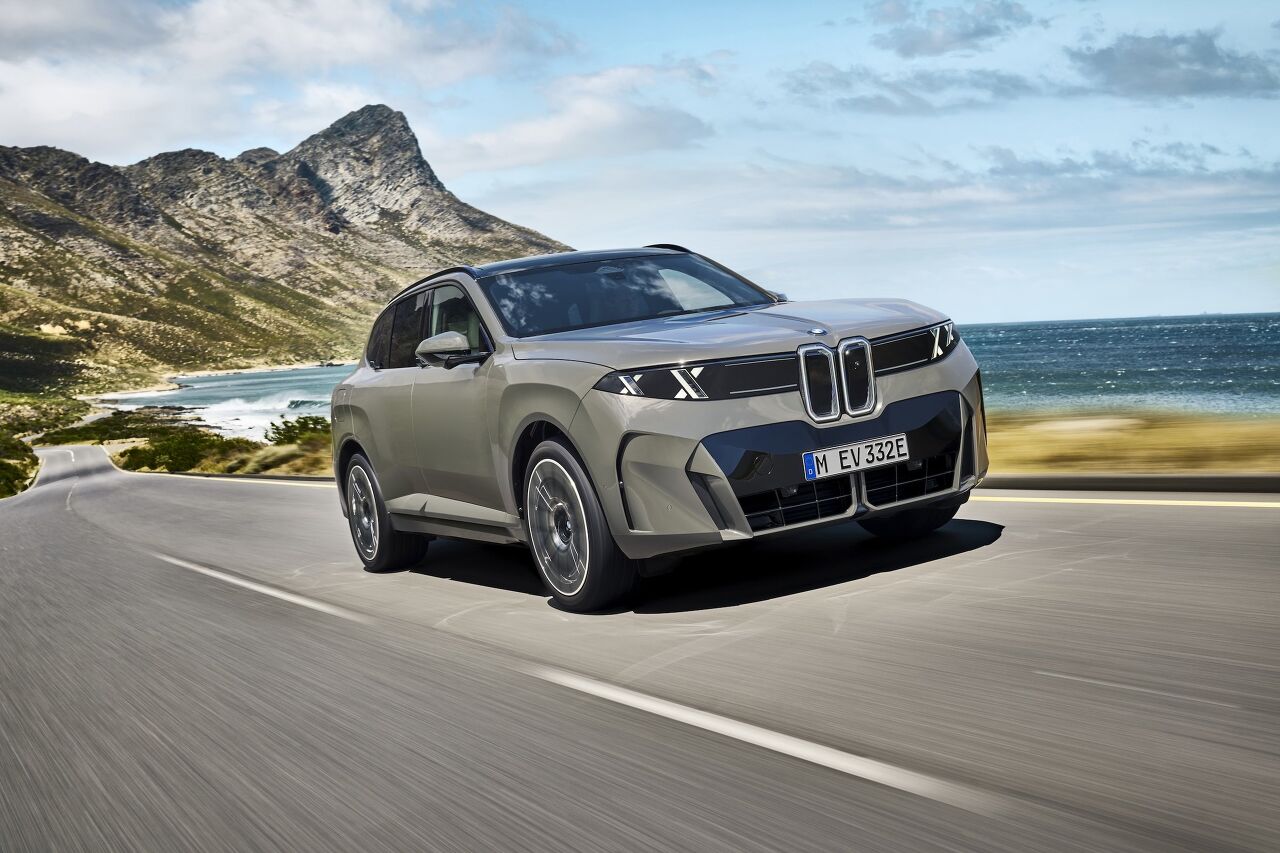
That raises a wider question of where retro stops and nostalgia starts. For example, BMW's Neue Klasse EVs are determinedly modern but the kidney grille treatment harks back to older cars. Does that make them retro or simply show a brand staying true to its design? The Porsche 911 has always maintained a similar layout and styling to the original, so is that a retro car?
Tobias Sühlmann, Porsche's new design chief, recently unveiled the new Mission S concept to showcase his future design direction for the brand - and it clearly leans on the past. But he says: "You don't need to look into the mirror. Let's not hang in the past all the time. We acknowledge the past and celebrate the past, but we look forward."
Gilles highlights Alfa Romeo's Paris motor show concept, the Cuorerosso, and says: "You want to think it's retro, but there's nothing retro about it. The surfacing is completely modern."
That philosophy is shared by Volkswagen design chief Andreas Mindt: he has rooted the brand back in a familiar design language that he labels the firm's "secret sauce", seen in the design of the new ID Polo. But he says: "I don't want to repeat the same design over and over again. There's a dead end to it. We had it with the New Beetle. We do one Beetle, then another new Beetle, and then how can you succeed from there? There's a stop somewhere."
Notably, while the Mini and Fiat 500 arguably revived the ethos of the originals, the New Beetle was largely a styling exercise rather than a true attempt to develop a new 'people's car'.
Mindt's approach, therefore, "is to have the values right", he explains: "I say 'stable', and in the past the Beetle was running and running and running, because it was mega-reliable. That's a value, and I can express that value with a design, with strong surfacing and a thick C-pillar.
"This is somehow retro, because the value is coming from the past. It's more fundamental than the outside shape. We do new designs and go to the future, but the values are from the past. That's the differentiation."
While Leboine has designed more overtly retro cars, he echoes that argument. When he joined Fiat, the brand was arguably overshadowed by the success of the 500, with its line-up featuring oddball models such as the 500X and 500L, which copied its styling but abandoned its ethos. The Grande Panda's success has helped create the space for a second 'family'.
"The goal of the Grande Panda was to make a bridge that allows us to make the Grizzly family SUV," he says. "Now we can begin to build something out of it. There is no retro design in the Multiplay, but it's about respecting your past in the storytelling and the philosophy."
That chimes with Renault's approach: while the firm's small-EV line-up is infused with retro models, it has deliberately ensured that its combustion cars feature fresh design.
"We need to pace it a bit [with retro design]," says van den Acker. "We need to balance future icons with legendary icons."
The other question is about how far retro design can go. There are only so many household-name cars out there and some firms are beginning to look for deep cuts to continue the nostalgia push. The Renault 8, for example, isn't exactly as celebrated as the 5 or Twingo.
So can retro design go too deep? "We thought it would be an issue with the R5, because it's a car from the '70s," says van den Acker. "But we've been very surprised that our sons and daughters love the car, and they don't know the history. They appreciate them much more than we thought, because it's just a cool car and it's a modern car, because it's an EV and has all the tech."
And nostalgia isn't just a trend in the car world, which is why it's here to stay.
"I recently talked to a girl in her twenties about the R5 and said: 'Why on earth do you like this?'" says van den Acker. "She said her generation loves history; they love the story. It's the same thing as young kids listening to old music now too. My daughter listens to Fleetwood Mac, but she also listens to modern stuff. For them it's all there. You don't have to go to a vintage store to find it; you just go to Spotify."
RETRO HITS
Mini hatchback (2001): BMW's reinvented Mini was largely engineered by Rover staff and, while bigger, captured the spirit of the original. It has drifted a bit but it's still going strong today.
Ford GT (2005 and 2017): So good they revived it twice. Inspired by the 1960s Le Mans-winning GT40, the GT proved successful on track and, as a limited-run supercar, a hot commodity off it.
Renault 5 (2025): The comeback of the decade so far: the decision by the Renault Group's then boss, Luca de Meo, to put this retro hatchback into production has spearheaded its wider revival.
RETRO MISSES
Volkswagen Beetle (1997): This one is relative. Particularly in its first generation, the New Beetle sold well, but it never came close to matching its huge-selling predecessor and later strayed from its roots.
Ford Capri (2025): Not a retro design, which is actually the problem. This decent electric SUV-coupé has nothing to do with the original Capri and the grumbling about that overshadowed its strengths.
Opel Manta (Canned): The return of the Manta as an electric coupé was previewed by a bold concept in 2021 when Stellantis outlined plans to electrify every brand. It was quietly ditched soon after.