The Ford Edsel — The History, Models, Features & Failure
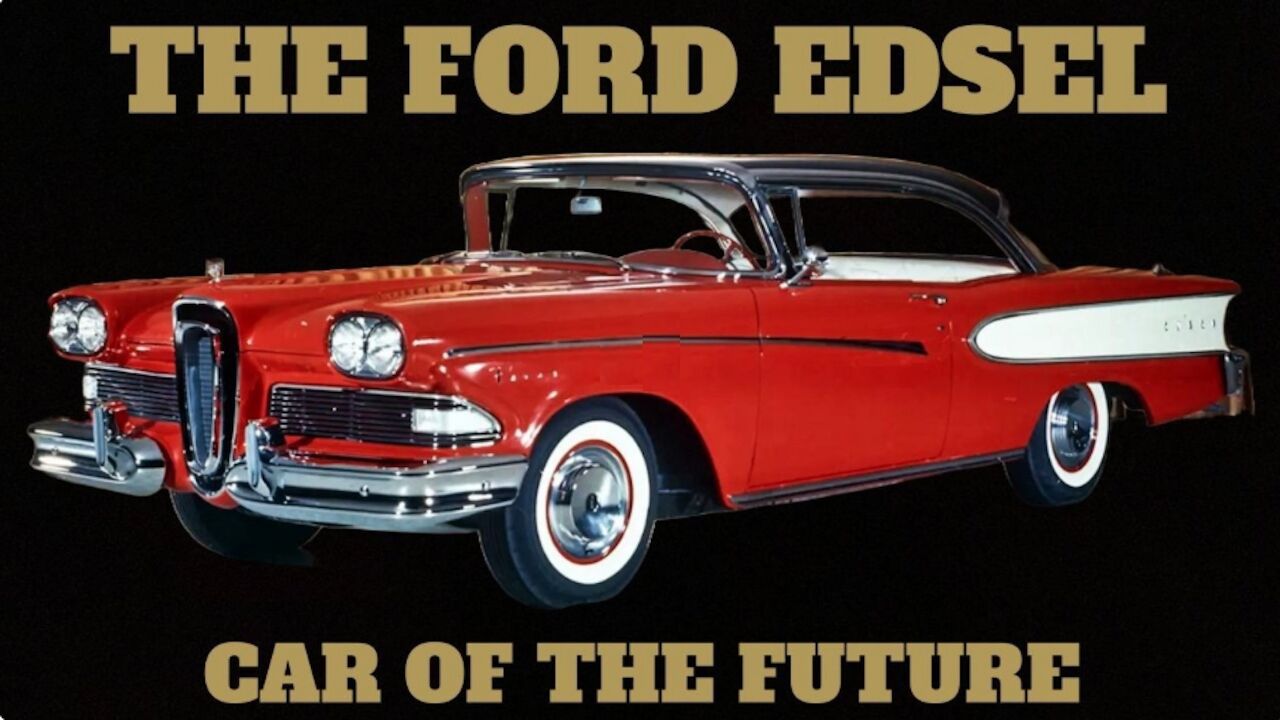
The Edsel. This was a new carline launched by the Ford Motor Co.
It was launched as the 4th brand of cars from the Ford Motor Company. Edsels were to be medium upscale model. Edsel was to fit between the Ford and Mercury division. They were to a bit more upscale than the Ford offerings but just step below those from Mercury.
Ford invested a considerable amount of money into an intensive advertising campaign leading up to the release of the Edsel. The Edsel was billed as “the car of the future”.
The TTAC Creators Series tells stories and amplifies creators from all corners of the car world, including culture, dealerships, collections, modified builds and more.
An AI-generated transcript summary edited by a staffer is below.
[Image: Tony's Fords and Mustangs/YouTube]
Become a TTAC insider. Get the latest news, features, TTAC takes, and everything else that gets to the truth about cars first by subscribing to our newsletter.
Summary
The transcript examines the history of the Ford Edsel, one of the most famous commercial failures in American automotive history. Introduced in September 1957 as a new medium-priced brand positioned between Ford and Mercury, the Edsel was supposed to represent the future of automotive design and technology. Despite an enormous marketing campaign, powerful V8 engines and several innovative features, the Edsel failed to attract buyers and was discontinued after just three model years.
The central argument of the video is that the Edsel wasn't necessarily a bad car. Rather, it was a product introduced at the wrong time, at the wrong price, with styling that proved too controversial.
1. The Edsel's Introduction and Marketing Campaign
Ford named the new brand after Edsel Ford, the son of Henry Ford and father of Henry Ford II.
The company's intention was to create a medium-upscale vehicle that would be slightly more luxurious than a Ford but less expensive than a Mercury.
Ford invested heavily in advertising, promoting the Edsel as the "car of the future." Its national introduction took place September 4, 1957, with a prime-time CBS television special hosted by Bing Crosby. The program featured Frank Sinatra, Rosemary Clooney, Louis Armstrong and comedian Bob Hope.
The broadcast was particularly notable because it was the first CBS program recorded on videotape for rebroadcast to audiences on the West Coast following its live East Coast presentation. It was also nominated for an Emmy as the best single program of the year.
Despite the publicity, the Edsel struggled to establish itself with American buyers.
2. Distinctive Styling and Model Lineup
The Edsel featured some of the most unconventional styling of the 1950s.
1958 Edsel Citation | California 2013 | RM Sotheby's
1958 Edsel Bermuda 6 Passenger Station Wagon [Beautifully Restored] for sale
1958 Edsel Bermuda Station Wagon Stock # 1513C for sale near Brookfield, WI | WI Edsel Dealer
10
Its most recognizable feature was a large, vertically oriented oval grille that extended from the hood toward the split front bumper. The design was unlike anything else on the road and quickly became controversial.
Other exterior features included:
- Four forward-projecting headlights.
- Split horizontal grilles housing the turn signals.
- Curved bodywork and wraparound front and rear windshields.
- Rear-quarter panels with contrasting paint or additional brightwork on higher trims.
- Large, horizontally mounted rear turn signals and brake lights.
- Distinctive boomerang-shaped rear lights on station wagons.
Ford initially introduced seven models across its sedan, convertible and station wagon offerings.
| Model | Description |
| Ranger | Entry-level sedan |
| Pacer | Higher-trim Ford-based sedan |
| Corsair | Upscale sedan based on Mercury |
| Citation | Top-level sedan based on Mercury |
| Roundup | Two-door station wagon |
| Villager | Four-door station wagon |
| Bermuda | Higher-trim four-door station wagon |
The convertible was available in Pacer and Corsair configurations.
The Edsel used body-on-frame construction, with three wheelbases depending on the model and body style: 116, 118 and 124 inches.
3. Powerful V8 Engines and Innovative Technology
Ford gave the Edsel substantial power, particularly in its more expensive configurations.
Two primary V8 engines were initially offered:
| Engine | Displacement | Horsepower | Torque |
| E400 | 361 cubic inches | 303 hp | 400 lb-ft |
| E475 | 410 cubic inches | 345 hp | 475 lb-ft |
Both engines featured four-barrel carburetors.
The E400 was available in Ranger and Pacer sedans and station wagons, while the larger E475 was reserved for the Corsair and Citation.
Transmission choices included a three-speed manual and an optional three-speed automatic.
One of the Edsel's most unusual innovations was its Teletouch Drive electronic transmission selector.
Rather than using a conventional column-mounted shifter, drivers selected Park, Reverse, Neutral, Drive or Low using buttons mounted in the center of the steering wheel.
The system was designed to make driving easier and safer by allowing drivers to keep both hands on the steering wheel while shifting.
Other notable features included:
- Warning lights replacing conventional oil-pressure, temperature and charging gauges.
- A rotating-dial speedometer.
- A single-dial heating and air-conditioning control.
- Self-adjusting drum brakes at all four wheels.
- A driver-adjustable speed warning light.
- Double-latch doors.
- Remote-operated trunk release.
- Optional power windows, power brakes and air conditioning.
- Optional seat belts, tinted glass and tachometer.
Despite its eventual reputation, the Edsel was technologically ambitious for its era.
4. The 1958 Edsel Falls Short of Expectations
The Edsel's first model year produced disappointing results.
Its 1,187 North American dealerships delivered 68,045 vehicles for 1958.
Although this represented the second-largest automotive launch in history at the time, it was far below Ford's expectations.
The company needed approximately 100,000 sales to break even and had originally anticipated selling 200,000 vehicles.
The disappointing performance prompted Ford to make substantial changes for 1959.
5. The 1959 Edsel: A Change in Direction
For 1959, Ford reorganized the Edsel operation by placing it within the Lincoln-Mercury division. This resulted in some Edsel-only dealerships closing while others became combined Lincoln-Mercury dealerships.
The vehicle also received significant styling revisions.
The controversial vertical grille remained, but it was made considerably smaller and more subtle. The headlights were repositioned within a larger horizontal grille, and the sides received a more continuous beltline.
The rear styling was also revised, with more conventional taillights positioned lower on the body.
Several distinctive interior features disappeared, including the rotating speedometer and Teletouch transmission selector.
Ford also reduced the model lineup to nine offerings, eliminating the Citation and Pacer sedans and the Roundup and Bermuda wagons.
The engine lineup was expanded and reorganized:
- 361-cubic-inch Super Express V8: 303 hp.
- 332-cubic-inch Express V8: 225 hp.
- 292-cubic-inch Ranger V8: 200 hp.
- 223-cubic-inch inline-six: 145 hp.
The addition of a six-cylinder engine provided a more economical alternative to the original V8-only lineup.
However, the changes failed to revive interest. Sales dropped to 47,396 vehicles for the 1959 model year.
6. The 1960 Edsel and the End of the Brand
By 1960, the Edsel was nearing extinction.
Ford introduced another completely restyled model based on the 1960 Ford Galaxie. The new vehicle shared much of its basic styling with Ford, although the grille, hood, bumpers and taillights were unique.
The four-door Ranger hardtop was particularly distinctive because Ford did not offer an equivalent body style.
However, the 1960 Edsel had an extremely short production run. Manufacturing began in the fall of 1959, and on November 19, 1959, Ford officially announced the cancellation of the program.
Production continued through the end of November.
Only 2,846 vehicles were built for the 1960 model year.
7. Driving a 1958 Edsel Bermuda Wagon
The video includes a road test of a 1958 Edsel Bermuda station wagon owned by a friend of the channel.
The owner's description of the vehicle is colorful: he calls it his "U.S.S. Edsel" because it handles like a cruise ship on a dock.
Despite its considerable size and body roll, the vehicle is described as extremely smooth and comfortable.
The steering is considered reasonably good, and the spacious interior makes the Edsel a pleasant vehicle to drive.
The road test reinforces the video's argument that the Edsel wasn't fundamentally a bad automobile.
8. Why the Edsel Really Failed
The video identifies several reasons behind the Edsel's commercial failure.
Economic timing
The Edsel arrived during an economic recession. Rather than looking for an upscale mid-priced automobile, many American consumers were becoming more interested in affordable, economical transportation.
Pricing problems
The Edsel was supposed to occupy the space between Ford and Mercury. However, its pricing often placed it above comparable Mercury models and, in some cases, close to Lincoln territory.
That undermined the brand's original positioning.
Lack of economical powertrains
The original Edsel lineup emphasized large, powerful V8 engines that required premium gasoline. Ford didn't initially offer an economical six-cylinder alternative, making the vehicles less appealing to buyers concerned about operating costs.
Controversial styling
The distinctive vertical grille became one of the Edsel's biggest liabilities. Consumers reportedly disliked its appearance, and the design quickly acquired the nickname "horse collar grille."
Ford's attempt to create something radically different simply didn't resonate with the buying public.
Problems with Teletouch Drive
The innovative transmission selector also proved troublesome.
The wiring harness was routed too close to the exhaust manifold, creating the possibility of overheating or electrical shorts.
The system's electric motor was relatively weak, sometimes requiring drivers to cycle through several gear positions before reaching the desired selection.
Another problem was the placement of the horn button in the center of the steering-wheel gear selector. Drivers attempting to sound the horn could accidentally press a transmission button instead.
These issues damaged confidence in one of the Edsel's most heavily promoted features.
9. The Financial Cost of the Edsel
The Edsel program ultimately cost Ford Motor Company approximately $250 million in late-1950s dollars.
The video estimates that this would equate to approximately $3 billion in 2026 dollars.
The failure also carried organizational and reputational consequences.
Henry Ford II reportedly opposed using the Edsel name, believing it was inappropriate for his father's name to appear on spinning hubcaps throughout North America.
However, Ford's board of directors ultimately took ownership of the brand and its outcome.
Key Takeaways
The Edsel's failure wasn't the result of one catastrophic mistake. It was a combination of product planning, market conditions, pricing and design decisions.
The most important lessons include:
- Timing matters: Ford introduced an upscale vehicle during an economic downturn when consumers were increasingly focused on affordability.
- Brand positioning matters: The Edsel was supposed to fit between Ford and Mercury, but its pricing often undermined that strategy.
- Radical styling carries risks: Its distinctive grille generated attention but also alienated potential buyers.
- Technology needs to work: Teletouch Drive was an interesting innovation, but reliability and usability problems hurt its reputation.
- Product variety matters: The original lineup lacked an economical engine option, limiting its appeal to cost-conscious buyers.
Bottom Line: The Ford Edsel remains one of the most recognizable failures in automotive history, but the vehicle itself was more interesting than its reputation suggests. It offered powerful engines, innovative technology, distinctive styling and a comfortable driving experience. Its downfall was largely a product of poor market timing, questionable pricing and a design that proved too unconventional for mainstream American buyers.
More Auto stories