When Luxury Goes Too Far: Do Cars Really Need Motorised Doors?
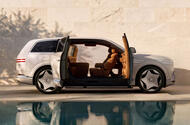
A run-in with the new Genesis GV90 begs the question: why do manufacturers keep trying to reinvent the door?
Might it be time to put motorised doors on our big list of mostly pointless car features, I wonder?
Those sorts of ideas that look great on a concept car or in an expensively shot TV advert but which add very little in real-world use and seldom work as envisaged or intended, more often than not just annoying the bejesus out of you.
Genesis's new flagship SUV, the GV90, has motorised doors. They're very ritzy and show-stopping when you see them in action, as you might well have on Autocar's social media channels. Their difference compared with other similar motorised door concepts is that they open and close on the GV90's fully pillarless body (albeit only so on the upper-tier Neolun derivative of this Range Rover rival), so the effect is a lot more spectacular. Also they can open and close entirely independently, rather than the front one overlapping the suicide-style rear one.
Genesis probably didn't spend millions developing them so that some impertinent journalist could use the S-word to describe them, granted, but there you go: everyone knows what a suicide door is, don't they?
Having been to the lavish global debut event for the car a couple of weeks ago, I've actually used the aforementioned doors, rather than just watched videos of them in perfect, choreographed motion. Tugged impatiently and a little too hard on their handles, no doubt. Stood in just the right place to trigger their failsafe sensors, making them jerk to a stop instead of easing gloriously, welcomingly wide. I'm sure I did it all wrong and could learn to do it better. But the bottom line is that I failed to make them work. Quite a lot.
They also singularly failed to impress me. It wasn't a tough environment for the technology to cope with. I was standing in a wide open space with very few people immediately around me. There were no cars parked adjacent or even close by, as there might have been in a normal car park. I wasn't trying to trip the system up. I just approached the car, pulled the handles and stepped back. Yet as often as not they stuttered and stopped rather than arcing open.
They were spooked by my elephantine feet, I dare say, or the angle of my retreat. They started opening slowly and, on more than one occasion, got worse from there. And had I been in a cold, dark car park getting rained on, rather than a warm exhibition hall under lots of artificial light, I probably would have been all the more annoyed about it.
The best motorised doors I've ever used were those 'assisted' ones you get on a Rolls-Royce. They can do everything for you, if you like, but otherwise you decide when you want the door to open and how urgently, then you pull it closed. The motors just help. And if you don't quite shut the door all the way, they take care of that bit as well.
The GV90's doors are huge, you see. As part of the Autocar road test we measure door span, as a corollary and indicator of how much space you might need to open a particular car's door in a confined space like a parking bay or garage. Lordy, you would need a big garage to get in and out of your GV90 easily - and you would pick the farthest, quietest part of the shopping centre car park every time, praying that no comedian in their beaten-up hatchback decides to squeeze in next to you just for laughs.
Shouldn't doors be simple things? Isn't simplicity and easy usability ultimately more luxurious than faffy motorised ceremony and faux convenience? That's what the Genesis GV90 left me thinking. It was like the car wanted a round of applause every time it opened for me and moral support every time it failed to.
It also conjured the memory of the Peugeot 1007, whose motorised sliding doors were so rubbish that, if you parked on a steep enough incline, they just wouldn't open. Some things don't need reinvention, for pity's sake. And usually simpler is better.
More Auto stories