Should You Buy, Sell Or Hold Ross Stores Stock Post Q2 Earnings?
Ross Stores, Inc. ROST delivered an impressive second-quarter fiscal 2026 performance, with both earnings and sales surpassing the Zacks Consensus Estimate and increasing year over year. The off-price retailer benefited from robust customer traffic, broader merchandise assortments and stronger engagement from new, lapsed and existing shoppers. Ross Stores also exited the quarter with solid business momentum, prompting management to raise its outlook for the second half and fiscal 2026.
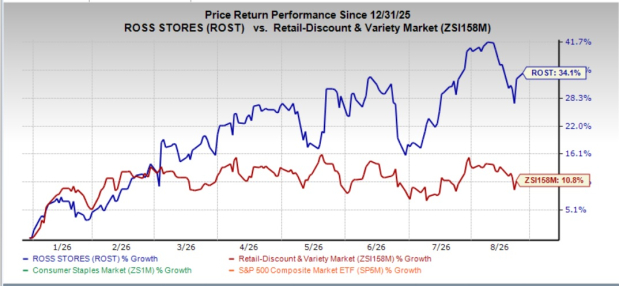
Shares of Ross Stores have rallied 34.1% in the year-to-date period compared with the Retail - Discount Stores industry's growth of 10.8%.
ROST Stock's Price Performance
Image Source: Zacks Investment Research
Taking a Quick Look at Ross Stores' Q2 Results
Ross Stores posted adjusted earnings of $2.06 per share, which beat the Zacks Consensus Estimate of $1.93 by 6.7% and increased from $1.56 in the year-ago quarter. Reported earnings were $2.66 per share, including an approximately 60-cent benefit from IEEPA tariff refunds.
Quarterly sales increased 13% year over year to roughly $6.27 billion, surpassing the Zacks Consensus Estimate of $6.14 billion. Comparable-store sales advanced 10%, primarily driven by increased transactions and customer traffic. Management noted that new and lapsed customers contributed to the gains, while existing shoppers visited more frequently and increased their spending.
The strength was broad based across merchandise categories and geographic markets at both Ross Dress for Less and dd's DISCOUNTS. Home and cosmetics were ROST's strongest businesses during the quarter, while the Midwest led geographic performance. Management also highlighted continued strength in ladies apparel and particularly encouraging trends in juniors.
Profitability improved substantially. Gross margin expanded 625 basis points year over year, including a 405-basis-point benefit from tariff refunds. Merchandise margin increased 110 basis points, while distribution costs declined 100 basis points on favorable packaway expense timing, productivity gains and the anniversary of tariff-related processing costs. Operating margin expanded 610 basis points and, excluding the tariff-refund benefit, improved 205 basis points.
Ross Stores also exited the quarter with a healthy financial position. Cash and cash equivalents were about $4.29 billion, while long-term debt stood at roughly $777 million and stockholders' equity totaled $6.74 billion. Net cash provided by operating activities for the first six months of fiscal 2026 was $1.71 billion, while capital expenditures totaled about $460 million.
Ross Stores' FY26 Outlook Points to Continued Momentum
Ross Stores raised its expectations for both the third and fourth quarters despite facing tougher year-over-year comparisons. Comparable-store sales are now projected to increase 6-7% in the third quarter and 4-5% in the fourth quarter. Third-quarter earnings are expected in the range of $1.75-$1.83 per share, while fourth-quarter earnings are projected at $2.17-$2.26 per share.
For fiscal 2026, earnings are now forecast at $8.61-$8.77 per share compared with $6.61 in fiscal 2025. The outlook includes the approximately 60-cent-per-share benefit from tariff refunds recognized in the second quarter. Ross Stores also increased its fiscal 2026 store-opening plan to 115 locations, comprising approximately 90 Ross stores and 25 dd's DISCOUNTS locations.
The Case for ROST Stock
Ross Stores' improving customer-engagement trends remain a key pillar of its growth story. The company's 10% comparable-store sales increase was driven primarily by transactions, reflecting gains from new shoppers, returning lapsed customers and higher visit frequency among existing customers. Management is also seeing customer acquisition across income and age groups, including younger shoppers, suggesting that ROST’s value proposition is resonating with a broader audience.
Merchandising initiatives are strengthening that proposition. Ross Stores is expanding relationships with existing vendors, adding new brands and improving how merchandise is presented across categories. Management noted that the company is gaining access to better and more popular brands, while closeout availability remains strong. Combined with improved stores and brand positioning, the stronger vendor ecosystem could help ROST sustain compelling assortments and reinforce its competitive positioning in off-price retail.
Inventory investments are also supporting the company's sales momentum. Consolidated inventory increased 18% at the end of the quarter as Ross Stores positioned merchandise to accommodate higher traffic and broaden selling-floor assortments. Importantly, management said the company continued to deliver fast inventory turns and higher merchandise margins while retaining flexibility to capitalize on closeout opportunities.
Ross Stores also has a meaningful runway for physical expansion. Management increased its 2026 opening plan to 115 locations and remains confident in its long-term model of roughly 5% annual unit growth. New stores have been performing ahead of initial expectations, while management remains encouraged by its expansion into the Northeast and opportunities across both established and newer markets.
ROST Stock: Risks to Watch
Despite the strong momentum, Ross Stores faces increasingly difficult comparisons in the second half following outsized comparable-sales growth. The company must continue attracting shoppers and converting traffic while preserving its value advantage at a time when consumers remain exposed to inflation and higher costs for necessities. Management also expects higher fuel prices to pressure domestic freight expenses, which could partly offset merchandise-margin gains and operating leverage from higher sales.
Investors should also distinguish between underlying operating improvement and the unusually large benefit from tariff refunds. Second-quarter operating margin benefited by 405 basis points and reported earnings received an approximately 60-cent-per-share boost from the refunds. Meanwhile, tariffs, trade-policy uncertainty and inflation remain potential sources of cost and demand volatility. Elevated inventories could also become a concern if consumer demand weakens unexpectedly, although management currently points to healthy inventory turns, low clearance levels and sufficient open-to-buy flexibility.
Buy, Sell or Hold ROST Stock?
Ross Stores remains well-positioned to build on its recent momentum, supported by strong traffic, improving customer acquisition, better merchandise assortments, healthy closeout availability and an expanding store footprint. The company’s marketing, merchandising and store-experience initiatives remain relatively early in their development, suggesting further scope for market-share gains. The raised second-half outlook also reflects management’s confidence in sustaining the underlying business momentum.
While tougher comparisons, higher freight costs, macroeconomic uncertainty and the nonrecurring tariff-refund benefit remain factors to watch, Ross Stores’ strong operating trends and growth initiatives appear to outweigh these concerns. Given its improving fundamentals and favorable business outlook, this Zacks Rank #2 (Buy) stock appears to be a compelling investment pick at present.
Other Stocks to consider
We have highlighted three other top-ranked stocks, namely, Target Corporation TGT, Dollar Tree Inc. DLTR and Dollar General Corporation DG.
Target offers guests fashionable, differentiated merchandise and everyday essentials at discounted prices. It currently carries a Zacks Rank #2. You can see the complete list of today’s Zacks #1 Rank (Strong Buy) stocks here.
The Zacks Consensus Estimate for Target’s current financial-year sales and EPS indicates growth of 4.6% and 35%, respectively, from the year-ago reported numbers. TGT delivered a trailing four-quarter earnings surprise of 10.5%, on average.
Dollar Tree is an operator of discount variety stores offering a broad assortment of everyday consumables and discretionary merchandise. The company currently carries a Zacks Rank of 2.
The Zacks Consensus Estimate for Dollar Tree’s current financial-year sales and EPS indicates growth of 6.5% and 22.1%, respectively, from the year-ago reported numbers. DLTR delivered a trailing four-quarter earnings surprise of 32.1%, on average.
Dollar General is one of the largest discount retailers in the United States, selling low-priced merchandise, typically $10 or less. The company currently has a Zacks Rank of 2.
The Zacks Consensus Estimate for Dollar General’s current financial-year sales and EPS is expected to rise 3.9% and 7.6%, respectively, from the year-ago reported figures. DG delivered a trailing four-quarter earnings surprise of 21%, on average.
Radical New Technology Could Hand Investors Huge Gains
Quantum Computing is the next technological revolution, and it could be even more advanced than AI.
While some believed the technology was years away, it is already present and moving fast. Large hyperscalers, such as Microsoft, Google, Amazon, Oracle, and even Meta and Tesla, are scrambling to integrate quantum computing into their infrastructure.
Senior Stock Strategist Kevin Cook reveals 7 carefully selected stocks poised to dominate the quantum computing landscape in his report, Beyond AI: The Quantum Leap in Computing Power.
Kevin was among the early experts who recognized NVIDIA's enormous potential back in 2016. Now, he has keyed in on what could be "the next big thing" in quantum computing supremacy. Today, you have a rare chance to position your portfolio at the forefront of this opportunity.
See Top Quantum Stocks Now >>This article originally published on Zacks Investment Research (zacks.com).
Popular Products
-
 Wireless Health Tracker Smart Ring - R11
$131.56$65.78 -
 Electric Hair Straightener and Curlin...
$161.56$80.78 -
 Pet Oral Repair Toothpaste Gel
$59.56$29.78 -
 Opove M3 Pro 2 Electric Massage Gun
$901.56$450.78 -
 Portable Electric Abdominal Massager ...
$45.56$22.78