Fewer Cars Doesn’t Always Mean Fewer Problems (part Ii)
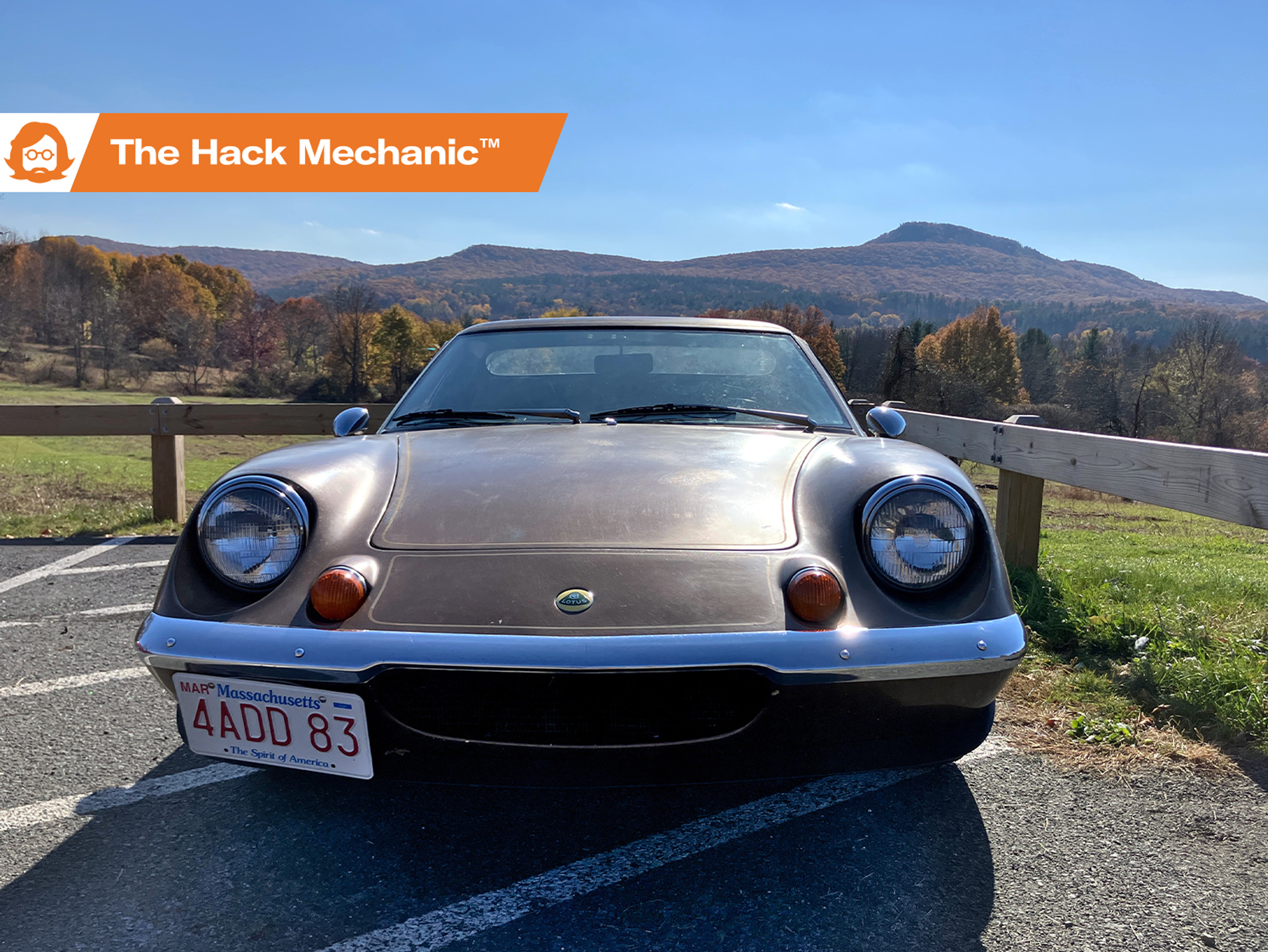
Last week, I talked about going out to the warehouse in Monson, Massachusetts, where I store three cars, finding that all of them had issues, and deciding not to bring my Lotus Europa home because it had a battery issue that would cause problems if I stalled it in traffic. I instead brought my ’72 BMW 2002tii home to troubleshoot its hard-starting problem and clunky suspension. I fixed everything quickly enough that I can put it all into this one article, which is great for you, but bad for me when, next week, I’m scratching for something to write about.
First, the 2002tii’s hard-starting issue. In this piece from several years back, I talked about how the ballast resistor on a vintage car exists to limit the current drawn by the coil during running, but is bypassed during cranking so that full battery voltage can reach the coil’s hot (“15” or “+”) side. This bypassing is managed by a relay. I’ve written countless articles about how relays use voltage applied between terminals 86 and 85 to energize an electromagnet that connects terminals 87 and 30. With the ballast-resistor-bypass circuit, 86 is fed 12V from the ignition cylinder when the key is turned, 85 is ground, 30 is battery voltage, and 87 feeds the coil’s hot side. The tii’s problem was simply a bad ground from 85. I cleaned the screw, and the hard-starting problem went away.

Next, the tii’s suspension issue. During the pandemic, I updated the car’s original suspension with the go-to combination for a 2002—H&R progressive-rate springs that also lower it an inch, Bilstein HD shocks, and Suspension Techniques 22mm front / 19mm rear sway bars. The first two components were new, but the sway bar set was used. I’ve had issues with the urethane bushings on these ST bars squeaking when they get old and requiring lubrication, and because these were used, they squeaked from the get-go, so at installation, I slathered them with silicone lube. Then, two years ago, they began squeaking again, so I switched to PTFE (Teflon-based) lube and installed grease fittings on the brackets holding them so that, in theory, I could lube them in place (because pulling them apart is a pain in the butt).

However, this time the issue appeared to be far beyond mere sway bar bushings—the front of the car had become oxcart-stiff and was metallic-noisy over bumps, as if the springs were too stiff and some other suspension or steering component was bad. I was wondering if I needed to undo some of the suspension mods I’d installed in 2020. This was why I brought the car home—it seemed like enough work that it would make a good winter project.
So I put the tii up on the mid-rise lift and had a look. Imagine my surprise when I saw that the front sway bar was actually hitting the inside of the nose.

It was bizarre. I looked back at an article I wrote for the BMW CCA about the installation in 2020, and saw a reference to my alleviating tight clearance for the sway bar by banging out the inside of the nose a bit, but I didn’t have a clue how it could’ve changed.
I disconnected the end links that attach the bar to the lower control arms and tried to pivot it. Since it was scraping against the inside of the nose, it moved with great difficulty, grinding and scraping as it did. Could this simple thing be the cause of both the stiffness and the clanking?
I disconnected the sway bar brackets where the sway bar is mounted to the subframe, lifted it away to ensure that it had zero contact with the body moving on the suspension. When I lowered the car and bounced the nose, it moved freely, and all noise was gone. It was absolutely wonderful.

I then took a hammer and beat on the inside face of the nose to create clearance for the sway bar. As you can see from the pics, the nose of this car is pretty rusty, so I hardly felt I was defacing a precious body panel. I moved the sway bar back into position, left the brackets loose, and ensured that it had adequate clearance.
Unfortunately, I wasn’t out of the woods yet, because when I bolted the brackets back down and test-pivoted the bar, the squeaking problem of old was out in full force. I used the grease fittings I’d installed years ago (and yes, I’d drilled holes in the urethane bushings behind them), but no amount of pivoting distributed the lube to quiet them down. So I pulled the whole thing apart, laid the lube on cake-frosting thick, put it together, and it was still squeaky.
Damn.
I contacted the manufacturer (now called ST Suspensions) via both email and voicemail about buying new bushings, waited several days, and heard nothing. I searched bmw2002faq.com (the 2002 brain trust) for another source for the bushings, and found none. Something as simple as sway bar bushings was threatening to turn an already-diagnosed problem into a project I was relieved I didn’t have.
Frustrated, I searched eBay for “22mm sway bar bushings,” and found that the Mazda 6 uses bushings of this size. However, the odds that they matched in any dimension other than inner diameter were small. But they were cheap, so I ordered them.
When they arrived, it was obvious that they were both too narrow and too tall—I needed to trim the ridges off the sides, and about 3/16” off the bottom. But 20 minutes and a single-edged razor blade did the trick.

Although they lack the side ridges to ensure they stay centered under the bracket, they installed without issue and compressed to the correct width. And—joy of joys—they don’t squeak like the awful urethane ones did. I’ll keep an eye on them over the next year to see if they drift out of position.

With my supposed 2002tii winter project complete, I made a snap decision to take advantage of the glorious fall weather and returned the car to the Monson warehouse. The idea was to swap it for the Lotus Europa, which had either a dead battery, a cracked positive battery clamp, or both. So I went out there with a new battery clamp as well as my battery tester. I pulled off the clamp, put it on the dimly-lit warehouse floor, illuminated it with a flashlight, and burst out laughing that while the clamp was still installed, I didn’t see that it was nearly broken in half.

I replaced the obviously bad clamp, but just to be certain, I also tested the battery. I have a Cen-Tech tester I bought from Harbor Freight probably ten years ago when this new generation of non-load battery testers (they instead measure resistance to infer battery health) cost about $80. They’re cheaper than that now. This thing works great. Less than five milliohms indicates a good battery. Over 10 milliohms indicates that the plates are sulfated, impeding its ability to hold a charge. Between the two is a gray area. This one tested at 9.5. Verdict? It’s done. Walmart sells this little Group 26R battery for only about $80, and for swap-ability, I use them in the 3.0CSi, the two 2002s, and the two Lotuses. It was in stock at the Walmart about ten miles from the warehouse.

But how to deal with installing it? My back is better than it was, but deadlifting the battery out of an awkward space where, to clear the coolant overflow tank, you need to stand the battery up sideways, was foolhardy. I gave it a ten-percent try, my back said “absolutely freaking not,” and I stopped. What to do?
Fortunately, the Monson warehouse, whose main business is not car storage but industrial irrigation supply and installation, always has someone in it doing something. I found a guy in his 30s who was sanding something, threw my aged, decrepit self at his mercy, and he yanked the battery out for me and put it in the trunk of the tii. I thanked him profusely and offered to bring him lunch, but he waved me off. He also cautioned me that, when I got back with the new battery, he’d be “on the clock” and unable to help.
After buying the battery, I stopped at a liquor store, grabbed a six-pack, and returned to the warehouse. I found the guy, thanked him again, and put the six-pack at his feet. He gave me kind of a funny look, and then I realized that I’d made an improper assumption. You never know what relationship people have with alcohol.
“I’m sorry,” I said. “I just wanted to thank you. Is this okay?”
“It’s fine,” he said. “I used to…” and then said something about drinking that was so earthy and colloquial that I can’t print it, “…but now I just have lawnmower beers. I’ll put it in the back of the fridge.”
Lawnmower beers. I like that.
My hope was that, because gravity would be working in my favor, dropping the new battery in would be far easier than taking it out. Fortunately, I was right.


With the Europa now able to start without the use of the jump pack, I began the drive I’d wanted to do the week before. I headed out to my adopted hometown of Amherst, where I first saw a Europa when I was 13, bought a sandwich, drove to the parking area partway up to the top of an apple orchard with a commanding view of South Amherst, and had lunch while staring at Mt. Norwottuck, the highest peak of the Holyoke range, whose presence loomed over my entire adolescence living in Amherst from 1969 through 1973. It was my moment of Zen.

I planned to let the car stretch its legs on the windy roads that circumnavigate Quabbin Reservoir. I had about 20 great minutes, but road construction and traffic popped that balloon. I began to drive the Europa home via the scenic route (that is, not taking I-90), but stopped and thought.
I hoped that this was neither my only decent drive in the Europa this year nor my last visit to the warehouse this season, but early snowfalls happen, and my wife and I get very busy around Thanksgiving. I took mental stock of the cars and spaces that are available at the house, and wondered if bringing the Europa home was really the right move. I love any opportunity to drive it, but I don’t really have any winter projects for it (a testament to how well-sorted it really has become; its companion, the Elan +2, can occupy me project-wise for much of the winter), and it really shouldn’t sit outside. If it came home, it would claim the last available garage space. Was that really what I wanted? Or should I leave that space open for my E39 that always seems to need something these days, or the 2007-2015 Jaguar XK I still hope to land? Just because I sold four cars in the past 18 months doesn’t mean there will never be any fresh meat.
Snap decision #2: The Europa went back to Monson. I grabbed the FrankenThirty (which I suffer no guilt about overwintering in the driveway) and headed home.

I say that the best automotive work I do involves “crimes of opportunity”—cars that are well-priced and close enough to look at, buy, and drag or drive home. The world is full of magic. Let’s see what sparks may catch before winter makes it all a lot more difficult.
Of course, if I need to wait until spring, the grass in the yard will get long again, and I can look forward to having my first lawnmower beer.
***
Rob’s newly expanded book, The Best of The Hack Mechanic : 40 years of hacks, kluges, and assorted automotive mayhem, is available on Amazon here. His other seven books are available here, or you can order personally inscribed copies from Rob’s website, www.robsiegel.com.
The post Fewer Cars Doesn’t Always Mean Fewer Problems (Part II) appeared first on Hagerty Media.