Pernell Spohn Customs Creates One-off Cars You Can Actually Use
Pernell Spohn doesn’t build custom cars because he wants to win trophies. His cars’ hand-formed metalwork and deftly integrated Corvette underpinnings won’t ever bask beneath the Autorama lights in pursuit of a Ridler. They certainly could, but for Spohn, that’s not the point.
Spohn’s relationship with cars has not always been good, but it has been constant. “I was 25, 26 when I built this shop,” says Spohn of the neatly kept concrete block building located adjacent to his house in Butler, Pennsylvania. “I loved cars back when I was younger; then I started the shop and I hated cars,” he says. “I did a lot of frame work—I was the last-stop reconstruction shop—If I couldn’t fix it, they used it for parts.” Business was good; there were times he’d straighten the frames of three cars a day. That went on for decades, and while he had no shortage of customers, one day Spohn decided to make a pivot by restomodding a ’67 Firebird.

That rekindled the flame. “After that, I was doing a car a year for myself, and after almost 10 years I had a collection of cars stacked up.” A local consignor talked Spohn into selling a half-dozen or so, and Spohn realized there might be a business in custom cars.
Around that time, his sons decided to get involved, first Spencer and then his older son, Jonah. “It got to the point where I realized that my time is short and I needed to teach them my skills,” says Spohn. With that, the evolution from repair shop to one-off builds was complete.

Calling anything Spohn has built after that ’67 Firebird a “restomod” would be an exponential understatement. He says of the ‘Bird: “I restomodded it, and I thought, ‘Man, this is going to be a really cool car.’ I drove [the finished car] around the block, which is a seven-mile journey, and I just shook my head. I couldn’t believe that when we were kids and we drove those cars, we had no idea that they were such a bucket of bolts.” That build was his motivation to go beyond the standard-issue restomod. Ever since, his builds deliver a fully modern driving experience.
How does he do it? His secret, for cars, is the C6 Corvette chassis. Spohn has become an expert at grafting the frame and suspension of the ’05-13 Corvette under everything from a ’60 Buick to an E-Type Jag to, of all things, a Citroën Traction Avant. This is where Spohn’s years of working metal and frames come in handy—he’s completely undeterred by having to right-size the Corvette’s rails and then, subtly or not-so-subtly, massaging a metal body around it.


We walk up to a deep purple ’60 Buick Invicta. “That one has a 2010 Grand Sport under it. The Buick was about 22 inches longer, so we had to lengthen the frame and the torque tube.” He doesn’t stop at getting the wheelbase lined up and bolting the body down—that’d be too easy. “The entire floor pan, tunnel, firewall, everything had to be made. Basically, this has a Corvette frame that was bared and lengthened, and then I unitized the body to the frame. I create a unibody for every car because of the strength—there’s no flex.” Even the inner fenders and radiator support are now structural.
Next to the Buick sit three more of his builds. Imagine how your 8-year-old self—or a veteran Hot Wheels designer—would have sculpted the ideal Chevy C10, ’68 Camaro, or Jag E-Type, and you won’t be far off from Spohn’s creations.


“That Camaro is 13 inches wider than stock in the back, and 12 inches wider up front,” Spohn says, pointing to the 355 section-width tires that sit just barely inside the rear fenders. “Low and wide, that’s what makes them handle. So everything goes wide,” he says. Under the rear wheel well of the bright-sky blue, two-seat Camaro, where you’d typically feel the sharp edge of the panel, or the rolled-flat lip of doubled-over sheetmetal, rests what feels like small-diameter pipe. “On my cars I put 3/8ths stainless-steel tubing around the lip of the wheel well. That way if it hits it’s not going to deform the fender. And they do occasionally hit—I get after it pretty hard in that car.”

We move on to the searingly yellow pickup. It’s immediately recognizable as a C10, but there isn’t a single body panel that Spohn hasn’t massaged. Beneath this, and all the trucks Spohn builds, is the chassis of a late-model GM truck. “We also use the firewall and the floor out of the new truck because that’s where all your main components attach: Your brakes, HVAC, everything that’s got all the engineering in it all bolts right back up. The seats actually bolt in, too.” He then blends the old cab and cowl to fit around the modern hard points.


As wild as he’s willing to get with a vehicle’s body, Spohn relies on the original manufacturer when he can for the mechanical bits. “OEM parts have so much engineering behind them,” he says. “If I can make an OEM product work in a build, I know it’s going to work for a long time.”
Along that vein, and because it was intended as a shop vehicle for their business, Spohn didn’t go nuts with the C10’s drivetrain. “We kept the five-three in it and added an LT4 supercharger, and it makes 480 lb-ft to the wheels. We could’ve spent more on it, but it’s plenty for what it is.” The added benefit of his OEM-first approach is that everything continues to run through the factory body control module, which eliminates a massive layer of complexity. No matter how fancy they may look on the outside, Spohn’s builds operate like the modern vehicles they effectively are.
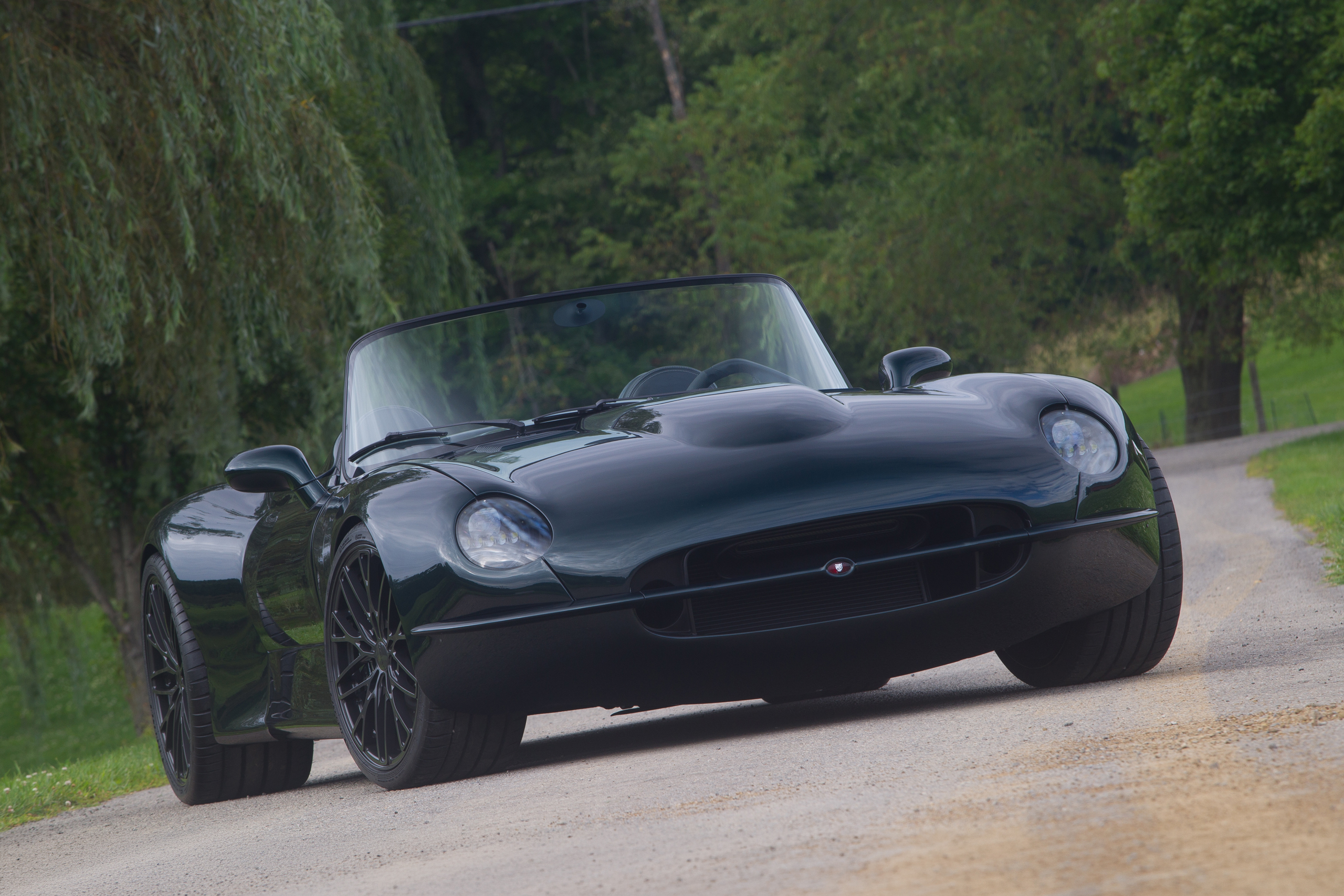
He’s arrived at this approach through a lot of trial and error, and it’s clear Spohn doesn’t stop iterating until something meets his expectations or the vision he has for the project. Once something works, he sticks with it, but Spohn isn’t one for shortcuts. That was apparent from the moment I set foot in his shop, and it’s perhaps no more evident than with his ’69 E-Type.
The car had been someone’s project, a hardtop made into a convertible at some point years ago, so Spohn didn’t feel bad about pulling it apart. He ended up making the whole body himself, even the windshield surround, from 20-gauge steel and aluminum.


“I have so much time in this. This hood is from an original piece—on the factory cars, the whole front end tilted up in one piece,” he shares as he points to the hood cut lines he made, which come in above the headlights. “My biggest mistake was making it split over the top of the light and go the whole way to the front,” he adds wistfully. “If I had made the front end one piece, it would’ve saved me probably three weeks.” That said, it’s probably structurally stiffer this way, and he made it work as if it were OEM, custom-fabricated hinges and all. It’s hard to improve upon the beauty and simplicity of an E-Type; Spohn’s creation instead adds the voluptuousness you’d find in a TVR or a Viper or a Cobra to yield a very aggressive and handsome roadster that has a look all its own.
From there, we head up a hillside to a freshly completed building that will serve as their new shop. Immediately upon opening the door, we saw a Square-body Suburban sitting on a 2022 GM truck chassis with a 6.6-liter diesel engine. I caught it just in time—its new owner was set to pick it up the following day.
“This was a big challenge, particularly because of the radiator,” says Spohn, noting how tough it is to squeeze the chonk of a modern three-quarter-ton diesel truck within the confines of a comparably svelte, minimally modified Square-Body. As with his other builds, everything down to the window regulators and the door-latch mechanisms is out of the donor vehicle to ensure that the body control module is satisfied.


The new owner of the Suburban already has one Spohn build in his garage, an International Travelall. Spohn thought he might have an interest in a Suburban, too, so he got going on the project and struck up a deal with the owner after he had teed up the body on the new frame. Steady relationships like this have been important for business, though Spohn does take on new customers. “But if somebody says they want to do a build in fiberglass, I say no, because fiberglass changes. It moves. It looks good when they get it, and then six weeks from then it looks like sh*t,” says Spohn, who is nothing if not direct.


As if on cue, the next project he takes me to is a bare-metal 1954 Citroën Taction Avant sitting in their new paint booth. The formerly front-wheel-drive French economy car looked a bit pokey when it was stock, its thick C-pillar making it resemble a German WWII army helmet. Now, though, its taut lines bulge with the muscularity of a 21st-century Franco-American hot rod. I’m simply at a loss for words.

“We cut it open to give it relief and pushed the floor out like two feet,” Spohn says. “On this one, we just used the front section and the rear section of the C6 frame, and then we built the entire center. We took a piece of square tube and bent the contour into it and then tied everything together.” His son, Jonah, sourced the rear floor pan out of a Subaru BRZ, and the cut-outs work perfectly for the rear seats (see below).


“This was the first front-wheel-drive unibody car that was ever developed. And it’s high-carbon steel, 20 gauge. Very, very rigid. But there’s no room for anything—everything’s so dainty. It was a real battle trying to get our windows in there and get the seals to work,” says Spohn.
The supercharged LS that’s destined for the engine bay should offer plenty of motivation. “The owner said he wanted something that he could take the kids to get ice cream and do a burnout. This will be perfect for that,” says Spohn.
I can’t help but stare at the partially finished Citroën and, with his other builds in mind, ask Spohn if he’s planning on entering any big custom shows. Spohn answers quickly and emphatically. “We’re not Ridler builders. We are absolutely the other extreme of that…Drivability, for me, is number one. Livability is number two. Number three is looks, but the looks come if you’re building the way we build.”
So often we see one extreme or the other—cars built to drive, or cars built to catch eyes. Pernell Spohn and his sons seem to have found a way to do both, and they do it not for the accolades, but simply because they love the work.


The post Pernell Spohn Customs Creates One-Off Cars You Can Actually Use appeared first on Hagerty Media.
More Auto stories