Dacia Won't Limit Petrol Car Sales To Meet Zev Mandate Targets
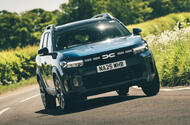
New Bigster put on a strong performance in the second half of 2025Brand's market share is up across much of Europe but down in the UK; mandate poses significant challenge
Dacia won't limit sales of petrol and hybrid cars to meet the UK’s zero emissions vehicle (ZEV) mandate targets, its vice-president for sales and marketing has told Autocar.
The mandate this year requires that 33% of every major car maker's sales are battery-electric, else it will incur a £12,000 fine per ICE car sold over the threshold.
Frank Marotte said that because Dacia is the most ICE-focused brand in the Renault Group, there will be a “trade-off between some ICE models that we could sell and the BEVs that we cannot sell”.
Although Dacia will be helped by the launch of a new electric city car, based on the Renault Twingo and set to be sold alongside the similarly positioned Dacia Spring, it remains under pressure to increase its EV sales mix.
Asked whether the Romanian brand will be forced to limit stocks of petrol cars, thereby improving its EV sales ratio, Marotte said: “It doesn’t mean we’re going to limit ICE sales, but we have to increase our EV sales.
“At the end of the day, we need to be compliant with the ZEV mandate, because the penalties are too high and we have no intention at Renault Group to pay penalties.”
Marotte also hinted that Dacia could accelerate the development of new EVs, saying it needs “more EV offers in our line-up, particularly for the UK short-term”.
He added that the ZEV mandate is the “forerunner” for similar schemes that are expected to arrive elsewhere in Europe, making compliance in the UK all the more important.
As well as the mandate, the arrival of new Chinese brands and the consolidation of incumbent ones has placed “constraints” on Dacia’s performance in the UK, said Marotte. “It was not an easy path for us in the UK,” he added.
Indeed, Dacia’s market share in the UK fell from 1.61% in 2024 to 1.49% last year, defying its growth across Europe on the whole. Its share of the entire European market grew by 0.1% as it recorded a total of 697,408 sales.
The Sandero supermini remained the brand’s best-seller – and indeed Europe’s most popular car – with 289,295 sales.
That was down 6.5% on 2024, however, which Marotte attributed to shrinkage of the French and Italian markets that are key to the model’s success.
It was followed by the Duster SUV, whose 193,974 sales were down by 9.8% compared with the year prior.
Marotte said this was due to “market conditions” and “the completion of our line-up”, the latter suggesting that some of its sales had been taken away by the launch of the larger Bigster.
Behind the Duster was the Jogger MPV, with 73,695 sales – down by a significant 23.6% compared with 2024. This was “obviously not the best result”, said Marotte.
He conceded that the Bigster probably impeded the Jogger but added that Dacia has yet to gather sufficient data to confirm whether that alone was the cause of the sharp decline.
The Bigster recorded 67,573 sales – a huge proportion of the brand’s overall volumes, given that deliveries in mainland Europe didn't begin until late June.
On that evidence, it's possible that its sales could outstrip even the Duster's this year.
Marotte added that more than six in 10 Bigsters were ordered with a hybrid powertrain – double the share in Dacia’s smaller models.
In last place was the Spring EV, although its 35,034 sales represented a 53% increase on 2024.
The UK was a key driver for that rise, given that Spring deliveries didn't begin here until November 2024 and this is one of Europe’s most favourable markets for EVs.
Popular Products
No popular products available in this category.