Donut Lab Solid-state Battery Tests Show Safety Gains
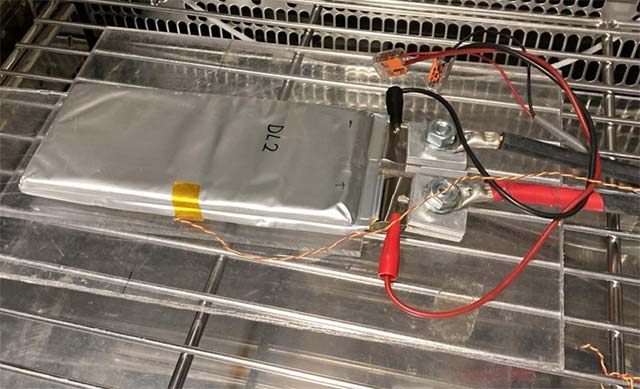
Donut Lab continues to push its solid-state battery technology into the spotlight, releasing new safety and performance data as the company approaches a self-imposed production deadline for integration into Verge Motorcycles.
The Finnish startup’s latest results combine internal testing with independent validation from VTT Technical Research Centre, offering a mixed but intriguing picture: strong safety characteristics under extreme conditions, yet lingering uncertainty around its most ambitious performance claims.
Damaged Cell Safety Test Highlights Solid-State Advantage
In its latest “I Donut Believe” campaign test, Donut Lab deliberately pushed a damaged battery cell (DL2) to its limits. The cell had previously lost its vacuum structure during a high-temperature test at 100°C—damage that would typically render a conventional lithium-ion battery unsafe.
Instead of discarding the compromised unit, engineers continued testing.
According to Donut Lab, the results reinforce a core advantage of solid-state design: safety under failure conditions. Even after structural damage, the DL2 cell:
– Completed five standard 1C charge/discharge cycles without incident
– Underwent over 50 high-speed 5C charging cycles
– Showed no thermal runaway, fire, or dangerous temperature spikes
The company attributes this resilience to the absence of liquid electrolyte. In traditional lithium-ion batteries, exposure to air after structural failure can lead to leakage, combustion, or catastrophic thermal events. Donut Lab claims its solid-state architecture eliminates that risk.
However, performance degradation was significant. The cell’s capacity dropped from roughly 25 Ah to around 11 Ah during testing, although minor recovery was observed toward the end of lower-rate cycles.
Independent Testing Confirms Results — With Important Caveats
The same DL2 cell was also evaluated by VTT in a controlled cycling test, offering the most independent insight yet into Donut Lab’s technology.
The findings broadly align with the company’s own data:
– Capacity fell by 54.66% after 50 cycles at 5C
– Energy efficiency dropped from 89.6% to 83.0%
– The cell experienced 17% physical swelling
Crucially, this test was conducted on an already damaged cell. The loss of vacuum—essential for maintaining internal layer contact in solid-state batteries—likely accelerated degradation.
While the result demonstrates that the battery remains operational even after severe structural compromise, it does not reflect the expected performance of an intact cell.
Five Tests, But Missing the Big Proof Points
Across five independent reports from VTT, Donut Lab has validated several important capabilities:
– Ultra-fast charging (up to 80% in 4.5 minutes at 11C)
– High-temperature tolerance
– Low self-discharge (97.7% retention after 10 days)
– Pack-level performance in a Verge TS Pro motorcycle
– Continued operation of a damaged cell
Each of these results represents meaningful engineering progress. However, none address the two claims that could redefine the battery industry:
– 400 Wh/kg energy density
– 100,000-cycle lifespan
These figures, if verified, would far exceed current lithium-ion benchmarks. Yet, despite being relatively straightforward to test—particularly energy density—no independent validation has been published.
Production Deadline Approaches
The timing adds urgency. Donut Lab CEO Marko Lehtimäki has committed to delivering production-ready batteries for Verge Motorcycles by the end of Q1 2026.
With March 31 fast approaching, several hurdles remain:
– Certification processes in the EU and US are still pending
– Production volumes for 2026 are expected to be limited (around 350 motorcycles)
– Real-world validation of energy density and cycle life has yet to occur
If production bikes do launch with Donut Lab batteries, broader testing will inevitably follow. At that point, the company’s boldest claims will face real-world scrutiny.
The post Donut Lab Solid-State Battery Tests Show Safety Gains appeared first on Electric Cars Report.
Popular Products
No popular products available in this category.