Jaguar Type 01: What Really Happened When The Wraps Came Off?
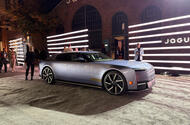
After years of build-up, Jaguar finally transforms into a luxury EV brand - and we were there to watch
The venue: Storied NYC, originally a taxi depot in the late 1900s, later photographer Annie Leibovitz's home and studio and now an events space in New York's Chelsea, on the west side of Manhattan Island, within throwing distance of the Hudson.
Jaguar has had some roads closed on the surrounding block to accommodate the arrival of a Type 01 and a fleet of Range Rovers dropping influencers and celebrities (including film star Florence Pugh and pop star Sienna Spiro, who will later sing) at the door, in front of an advertising board thronged by paparazzi.
But given the city traffic has horns blaring and sirens whooping, easier access is via a walk along the High Line, a former railroad spur turned elevated park that runs next to the building. Brick, concrete, moody lighting... Demonstration exhibits from the earlier press presentation (a full-size silhouette of the car and the 'impossible panel', a 3.5m-long aluminium pressing) are left in place as some 400 attendees (in 'elevated smart casual' dress) mingle.
At 8:03pm, a video starts; smoke appears then clears to reveal a Type 01 and Jaguar managing director Rawdon Glover as the whoops fade.
In the end, when the covers are pulled back, what we see isn't a big surprise. After two years of teaser pictures, computer renderings, the Type 00 concept car and, finally, on the afternoon of the unveiling, an inadvertently uploaded picture of a hapless journalist's video thumbnail, how could it be a surprise? Yes, the new production Jaguar really does look like this.
Wild. Very big. Very small glass area. Wheels more than half the car's height. A clean, four-seat interior with clear demarcation between zones.
This launch-specification Type 01, finished in the very same colour that the first clay design model was painted in a Gaydon studio more than four years ago – after which it was picked unanimously out of 18 potential contenders – will arrive on the road mid-next year.
"Ask yourself: have you ever seen a car like this before?" implores Alexey Andreev, its lead exterior designer.
No but, by Jaguar's own admission, sort of yes too. True, we haven't seen an electric car with 23in wheels and a sub-1400mm roofline and no rear window before, yet Jaguar says we have seen elements of the Type 01's proportions before.
The company continues to put distance between its initial and so controversial 'Copy Nothing' advertising campaign from November 2024, which followed JLR creative chief Gerry McGovern's comments that the Jaguar brand "had no equity whatsoever"; both occurrences Jaguar would prefer hadn't played out as they did. Since then both the design boss and the messaging have changed.
That Jaguar needed reinvention is something still widely acknowledged, but the company now knows that turning its back (or seeming to) on Jaguar's history was upsetting, a wrong they're still attempting to right.
Hence Glover's opening remarks as the cover comes off the Type 01: "We need people to desire this vehicle like they did great Jaguars of the past.
"It returns Jaguar to its natural habitat, to what we did best, to what made those cars so desirable: a low roofline and a reversed [cab-rearward] stance."
Rather than testing competitor cars when the Type 01 project was initiated, Jaguar's designers and engineers spent days scouring and driving the company's own back catalogue for inspiration, most notably honing in on coupés like the 1970s XJC and XJS. It smarted with some staff that their bosses didn't tell the wider world about that. The insistence now, though, is that the Type 01 is a Jaguar true to the company's heritage and was always supposed to be.
"We think New York is a centre of creativity and culture, very much in keeping with us, that sense of old and new," Glover says. "It's like Jaguar: a mix of incredible history but looking forward."
The Type 01 initiates a new era for Jaguar after a self-imposed hiatus, then, as a 1016bhp, tri-motor, 5.2m-long electric car with a 3.2m wheelbase and almost a metre between the windscreen and the front wheels—the 'luxury gap', as Jaguar calls it.
There's a long bonnet even though EVs don't strictly need one, so Jaguar found a use for it: it houses one pack of battery cells and some high-voltage electrical gubbins, both of which would traditionally sit beneath the passenger cabin floor. This makes the Type 01 a departure from the kind of skateboard architecture that usually means "with electric vehicles you will find you sit on the car, not in the car," according to Tom Bury, Jaguar's product marketing director. "This is a GT car," he added.
The separated battery packs of the new Jaguar Electric Architecture, which makes its debut underneath the Type 01, allow the cabin floor to be lower. The seat bases are effectively atop the packs with 'foot garages' cut before them, hence allowing that rakish profile, with a roof height so low that the creators of the Ferrari Luce must look upon it enviably.
This isn't an SUV. One of those will follow, probably the next Jaguar out of the gate, based on a different architecture. But for now the reinvention of Jaguar starts with a bespoke-engineered, four-door, four-seat fastback.
And whatever you think of the Type 01's appearance, isn't there something admirable about that? JLR is in global terms quite a small car company, making hundreds of thousands rather than millions of cars per year, yet it's a company that likes to do things itself. It makes mostly large SUVs, yet it uses four different platforms to underpin its models. That beneath the Type 01, which will surely be a niche product, is currently used by nothing else and the next Jaguar along probably won't use it either. How does JLR expect to recoup that investment?
The Jaguars that follow, we suspect, will be the ones that make the money, with the Type 01 if not exactly acting as a loss-leader then at least being a car that sets the tone for Jaguars to come.
Jaguar won't talk production volume beyond Glover saying the company would like to make "one fewer car than the market demands", but it confirms that it's shifting the area in which it wants to sell cars.
"Our business model is about value, not volume," Glover continues. "The average retail price for a Jaguar was about £60,000 and now we need to double that. We think we're on the right course and the vehicle will resonate with the right clients."
Other JLR brands haven't had a problem in moving upmarket. Range Rover recently sold a car for more than £400,000 and a £250,000 car is not an anomaly for it. This is the kind of arena that Jaguar intends to move into.
As part of the Type 01's launch cycle, 60 cars will be offered in the striking London Red or Blue Ultramarine colours in which the Type 00 concept was finished. The bespoke programme that has become so significant for Range Rovers will be developed for Jaguar too.
The Type 01's design – design being the number-one reason luxury car buyers choose any car – is pivotal to that. Company insiders say the uncompromising dedication to turning the original vision into a production reality "pretty much exactly as you see it" (according to Andreev) wasn't down to design department insistence – as in it didn't take McGovern being awkward – but rather clear instructions from the highest level of JLR's owner, Tata. That's why the Type 01 looks incredibly similar to the original vision, whereas rival car companies' concepts and realities can look rather more different.
Not that that's necessarily a bad thing: the reason Jaguar needs reinvention when the German big three don't is because they have delivered a consistent level of model-line design and engineering that Jaguar simply hasn't previously matched. BMW doesn't need to fundamentally change because it routinely sells more than two million cars per year. The respawning of Jaguar is ultimately an indication and acceptance that it was mortally wounded in a previous incarnation.
The XJS is the car that I probably return to most when trying to gauge where the Type 01 sits in Jaguar's catalogue. There are other long-bonneted, low-roofed coupés in Jaguar's history too, but this 1975 car, whose 21-year production run was probably twice as long as it should have been, today looks very much of its time, in a way that I wonder if the Type 01 will in 50 years' time.
Glover acknowledges that the XJS wasn't universally loved at its launch, and now Jaguar says that polarisation is better than 'meh' when it comes to the Type 01's design; that for everyone who decides not to have one, there will be someone who likes its "exuberance" and "presence" so much that nothing else will do.
Glover says that during a recent visit to the millionaires' playground of Monterey Car Week, he found several classic Jaguars in attendance, and "it's our job that in 40 years time there's a Type 01 there".
Jaguar's previous problems weren't only down to design or model competence, of course, and there's still evidently more work to do in those other areas too. "We will open for deposits tomorrow," Glover tells us at the launch, but immediately following the unveiling a friend of Autocar visits the Jaguar website and, when he asks it where nearest the retailer is to his Somerset home, it directs him to Vertu Accident Repair Centre Yeovil. A marketing email duly arrives with him too, and when he clicks the link within it, it returns a 404 server error. I then ask the same about Oxford retailers and am directed first to Top Gun Refinishing, a repairer in Kidlington, over the Jaguar Oxford dealer.
Jaguar will hope that repairers and service centres are a long way down the list of Type 01 owners' concerns. Carlee Hardaker, its communications and marketing director, says the Type 01 has undergone "700,000 and still counting" miles of real world-testing, as well as 200,000 hours of virtual testing. "We have confidence in its Nvidia computer chips, having run 15,000 tests on those," she added.
Final tweaks, particularly regarding software integration, are still being made to the Type 01, which has a 50:50 weight distribution, rear-wheel steering and a yaw point, its engineers say, where the driver sits, making it feel like the car is turning around you and reputedly making what is a big car (no weight has been quoted, but 2600kg would seem a reasonable estimation) feel surprisingly agile. Our early testing supports that.
"Electric cars are all quick, all quiet," Glover says. "That's not enough."
If all engineering and design planets align, it's still fair to harbour concerns about whether there are enough people in the world who want to spend £150,000 on an electric four-seat GT. For all the furore, I wonder if a new Jaguar SUV will financially have more riding on it, when that arrives within the next couple of years, than the Type 01 - if it's possible to ignore the fact that the GT sets the tone for all future Jaguars.
Still, as the music dies down, the spotlights settle on the stage and the crowd takes in the realities of the Type 01's shape, Glover says it with no little understatement: "This is quite a big moment for us."
Popular Products
No popular products available in this category.