Ninth-gen Ford F-series Trucks - Are They The Best Of The Breed?
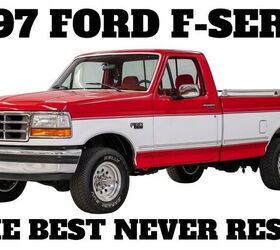
The 9th Gen of F-series Trucks. They would be an evolution of 7th and 8th generations more so than a completely new truck and many feel this is the best generation F-Series.
This would also be the last F-series built before Ford split the Light duty and heavy Duty Trucks. For those that own/owned these trucks I hope you enjoy this weeks video.
For more Ford related content subscribe here: https://www.youtube.com/c/TonysFordsa...
The TTAC Creators Series tells stories and amplifies creators from all corners of the car world, including culture, dealerships, collections, modified builds and more.
A transcript, created by AI and edited by a staffer, is below.
[Image: Tony's Fords and Mustangs/YouTube]
Become a TTAC insider. Get the latest news, features, TTAC takes, and everything else that gets to the truth about cars first by subscribing to our newsletter.
Transcript:
The ninth-generation F-Series truck was more of an evolution of the seventh and eighth generations rather than a completely new pickup. Before getting into it, a couple of clarifications are worth noting. During the seventh, eighth, and ninth generations, the F-Series name covered everything from the F-150 up through the F-800. This overview focuses only on the F-150 through F-350 models, which were more consumer-oriented than commercial. The Lightning was also introduced during this generation, but that truck deserves its own separate video.
Introduced in September of 1991 as a 1992 model, the ninth-generation F-Series pickups were largely a restyle of the eighth generation. The lineup included the F-150 with a gross vehicle weight rating of 6,250 pounds, the F-250 Light Duty at 6,600 pounds, the standard F-250 at 8,800 pounds, and the F-350 at 9,200 pounds. GVWR refers to the maximum amount of weight the vehicle can safely carry, including passengers and cargo.
The front end received a completely new fascia, with new sheet metal from the A-pillars forward. These changes were intended to improve aerodynamics and give the truck a more rounded appearance. The headlamp buckets were larger and combined the headlights, turn signals, and parking lamps into a single unit. The grille was also enlarged, and the leading edge of the hood was trimmed back.
Inside, the cabin was revised to feel more open. The dashboard storage shelf extended closer to the driver, and the controls were redesigned for easier use. SuperCab models received larger rear side windows.
Trim levels started with the base Custom, which included tinted glass, an argent grille, steel wheels with hubcaps, a color-keyed floor mat, an AM radio with a digital clock, a vinyl bench seat, and basic gauges for voltage, oil pressure, and temperature. The XL added air conditioning, cloth seating surfaces, a headliner, and upgraded steel wheels. The XLT introduced a black rub strip, chrome grille, aluminum wheels, carpeted map pockets, an AM/FM stereo with clock and two speakers, and a cloth-and-vinyl bench seat. The XLT Lariat sat at the top of the lineup and added features such as air conditioning, the light group, a leather-wrapped steering wheel, and the convenience group.
Ford also reintroduced the Flareside bed, although this version was a narrow-body adaptation of the dual rear-wheel bed. The Nite appearance package carried over, featuring a black monochromatic paint scheme with either pink or blue-purple striping, Nite decals on the cargo box, and a sliding rear window. This package was limited to V8-equipped F-150s. The Sport Appearance Package also returned, adding a 15-by-8-inch wheel and tire setup along with body-side tape stripes.
The engine lineup began with a 4.9-liter 300-cubic-inch inline-six producing 145 horsepower, standard in the F-150 and light-duty F-250. Optional engines included the fuel-injected 5.0-liter 302 V8, also rated at 145 horsepower, and the 5.8-liter 351 V8 producing 210 horsepower. The heavy-duty F-250 and F-350 came standard with the 5.8-liter V8, with optional engines including the 7.5-liter 460 V8 rated at 320 horsepower and 390 pound-feet of torque, or the 7.3-liter International diesel producing 185 horsepower and 360 pound-feet of torque.
Transmission choices included a five-speed manual, a four-speed manual, a four-speed automatic overdrive, and an electronically controlled four-speed automatic overdrive. Suspension consisted of Ford’s Twin I-Beam independent front suspension for two-wheel-drive models and the Twin Traction Beam setup for four-wheel-drive trucks.
Standard features included halogen headlamps, tinted glass, full instrumentation, interval wipers, power steering, power brakes with rear anti-lock braking, and automatic locking hubs on four-wheel-drive models. Popular options ranged from air conditioning and sliding rear windows to power windows and locks, cruise control, tilt steering, AM/FM cassette players, two-tone paint, towing and handling packages, multiple wheel and tire options, and limited-slip front axles for four-wheel-drive trucks.
Accurate production numbers for 1992 are not available, but Ford retained its position as the best-selling truck brand in America.
For 1993, several changes were made. The Custom trim, Sport Equipment Package, and Nite Package were dropped, making the XL the new base trim. Ford also introduced the Lightning, which is covered separately. Midway through the model year, a turbocharged version of the 7.3-liter IDI diesel was introduced, producing 190 horsepower and 390 pound-feet of torque. Ford once again retained the best-selling truck title.
In 1994, the steering wheel was updated, and a driver-side airbag became standard on F-150 and F-250 models, along with a center high-mounted third brake light. New options included remote keyless entry with an alarm and an in-dash AM/FM CD player. Ford also introduced the Eddie Bauer trim on F-150 models, adding unique exterior trim, running boards, special interior materials, power mirrors, two-tone paint, forged aluminum wheels, bed accessories, and branded luggage.
Powertrain updates followed as well. The 5.0-liter V8 was refined and saw its output increased to 210 horsepower, while the 5.8-liter V8 lost 30 horsepower but gained roller lifters. Midway through the year, Ford introduced the 7.3-liter Power Stroke diesel, rated at 210 horsepower and 425 pound-feet of torque. Ford again retained its best-selling status.
For 1995, Ford added the Special trim, which effectively replaced the Custom model that had been dropped earlier. No other major changes were made, and the F-Series continued as the best-selling truck in America.
The 1996 model year was a complete carryover for the F-Series. It marked the final year for the ninth-generation F-150 and light-duty F-250, as Ford prepared to move those trucks to an all-new platform for 1997. The heavy-duty F-250 and F-350 remained on the ninth-generation platform through 1996 and 1997 with no significant changes. This period also marked Ford’s move toward separating light-duty and heavy-duty trucks, which culminated in the launch of the Super Duty lineup for the 1999 model year.
Today, the ninth-generation F-Series is considered by many to be one of the strongest generations and has become increasingly collectible. That doesn’t mean every worn farm truck is suddenly valuable, but well-kept examples do hold interest. Exact production numbers are unavailable, but Ford sold over 500,000 F-Series trucks each year during this generation, with sales nearing 800,000 units by 1996. That volume meant Ford outsold both Chevrolet and GMC combined.
One final clarification: there were no 1998 heavy-duty F-250 or F-350 models. Super Duty production began in January of 1998 as 1999 model-year vehicles. The tenth-generation F-Series was a complete redesign, and that story is best saved for another video.
Thank you for watching.
Popular Products
No popular products available in this category.