Pick Of The Day: 1963 Pontiac Bonneville Convertible
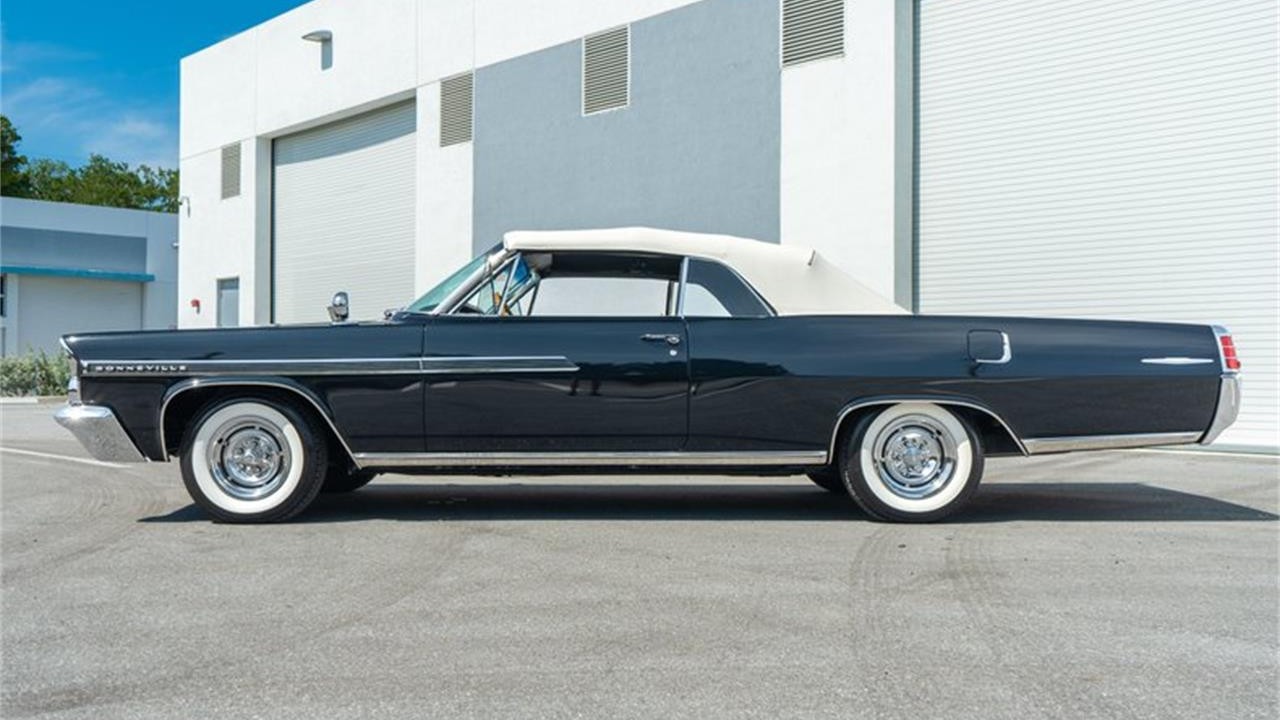
Has anyone ever asked why quad headlights tend to be horizontal? When they became legal in the U.S. in 1957, it seems just about every brand save Nash and Lincoln featured quads, one next to the other. Lincoln then went canted, to be joined by Chrysler and DeSoto. Dodge even played with asymmetry in 1962-63, but none of that really prepared the world for our Pick of the Day. This 1963 Pontiac Bonneville convertible is listed for sale on ClassicCars.com by a dealership in Fort Lauderdale, Florida.
I am reminded of weekend trips to metro Philly — maybe Media — where the town had horizontal stoplights. It’s a configuration that was not often seen (and may have been unique for the U.S.), but as a kid, I thought they looked cool. I called them “caterpillar lights.”
And those cars on the road that had vertical headlights? Kinda cool to this kid, though not quite in the same way. As I saw every car having a face of sorts, there was nothing about a car with vertical headlights that looked pretty. Many years later (embarrassingly, maybe when I entered by 40s), I discovered the inspiration for this design was turbines, a natural and more modern extension of the aviation/astronautics progression that was part of the Atomic Age. Wide-mouth grilles, ornamental air intakes, cockpit-like dashboards, and turbine-themed grilles, wheel covers, and the like were all part of the evolution. The full-size 1963 Pontiac may have been the peak of this philosophy.
The 1963 Pontiac certainly was the first of several cars in the American landscape to promote vertical headlights as a styling trend. What made this car more interesting and authentic compared to copycats from Cadillac, Ford, Plymouth, Mercury, Buick, and American Motors was that the headlight cavities looked like they could catch air, versus just applying vertical headlights to a design. In fact, if you look at the 1963 Pontiac X-400 show car (which still exists today, believe it or not), you’ll notice that it was built with custom Euro-style headlights (somewhat of a new phenomenon across the pond), which gave the impression of air intakes even more clearly.
The production cars were visually tamed, but the look certainly was different and more evolved than what came several years before. While the 1963 Grand Prix is often held as a paragon of Pontiac’s style in the 1960s, especially with its unique concave backlite and tasteful use of trim, the Bonneville was much more typical of the era. Two-door hardtops featured General Motors’ contemporary design that looked like a convertible with the top up, plus all Bonnevilles featured ribbed horizontal stainless steel molding running from the headlights to the middle of the front door. Though not as restrained as the Grand Prix, it nonetheless was tasteful and not ostentatious.
This Nocturne Blue 1963 Pontiac Bonneville convertible received a reported $140,000 investment in its restoration over 15 years ago. It is typical as far as Bonnevilles go — 303-horsepower 389 four-barrel backed by four-speed Hydra-Matic — but that’s never been a bad way to go. A white top and white leather bench-seat interior nicely highlight the blue hue. An unusual option shown on this Bonneville is the Sports wheel cover, a chrome-flashed stainless steel design that’s rarely seen and makes for a nice alternative to the classic (and expected) “8-lug” aluminum wheel hubs.
This Bonneville was built at a time when Pontiac was aspirational — not that consumers aspired to be Pontiac owners, but that Pontiac often aspired to compete above its pay grade. This Bonneville shows how it was done with the design purity that eventually was lost as the decade continued. If you too feel this Poncho was part of Pontiac’s peak, then reach out to the seller to learn more about what it would take to bring it home.
Click here to view this Pick of the Day on ClassicCars.com
Popular Products
No popular products available in this category.