Pick Of The Day: 1994 Jaguar Xj220
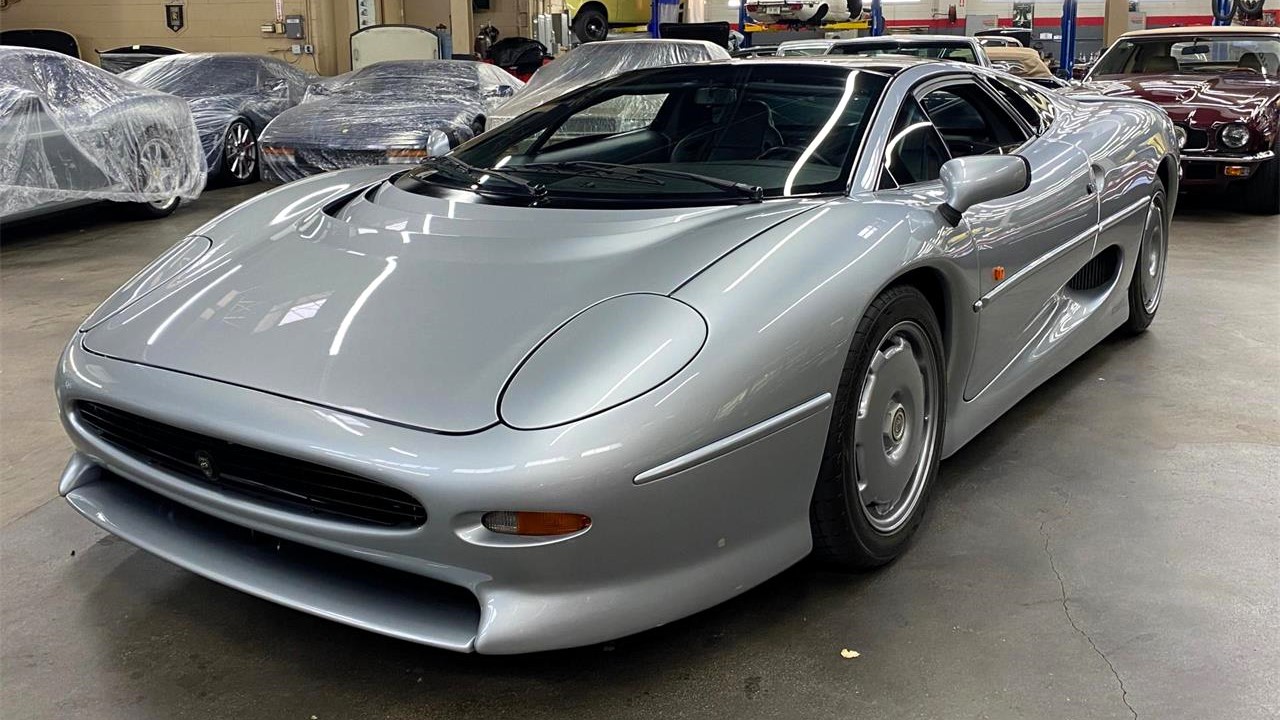
It’s almost that time of year again: Monterey Car Week (MCW). August 7-16, California’s Pebble Beach/Carmel-by-the-Sea/Monterey area will be jam-packed with people ogling the meticulously restored prewar concours cars, vintage racing machines, precisely crafted Swiss watches, and multi-million-dollar exotics that are mere feet away from them. That got me, someone who largely grew up in the 1990s, thinking about how many supercars from that decade will be there. If you go to MCW, you just might get lucky and see a car like our Pick of the Day. You can find this 1994 Jaguar XJ220 listed for sale on ClassicCars.com by a dealership in Huntington Station, New York. It comes with a Jaguar Daimler Heritage Trust Certificate, owner’s and service manuals, service records, wheel tool, and more. The video below shows a cold start, road test, fly-bys, and exterior/interior tour.
The supercars of the 1990s, such the Bugatti EB110, Ferrari F50, and Lamborghini Diablo, are part of a snapshot of a particular time in the automotive industry. The quad-turbo V-12 powering the EB110 was the product of a new Bugatti that was brought back to life (and relocated to Italy) after decades of dormancy; the 513-horsepower F50 was the first “Prancing Horse” halo car to be introduced after the death of company founder Enzo Ferrari; its Diablo rival from Lamborghini was produced under Chrysler’s ownership. Early models had rear-wheel drive and a five-speed manual, two things that Lamborghini eventually phased out in favor of all-wheel drive and later, for the Murcielago, a six-speed gearbox and an automated manual transmission.
That snapshot of ’90s supercars also includes the Jaguar XJ220, although the idea for it came from the previous decade. According to the press kit for the XJ220 concept, “It was originally conceived by Jim Randle, Jaguar’s Director Product Engineering, as a Group B road racing concept in early 1985. A group of 12 Jaguar designers and engineers volunteered to work on the project in their own time.”
At the 1988 Birmingham International Motor Show, Jaguar revealed the XJ220 concept, complete with butterfly doors, 6.2-liter DOHC V-12 that produced more than 500 horsepower and 400 lb-ft of torque, and all-wheel drive. It had no plans to produce the car unless the public reaction to it was positive and producing it was feasible (though it wasn’t at the time.)
It’s safe to say that Jaguar got what it needed to move forward with making a production version of the XJ220. One of its affiliate companies, JaguarSport, handled the manufacturing. Although the end result largely resembled the long, wide, and windswept concept, it deviated from it in several major ways. First, the doors opened conventionally. Second, power went through the rear wheels only. Third, that power came from a twin-turbo 3.5-liter V-6. However, despite the engine’s size, it produced 542 horses and 475 lb-ft of torque, all processed by a five-speed manual gearbox and limited-slip differential. Flat out, the XJ220 reached 213 mph with Le Mans/Daytona/Sebring champion Andy Wallace behind the wheel. Driving with the catalytic converters off, Le Mans winner Martin Brundle hit 217 at the Nardo track in Italy (Brundle revealed that had the track been flat instead of banked, that speed would have been 222 mph). Either way, the XJ220 was the fastest car available — until the McLaren F1 showed up.
Ultimately, thanks in part to the recession in the early 1990s and a price of over $700,000, fewer than 300 XJ220s left the factory. Production numbers vary by the source. The Jaguar Media Centre states, “Production ceased in 1994, by which time 275 cars had been built.” The Jaguar Daimler Heritage Trust has a slightly higher figure: “From 1992 to 1994, a total of 281 XJ220 cars were produced.”
This particular XJ220 was built on January 7, 1994, according to the selling dealer. “Originally sold in Germany where it remained until 2004, the Jag was then imported to the United States and sold to a doctor in Florida. It was then sold to its last caretaker, a well-known collector in 2010 and has been immaculately maintained ever since.” Jeff’s Resurrections in Taylor, Texas serviced and overhauled the fuel system, then connected it to a new fuel cell. “After this work was completed, the car was shipped back to Jaguar in Coventry in 2011 and the factory completely went through and serviced all components including rebuilding the engine to exact original European factory specs.” All these updates are due to age, not the mileage, which is only about 3,600. You can see that low number reflected in the condition of the Spa Silver paint that covers the body’s graceful, flowing curves, and the shape of the generous amounts of Smoke Grey leather in the cockpit.
Jaguar didn’t build a lot of XJ220s and it hasn’t produced a car like it in more than 30 years. If you go to an exotic car show, you’ll probably see a mix of Lamborghinis, Ferraris, and maybe even Bugattis, but there’s a much slimmer chance you’ll spot an XJ220. You can bring this 1994 Jaguar XJ220 to your next local supercar event, but first you will want to contact the selling dealer for the price.
Click here to view this Pick of the Day on ClassicCars.com
Popular Products
No popular products available in this category.