Super-suv Showdown: Porsche Cayenne Ev Vs Polestar And Bmw
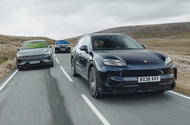
Porsche Cayenne has beaten all comers for decades in ICE form - let's see if the EV follows suit
Can a big premium electric car really do it all? You might be pondering that question, especially if you own, have owned or have ever considered owning a Porsche Cayenne – the defining, dividing, dominating super-SUV of our age.
Could an electric take on the concept have the same incredible span of versatility to its dynamic character that, over several generations, the combustion-engined car came to symbolise? To handle like a rear-driven sports car at one minute and perform like the fastest super-saloon the next. To cosset like a luxury car; cruise like a limousine; swallow cargo like a roomy station wagon; and then haul, scrabble, climb and descend like a truly capable off-roader. Apart from anything else, could a Cayenne EV have the same aura of all-conquering superiority?
It's the toughest of tough briefs, but here we are, with an opportunity to find out. Having already carried out a preliminary test of the range-topping, 1141bhp Cayenne Turbo Electric on UK roads, we're keeping our frame of reference just a little more 'real world' for this, the new Cayenne's official UK welcoming party.
A full, instrumented road test of the mid-range Cayenne S Electric will probably come later. But here and now, the base-model, dual-motor, £83,000 Cayenne Electric meets its closest, full-size, premium-brand rivals of the moment: the BMW iX xDrive60 M Sport and the Polestar 3 Dual Motor.
Unlike some electric SUVs in its orbit, the Cayenne Electric comes with two drive motors and adaptive air suspension even as an entry-level proposition. It can't be had with a cut-down battery pack in order to push the price down, either.
That's why, even though it's Porsche's base model, it's going up against mid-ranking derivatives from BMW and Polestar. You can spend less on either of those rivals, it's true. But plenty of range and four driven wheels ought to be minimum requirements for a really capable premium SUV, shouldn't they? If you want some driver appeal as well, assuming you don't need seven seats and you've got £80k-£90k to spend of your own or your company's money, these are your options. This is the contest, in other words, that the Cayenne Electric really needs to win before going any further.
It's certainly right in among those rivals on paper. It's a little down on peak power compared with the BMW and Polestar (as can be seen in the spec box at the bottom of this story), but it gives up little on the 0-62mph sprint to either rival and is very evenly matched on kerb weight.
The base Cayenne Electric isn't quite the longest-range model in the line-up – the 657bhp S Electric pips it by four miles according to the WLTP lab test, no doubt because of the different gearing of its different electric motors – but it is very closely matched indeed with its rivals.
What we have here, then, in principle at least, are three big, heavy, versatile EVs, each with real-world performance to spare and claiming to deliver 400 miles between charges or very close to it. That's worth pausing to reflect on. Back in 2024, I lined up an Audi SQ8 E-tron Sportback for comparison with the then new Lotus Eletre S – both £100,000 upmarket EVs at the time – and found that the Audi had a real-world cruising range of about 220 miles and the Lotus only about 250. Plainly not good enough, especially for extra-capable, high-end SUVs. On that score, though, it appears we have come quite a long way in a fairly short space of time.
But how will the optional alloy wheels of our electric SUV test cars (all larger than the default-fit, lab-test-figure-defining rims) affect their real-world range? Is there now sufficient margin to stop worrying about where your next charge is coming from and be confident enough about getting to your destination to really enjoy the journey? Or will the indefatigable, go-anywhere, do-anything aura that you want in any premium SUV dissipate at the first asking?
Beauty contest
As the rain falls in a damp gravel car park high in the Welsh mountains, a slightly bedraggled-looking colleague is covering up the badge on the bonnet of the Cayenne Electric and asking the obvious question.
From some angles, he certainly has a point. It looks a bit anonymous and generic, this car. From the front, it's undeniably 'lizardy'. And particularly awkward, it turns out, if you order the optional Offroad Package, which adds a clearance-boosting lower bumper that makes the car look a little like a skink with an overbite problem. The rear end is similarly anonymous, but at least the profile is recognisably 'Cayenne'.
Bottom line: the car's exterior design probably shouldn't be so inconsistent. A great design could have won a lot of people over here and made them want the car regardless of how it was powered. A key opportunity has been missed, it seems to me.
If you want a handsome SUV, the Polestar 3 knocks its opponents for six. It has outstanding proportions, appealing details and stonking wheels. (They're 22in as fitted here but have that trick of making others the same size—like the BMW's—pretty much invisible.) It wins the car park beauty contest with room to spare.
As for the BMW, how should we put this? Idiosyncratic? Characterful? Plain 'fugly'? It all depends how predisposed you are towards it. I'm surprised at how little the iX's unconventional look has mellowed since 2021 – and how little I mind, actually. It's still so strange and provocative. Likeable, though, for how well it owns that shock value. It's not being directly replaced but rather gradually succeeded later this year by the new iX5. Once it's gone, I think we will miss it.
Next to opening doors, putting bums on seats, and fiddling with things. For outright space, the Porsche splits the difference between the Polestar and BMW rather convincingly. The 3 is roomy enough if a little more snug around your head and knees, when you're in the back, than you might expect of a big, premium car. The iX, meanwhile, is quite upscale and upright, with a proper three-seat bench in the back, and space to stretch out pretty much anywhere. But the Cayenne has big-car levels of accommodation in both rows, and head room and leg room to spare. The sculpted shape of its rear-seat cushions would make you unlikely to carry more than three passengers very often. That apart, it's a very practical car indeed.
On boot space, the Cayenne (506 litres) actually narrowly beats the iX, whose 500-litre boot is narrower than you might expect but deep, and it's also roomier than the Polestar's (484 litres). In addition, the Porsche's back seats both slide and fold, whereas its rivals offer only the latter.
The Cayenne has the most convincing carrying versatility of our trio, then. For luxury cabin ambience, however, the BMW old-stager gives it some really stiff competition. I think the Porsche just edges the contest because it has the better attention to detail. Every switch has integrity and heft, and every surface and fixture feels solid and tactile. It's fastidiously expensive-feeling.
The BMW isn't so unerring, but it remains airy and inviting, with a low scuttle, a commanding feel, excellent visibility and a great sense of space.
The Polestar's cabin layout is a little easier not to like, to be brutally honest—at extended acquaintance, at least. It makes a good first impression, being very neat, sleek, restrained and minimalist, and having a more comfortable, recumbent driving position than any of our trio. But its stripped-back, touchscreen-dependent human-machine interface is just not intuitive enough. While the Porsche and BMW manage to make a few physical controls for just the right things go such a long way, the Polestar draws your focus to the touchscreen all the time, even for basic things such as adjusting the mirrors or the steering column. It strains your eyesight with overly small font sizes and diverts your attention from the road, while you prod and swipe your way through several menus, when all you want is something as simple as a trip computer running efficiency indication.
It's a premium car that taxes – even vexes – you just that little bit, instead of making you feel like your life is being made easier and better. All it takes is the context of a couple of more accomplished premium operators to provide the perspective to see it.
On the road
How fast would you like your full-size premium EV to be, sir? And just how comfortable, composed, agile, efficient and easy to drive? The answer, it strikes me, is currently a moving target.
Having spent time in lots of very fast electric cars over the past few years, I'd say excessive performance is a less dependable sales motivator now than it has been for some time. It's hard to make a really fast EV that does more than just 'go fast', as we know—or that doesn't exact a clear compromise or two, which may make the cost in pounds, shillings and pence seem harder to stomach.
So if you took a Cayenne Electric buyer and offered the choice, what would most convince him or her to fork out another 20%, 30% or even 50%, do you think? An extra 300 horsepower? An extra 150 miles of range? The ability to recharge in five minutes flat without getting out of the car or wrestling with a cable? What are EV buyers really prepared to pay big prices for? The car industry is clearly still in the process of working it out.
The new Cayenne Electric's main bet feels like adaptability. Even in base-model form it just has more dynamic answers than its competitors and can be better moulded to suit different roles and journeys.
You would probably expect that kind of versatility from all these cars but you don't really find it in all of them. The 3, for instance, has a notably firmer ride and poorer ride isolation than its opponents – something you tend to focus on in an EV, for obvious reasons. You might be willing to accept that, because there's also a simplicity and directness about its handling and steering that make it a real match for the Cayenne on outright driver appeal.
More than a match, in some respects. It feels quicker and more urgent than the Porsche when accelerating. It also grips and corners with a keenness that's abiding and accessible and it doesn't require you to dial up the right driving mode to enjoy it. The removal of the pre-facelift dual-motor car's torque-vectoring rear differential is a shame and, having tested that pre-facelift car, I do notice a bit less on-throttle cornering balance in this post-facelift 3. But it doesn't change the bigger picture, which might surprise you. If you want the clearest sporty choice in this particular pack, it's not the Porsche: it's the Polestar.
The BMW feels marginally quicker than the Porsche, too, and handles neatly enough, but it's a car with a clear luxury brief, compared with the Polestar's avowed sporting agenda. That's true, to give BMW its due, even with the iX running on its standard steel coil suspension. I've tested one on the optional air springs, which rode in remarkably plush and quiet fashion. Without doubt, that's how I'd option one. But even on steel coils the iX has a filtering, cushioning ride that makes it bob along very pleasantly indeed. It rolls and heaves around notably more than either of its rivals at pace, however, and probably feels a size larger on a really winding road. Despite what the car's voice assistant will tell you when introducing itself, then, it's not the ultimate driving machine – although it's still a pretty good one.
Which brings us back to the Cayenne, and that talent for adaptability. In Comfort mode its air suspension stays fixed at its 'normal' (read higher) ride height even as it speeds up, which gives it much of the BMW's ride suppleness and isolation. Wind the drive mode selector clockwise, however, and the car sits down and firms up on its axles, feeling more connected to the road, more contained in its body movements and quicker on its feet, like the Polestar.
The base model doesn't have the torque-vectoring smarts you get on pricier Cayenne Electric derivatives, so it can't quite run away with this contest on the road. As a keen driver, I prefer the way the Polestar steers and the firmness of its brake pedal. But it's the dynamic versatility of the Cayenne that gets it over the line and allows it to cover off its rivals' greatest strengths and feel like the quality of the field.
On real-world range, which I did promise we would investigate, there's a slightly different order of superiority. The iX rules the roost. Its 426-mile claim translated into a dependable 380-mile range as tested in mixed-roads running on its optional 22in wheels, which is very impressive indeed. The 3 sits at the bottom of the pile, its 402-mile claim becoming only 310 miles of real-world range on its optional 22in rims. In 2026 that seems low for an £80,000 premium car. The Cayenne Electric, meanwhile, abides comfortably enough between the two, delivering around 350 miles from a 399-mile claim. It also has the fastest outright rapid-charging potential of our trio.
It's completeness in the end, then, that makes the Porsche our winner here. The Cayenne Electric is classy and luxurious; spacious and practical; efficient and rangy; refined and comfortable; appealing to drive but also easy to drive.
It's the contender without a weakness. But has it got true dynamic star quality? That old voodoo that so many combustion-engined Cayennes have used to steam-roll their way to so many Autocar group test wins over the past two decades?
I think perhaps not. It's good, sure enough. But it's reachable - assailable, even. And if I were Porsche's opposition, having spent so long in quiet awe of so many generations of piston-powered Cayennes, I think I'd be feeling quietly opportunistic about the electric one.
| PORSCHE CAYENNE ELECTRIC | BMW iX xDRIVE60 M SPORT | POLESTAR 3 DUAL MOTOR | |
|---|---|---|---|
| Rating | ★★★★☆ | ★★★★☆ | ★★★☆☆ |
| Price | £83,265 | £93,205 | £84,540 |
| Engine | Two permanent magnet synchronous motors | Two separately excited synchronous motors | Asynchronous motor (f), permanent magnet synchronous motor (r) |
| Power | 436bhp | 537bhp | 537bhp |
| Torque | 616lb ft | 564lb ft | 546lb ft |
| Gearbox | 1-spd reduction gear, 4WD | 1-spd reduction gear, 4WD | 1-spd reduction gear, 4WD |
| Kerb weight | 2525kg | 2505kg | 2490kg |
| 0-62mph | 4.8sec | 4.6sec | 4.5sec |
| Top speed | 143mph | 124mph | 140mph |
| Battery | 113/108kWh (total/usable), NMC | 111.8/109.1kWh (total/usable), NMC | 107/103kWh (total/usable), NMC |
| Range | 399 miles | 426 miles | 402 miles |
| Economy | 3.2mpkWh | 3.4mpkWh | 3.3mpkWh |
| Max charging rate | 390kW | 195kW | 350kW |
Popular Products
No popular products available in this category.