Volkswagen’s Forgotten Attempt At A People’s Roadster
By the early 1970s, Volkswagen found itself in a peculiar position. It was, without question, the company of the Beetle.
That pudgy little car had conquered continents, mobilised post-war Europe, and become a cultural phenomenon in America. But success is also a prison, and Volkswagen was locked into a rear-engined, air-cooled architecture that was beginning to feel like a relic. Rivals were marching into the future with front-engined, water-cooled cars, while VW still clung to the mechanical simplicity that had made the Beetle such a hit. Something had to change, but in the meantime, they tried experimenting. And that’s where the Cheetah enters the story.
The TTAC Creators Series tells stories and amplifies creators from all corners of the car world, including culture, dealerships, collections, modified builds and more.
A transcript, cleaned up via AI and edited by a staffer, is below.
[Image: YouTube Screenshot]
Become a TTAC insider. Get the latest news, features, TTAC takes, and everything else that gets to the truth about cars first by subscribing to our newsletter.
Transcript:
By the early 1970s, Volkswagen found itself in a peculiar position. It was, without question, the company of the Beetle. That pudgy little car had conquered continents, mobilized postwar Europe, and become a cultural phenomenon in America. But success can also be a prison, and Volkswagen was locked into a rear-engined, air-cooled architecture that was starting to feel like a relic.
Rivals were moving forward with front-engined, water-cooled cars. While VW still clung to the mechanical simplicity that had made the Beetle such a hit, it was clear that something had to change. In the meantime, the company experimented. That’s where the Cheetah enters the story.
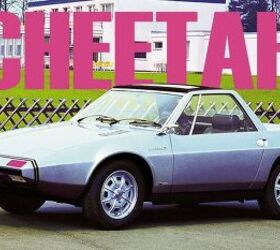
And if the name sounds exotic, don’t get too excited. This wasn’t a mid-engined predator ready to take on Ferraris. Instead, it was a 1971 Italdesign concept: a cheap, square-edged roadster built on the same humble Beetle underpinnings that had carried college students to class.
Volkswagen, together with coachbuilder Karmann, asked Giorgetto Giugiaro and his young Italdesign studio to sketch a car that could be produced inexpensively, sold globally, and perhaps give VW some credibility in a sporty segment it had never truly conquered. The result was the Cheetah, revealed at the Geneva Motor Show in 1971. It was bold, clever, and very nearly relevant—but like many prototypes of the era, it went absolutely nowhere.
Volkswagen had worked with Karmann before. The coachbuilder had been producing the Karmann Ghia since 1955, a car that wrapped Beetle underpinnings in curvaceous Italian bodywork. It wasn’t fast, but it looked sensational and gave VW a touch of glamour it otherwise lacked.
By the late 1960s, both companies were already working on what would become the Scirocco, a proper water-cooled coupe that would finally drag Volkswagen into the modern age. But the Cheetah came first.
Conceived as an economical roadster—a cheap, open-top sports car—it was meant to use the familiar 1600cc Beetle engine and chassis as its foundation. That meant a rear-mounted, air-cooled flat-four, swing-axle heritage, and mechanical components proven in millions of cars. Cheap, simple, durable, and theoretically perfect for a mass-market two-seater.
At least, that was the theory.
This was the era of Italdesign’s experiments with crisp, angular forms. Giugiaro had already shocked the world with the Alfa Romeo Iguana and was preparing the wedge-shaped Maserati Boomerang. The Cheetah carried that torch, moving away from the curvy, organic surfacing of the Karmann Ghia toward something more modern.
The sides were clean and flat, dominated by two chunky pillars that replaced a conventional roll bar. These weren’t just stylistic; they simplified the mechanism for fitting a hardtop—an ingenious solution to keep costs down while preserving safety. At the rear, the proportions remained stubby, a direct consequence of the Beetle’s mechanical layout.
This wasn’t a long-bonneted sports car like the MGB or the Triumph Spitfire. It was more compact, more practical, and very much a “people’s car gone sporty.”
Of course, design is one thing. Performance is another. And this is where the Cheetah’s claws looked a little blunt.
Underneath that striking new skin sat Volkswagen’s familiar 1.6-liter air-cooled flat-four, producing all of 50 horsepower. That’s it. Not 150. Not 100. Just 50—the same figure you’d find in a family-spec Beetle.
So no, it wasn’t exactly living up to the name “Cheetah.” Still, 50 horsepower in a lightweight roadster wasn’t entirely useless. Around town, it would have felt sprightly enough, and thanks to the Beetle’s torque-rich delivery, it may even have felt peppy in first and second gear.
But against the competition—the MGB, the Fiat 124 Spider—it was underwhelming. Those cars offered 80 to 100 horsepower, sometimes more, and they came with genuine sporting credibility baked into their image. The Cheetah, with its Beetle roots, would have struggled to convince buyers it was anything more than a dressed-up people’s car.
Even so, this car still mattered.
The real significance of the Cheetah lies not in its performance, but in its intent. Volkswagen was beginning to explore new niches, testing whether its mechanical toolkit could stretch beyond the Beetle’s utilitarian appeal. A cheap roadster made sense on paper. It could attract younger buyers, particularly in America, where European imports were thriving. It would have been inexpensive to produce, sharing parts with millions of Beetles. And it gave Italdesign another opportunity to push its design philosophy onto a global stage.
But Volkswagen’s priorities were already shifting. The company knew rear-engined cars were nearing the end of their shelf life. Water-cooled, front-engined layouts were the future, and projects like the Golf and the Scirocco were quietly moving forward.
So why invest in a Beetle-based roadster when the architecture itself was about to be abandoned?
Because of that, the Cheetah remained just that—a concept. After its Geneva appearance, it faded into obscurity, overshadowed by far more important models Volkswagen was preparing.
That said, let me know what you think of this car and its story. If you enjoyed the video, feel free to like and subscribe. And if you found it interesting, there’s a good chance you’ll enjoy some of the other videos on the channel as well.
I’ll see you in the next one. Cheers.
[Music]
Popular Products
No popular products available in this category.