Airtel Earns Nearly Twice As Much Revenue Per Gb As Jio: New Street Research
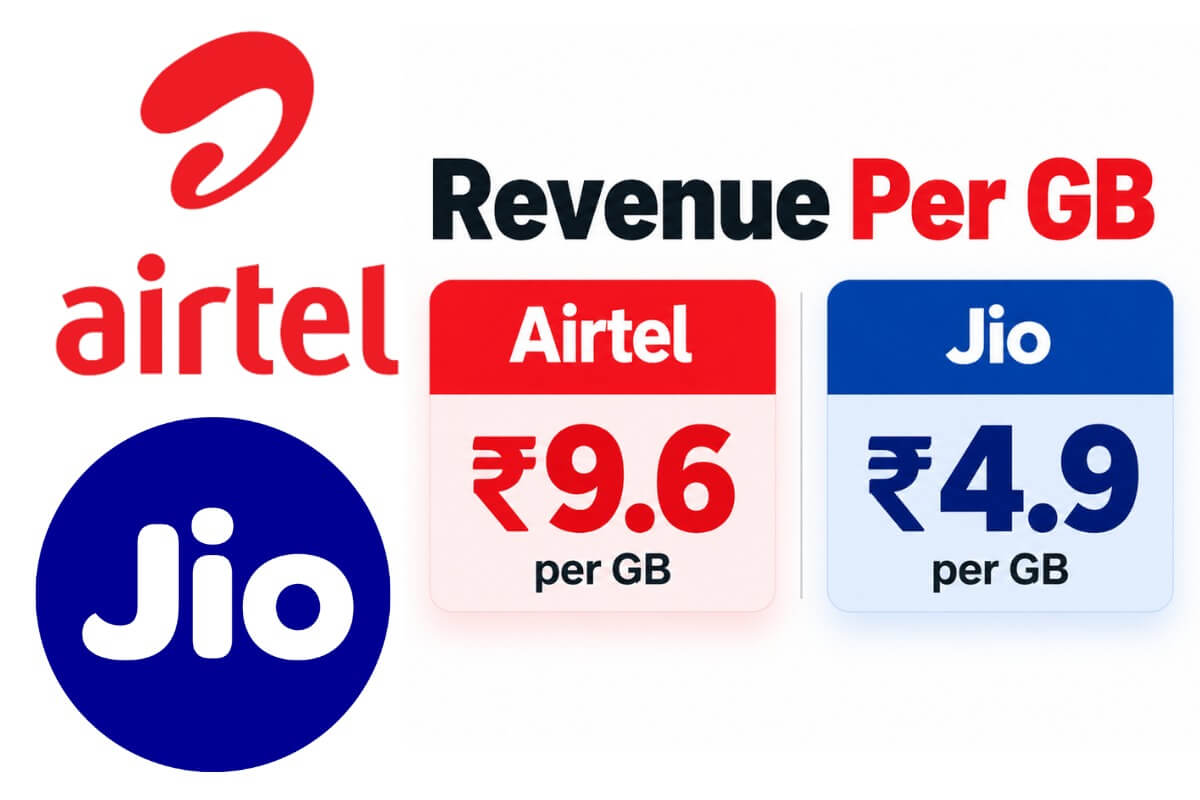
Bharti Airtel generates nearly twice as much revenue per GB of reported data traffic as Reliance Jio, according to an analysis by New Street Research. The findings highlight Airtel’s focus on premium customers, pricing discipline and monetisation, compared with Jio’s emphasis on network scale and higher data consumption.
In its October 26, 2026 report titled Bharti Airtel vs Jio: Performance and Strategy Compared, the research firm estimated Airtel’s revenue per GB at Rs 9.6, compared with Rs 4.9 for Reliance Jio.
However, the comparison uses different operating perimeters. Airtel’s calculation covers mobile services, while Jio’s includes home broadband and fixed wireless access (FWA). Revenue also includes voice and SMS services, so the figures don’t reflect mobile data prices alone.
Also Read: JioFiber vs Airtel Broadband: What Do You Get for Rs 399 and Rs 499?
Airtel’s Revenue Monetisation Advantage
According to New Street Research, Airtel generates more revenue per GB because of its premium customer positioning, higher average revenue per user (ARPU), and pricing strategy.
The report noted that the difference in monetisation has persisted despite declining data prices over the years.
Airtel has focused on extracting greater value from its existing subscriber base, rather than competing primarily on traffic volumes. This strategy has enabled the operator to maintain a higher revenue yield relative to its reported network traffic.
The research firm also highlighted Airtel’s role in industry tariff adjustments.
Airtel moved first during the November 2021 tariff increases, with Jio following within a week. During the July 2024 tariff revisions, Jio announced its increases first, followed by Airtel the next day.
Also Read: Bharti Airtel Adds YouTube Premium to Rs 200 Prepaid OTT Pack With 30GB Data
Airtel’s Premium Customer Base Supports Higher ARPU
Airtel’s premiumisation strategy is reflected in its customer mix and revenue performance.
According to the report, Airtel had approximately 30 million postpaid subscribers and 302 million smartphone customers as of June 2026, with smartphone users accounting for around 80 percent of its mobile subscriber base.
New Street Research calculated Airtel’s combined mobile and home broadband ARPU at Rs 275, compared with Jio’s reported ARPU of Rs 216.
This represents a 27 percent premium over Jio, up from about 6 percent in the April-June 2019 quarter.
For context, Airtel’s separately reported mobile ARPU stood at Rs 264 in the April-June 2026 quarter. The higher Rs 275 figure is the research firm’s combined mobile and home broadband calculation.
The widening gap reflects Airtel’s strategy of targeting higher-value customers, including postpaid and smartphone subscribers, while maintaining a focus on revenue growth.
Also Read: Airtel vs Jio: Whose YouTube Premium Plan is Better
Jio Leads in Network Traffic and Download Speeds
While Airtel has an advantage in calculated revenue per GB, Reliance Jio continues to lead in overall reported network traffic and average download speeds.
According to the report, Jio carried approximately 69 billion GB of quarterly traffic, including FWA and home broadband usage, compared with 31 billion GB of mobile traffic reported for Airtel.
These figures are not directly comparable because Airtel does not disclose home broadband traffic in the same way.
The research firm also cited Opensignal’s February 2026 measurements, which showed Jio recording average download speeds of approximately 107 Mbps, compared with Airtel’s 58 Mbps.
New Street Research attributed Jio’s network performance partly to its investments in standalone 5G infrastructure, including spectrum in the 700 MHz and 3.5 GHz bands.
The report characterized Jio’s approach as prioritizing network scale and performance, while Airtel has placed greater emphasis on capital efficiency and cash generation.
Also Read: Jio Rs 399 Plan or Rs 459 Plan, Which is Better?
Airtel Generates Higher Returns on Capital Expenditure
Beyond revenue monetisation, New Street Research highlighted Airtel’s stronger capital efficiency.
Between FY23 and FY26, every Rs 100 of capital expenditure generated about Rs 35 in additional annual EBITDA for Airtel’s mobile, home, and business operations, compared with Rs 21 for Jio, according to the research firm’s calculations.
This represents approximately 70 percent more incremental EBITDA per rupee of capital expenditure for Airtel over the measured period.
The report also found that Airtel recorded an operating free cash flow margin of approximately 36 percent in FY26, compared with 29 percent for Jio under the research firm’s comparison methodology.
Airtel’s lower capital intensity, cost controls and focus on monetisation have contributed to its stronger cash generation.
Also Read: Reliance Jio IPO Allotment: How to Check if You Got it
What This Means for India’s Telecom Sector
The findings highlight two distinct approaches adopted by India’s largest private telecom operators.
Jio continues to invest in network infrastructure, coverage, and data capacity, while Airtel focuses on premium customers, capital discipline, and higher revenue from its network.
New Street Research suggested that improved monetisation of data traffic represents a significant opportunity for Jio, which could influence future pricing decisions across the industry.
For Airtel, the analysis demonstrates the financial benefits of its premiumization strategy and focus on generating stronger returns from network investments.
Overall, New Street Research preferred Bharti Airtel over Reliance Jio, citing stronger execution, capital allocation, and cash generation, despite Jio’s advantage in network speeds and traffic volumes.
Popular Products
-
 Pet Oral Repair Toothpaste Gel
$59.56$29.78 -
 Opove M3 Pro 2 Electric Massage Gun
$901.56$450.78 -
 Portable Electric Abdominal Massager ...
$45.56$22.78 -
 Bee Venom Capsules for Joint Support ...
$43.56$21.78 -
 Ashwagandha & Black Cumin Seed Oil
$43.56$21.78