Bears Sometimes Make For Difficult Neighbors. One Expert Started A Company To Help

It’s that time of year when black bears are beefing up, often on trash, in Southern California’s foothill communities.
From fall to early winter, bears quadruple their food intake in preparation for the cooler months — bears here don’t really hibernate given our mild weather and plethora of resources, but they do slow down during the winter (as we all should). And right now, mother bears are looking to find a safe place to den and have their cubs.
Bears aren’t just roaming the roads of mountain towns either. They’re in suburban neighborhood streets along the 210 Freeway corridor — including Altadena, Sierra Madre and Monrovia — and even in Encino and Tarzana.
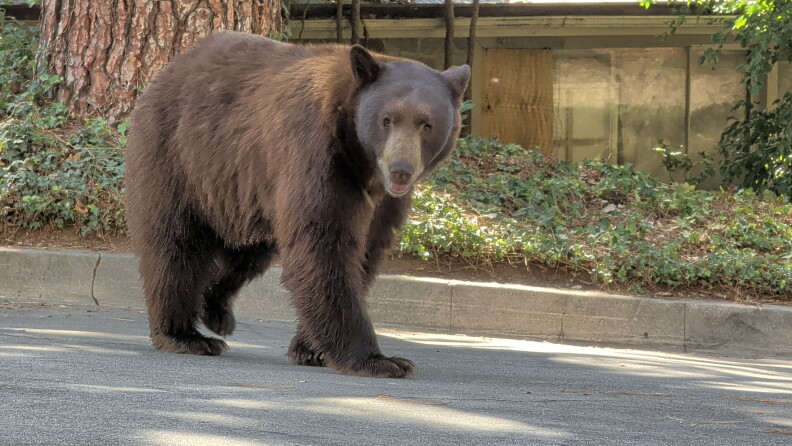
This time of year is when humans and bears might come into conflict more frequently, says a former biologist with the California Department of Fish and Wildlife.
“You're going to see those bears just eating ravenously, foraging all day for food, and then also they're going to start looking for these potential denning sites under our crawl spaces, unfortunately,” said Jessica West, a human-wildlife conflict specialist who over the last five years worked for the state on bear coexistence efforts from Santa Barbara to San Diego.
Nearly 60,000 black bears are estimated to live in California. Here in Southern California, the estimate is around 2,000, according to the latest count by the state’s Department of Fish and Wildlife.
State resources to help communities coexist with bears have been cut. That includes West, who was the sole wildlife conflict biologist serving Southern California counties. Gov. Gavin Newsom just signed a bill into law that aims to bring some of those resources back, but in the meantime, the need remains.
“More than ever, people and bears are sharing space,” West said. "The fact is that they're here and they're not going anywhere, and we're here as humans and we're not going anywhere.”
Neither did West’s passion for wildlife coexistence when she was laid off. That’s why she just launched her own business to help fill the resource gap: Wild Neighbor.
She offers detailed property assessments and recommendations for $150. She focuses primarily on prevention, such as strategically placing electric wiring and “unwelcome” mats to secure crawl spaces, trash and other vulnerable areas, which can cost $350 to around $900 depending on the home. She also rents such equipment if residents prefer. West works with manufacturers of electric bear-resistant tools that have been vetted for fire safety and bear conflict.
“What the science shows is that the most effective deterrent that we have at this point in time in our tool belt for bears is electricity,” West said. “There's really nothing like that in the wild for bears. It's a very novel stimulus for them.”If a bear has already gotten into your crawl space, West can be hired to coax it out. But if a mother bear with cubs is under the house, West won’t evict them. Instead, she’ll work with the property owner to monitor the situation until the bear family leaves.
“We really want to avoid potentially orphaning those cubs,” she said.
It’s best to avoid allowing a bear to get into your crawl space or trash in the first place, West said. When bears become too accustomed to humans and eating human food, the risk of injury to people and pets rises. And the bears themselves are more likely to be euthanized.
In 2023, California hit a tragic milestone: It was the state’s first documented killing of a human by a black bear, in Northern California. In Southern California, foothill communities such as Sierra Madre have seen several bear-related injuries in recent years (more on that in our 2024 podcast on this topic). Several bears, including a well-known one in La Cañada Flintridge, have also been euthanized in recent years.
In the vast majority of cases, this is preventable, West said, if residents take a little responsibility for securing their own properties. That can also save thousands of dollars in damage caused by a bear.
Since West is no longer with the state, she can’t trap bears that have risen to the point of becoming a problem — for example, those that learn how to regularly get into homes or cars, or have lost their fear of humans. She does encourage her clients to share sightings and any concerning conflicts with the Department of Fish and Wildlife, but she doesn’t share anything herself without clients’ permission. (Learn how to report bear sightings or human-bear conflict here.)
West said that in lieu of state resources, companies like hers may become more common.
“What [clients] can expect is someone who is going to listen to them, and someone who is passionate about their job and really wants to help them,” West said. “Because at the end of the day, I'm a bear biologist by training. I love bears, but my whole goal in all of this is to help people. Because if we help people, we're also helping bears.”
Popular Products
-
 Mommy Diaper Backpack with Stroller O...
$111.56$55.78 -
 Ai Dash Cam with Front & Rear HD, GPS...
$295.56$147.78 -
 Smart Auto-Recharge Robot Vacuum Cleaner
$613.56$306.78 -
 Wireless Health Tracker Smart Ring - R11
$131.56$65.78 -
 Electric Hair Straightener and Curlin...
$161.56$80.78