Brokers Suggest Investing In Commvault (cvlt): Read This Before Placing A Bet
The recommendations of Wall Street analysts are often relied on by investors when deciding whether to buy, sell, or hold a stock. Media reports about these brokerage-firm-employed (or sell-side) analysts changing their ratings often affect a stock's price. Do they really matter, though?
Let's take a look at what these Wall Street heavyweights have to say about Commvault Systems (CVLT) before we discuss the reliability of brokerage recommendations and how to use them to your advantage.
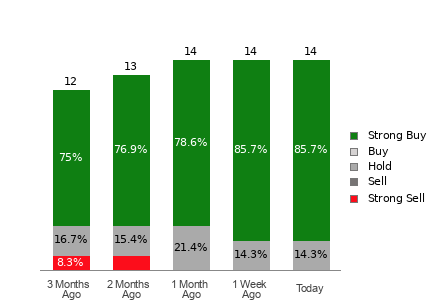
Commvault currently has an average brokerage recommendation (ABR) of 1.29, on a scale of 1 to 5 (Strong Buy to Strong Sell), calculated based on the actual recommendations (Buy, Hold, Sell, etc.) made by 14 brokerage firms. An ABR of 1.29 approximates between Strong Buy and Buy.
Of the 14 recommendations that derive the current ABR, 12 are Strong Buy, representing 85.7% of all recommendations.
Brokerage Recommendation Trends for CVLT
Check price target & stock forecast for Commvault here>>>
While the ABR calls for buying Commvault, it may not be wise to make an investment decision solely based on this information. Several studies have shown limited to no success of brokerage recommendations in guiding investors to pick stocks with the best price increase potential.
Are you wondering why? The vested interest of brokerage firms in a stock they cover often results in a strong positive bias of their analysts in rating it. Our research shows that for every "Strong Sell" recommendation, brokerage firms assign five "Strong Buy" recommendations.
This means that the interests of these institutions are not always aligned with those of retail investors, giving little insight into the direction of a stock's future price movement. It would therefore be best to use this information to validate your own analysis or a tool that has proven to be highly effective at predicting stock price movements.
With an impressive externally audited track record, our proprietary stock rating tool, the Zacks Rank, which classifies stocks into five groups, ranging from Zacks Rank #1 (Strong Buy) to Zacks Rank #5 (Strong Sell), is a reliable indicator of a stock's near-term price performance. So, validating the Zacks Rank with ABR could go a long way in making a profitable investment decision.
Zacks Rank Should Not Be Confused With ABR
In spite of the fact that Zacks Rank and ABR both appear on a scale from 1 to 5, they are two completely different measures.
The ABR is calculated solely based on brokerage recommendations and is typically displayed with decimals (example: 1.28). In contrast, the Zacks Rank is a quantitative model allowing investors to harness the power of earnings estimate revisions. It is displayed in whole numbers -- 1 to 5.
It has been and continues to be the case that analysts employed by brokerage firms are overly optimistic with their recommendations. Because of their employers' vested interests, these analysts issue more favorable ratings than their research would support, misguiding investors far more often than helping them.
In contrast, the Zacks Rank is driven by earnings estimate revisions. And near-term stock price movements are strongly correlated with trends in earnings estimate revisions, according to empirical research.
Furthermore, the different grades of the Zacks Rank are applied proportionately across all stocks for which brokerage analysts provide earnings estimates for the current year. In other words, at all times, this tool maintains a balance among the five ranks it assigns.
There is also a key difference between the ABR and Zacks Rank when it comes to freshness. When you look at the ABR, it may not be up-to-date. Nonetheless, since brokerage analysts constantly revise their earnings estimates to reflect changing business trends, and their actions get reflected in the Zacks Rank quickly enough, it is always timely in predicting future stock prices.
Should You Invest in CVLT?
In terms of earnings estimate revisions for Commvault, the Zacks Consensus Estimate for the current year has increased 24.7% over the past month to $4.19.
Analysts' growing optimism over the company's earnings prospects, as indicated by strong agreement among them in revising EPS estimates higher, could be a legitimate reason for the stock to soar in the near term.
The size of the recent change in the consensus estimate, along with three other factors related to earnings estimates, has resulted in a Zacks Rank #1 (Strong Buy) for Commvault. You can see the complete list of today's Zacks Rank #1 (Strong Buy) stocks here >>>>
Therefore, the Buy-equivalent ABR for Commvault may serve as a useful guide for investors.
5 Stocks Set to Double
Each was handpicked by a Zacks expert as the #1 favorite stock to gain +100% or more in the coming year. While not all picks can be winners, previous recommendations have soared +112%, +171%, +209% and +232%.
Most of the stocks in this report are flying under Wall Street radar, which provides a great opportunity to get in on the ground floor.
Today, See These 5 Potential Home Runs >>Want the latest recommendations from Zacks Investment Research? Today, you can download 7 Best Stocks for the Next 30 Days. Click to get this free report
CommVault Systems, Inc. (CVLT): Free Stock Analysis Report
This article originally published on Zacks Investment Research (zacks.com).
Popular Products
-
 Fake Pregnancy Test
$61.56$30.78 -
 Anti-Slip Safety Handle for Elderly S...
$57.56$28.78 -
 Toe Corrector Orthotics
$41.56$20.78 -
 Waterproof Trauma Medical First Aid Kit
$169.56$84.78 -
 Rescue Zip Stitch Kit
$109.56$54.78