How Jollibee Became Filipino Food’s Biggest Ambassador In The Us
NEW YORK, USA – When Jollibee opened the doors to its first store in Manhattan, New York City in 2018, customers arrived in droves.
They braved the rain. A few came dressed as the restaurant’s iconic red bee mascot. Others claimed to have waited in line for over 20 hours.
The Eighth Avenue location, located near Times Square, was Jollibee’s 41st store in North America, and the first of three branches in New York City.
In just six years, the homegrown Filipino fast-food chain would more than double its number of stores in North America and establish a fanbase that rivals the likes of McDonald’s and KFC.
New York City resident Daniel Kim visited Jollibee’s flagship Times Square location with his fiancée, Izzie Penn. Kim, who moved to New York from Metro Manila for school two years ago, said that he eats at Jollibee when he’s missing home and craves Filipino food.
He noted from his visits that the restaurant was usually packed with a mix of Filipino and non-Filipino customers.
“It’s the Filipino restaurant that has the most clout outside of the Philippines,” he said. “When I first came into the Jollibee, I expected all the customers to be Filipino, but I was pleasantly surprised to see that there were a lot of different people.”
The company currently operates over 100 stores in North America and plans to reach 500 stores by 2030, according to a company press release issued last year.
Its rapid expansion comes at a time of increasing interest in Filipino culture and media abroad, from tennis player Alex Eala’s historic Washington Open win, music groups Bini and SB19’s surging global popularity, and the recent ube craze.
With the Philippines in the spotlight, experts say now is the best time for Jollibee to continue to grow and serve as a cultural ambassador for the country.
“Jollibee has the momentum and the wind in its sails at this moment,” said Ty Matejowsky, a food scholar and anthropology professor at the University of Central Florida. “They’ve shown that they can go toe to toe in international markets. I really feel like they will, if not achieve the 500-store goal, then get pretty close.”
Buzzy beginnings
Jollibee was founded by current Jollibee Foods Corporation chairman Tony Tan Caktiong in 1975 as an ice-cream-selling business before morphing in 1978 into the fast-food brand it is known as today.
It has seen exponential growth over the decades, landing a spot as one of the Philippines’ top 100 corporations in 1987, debuting on the Philippine Stock Exchange in 1993, and eventually becoming the dominant fast-food chain in the country. It took its ambitions abroad and opened its first US store in Daly City, California, in 1998.
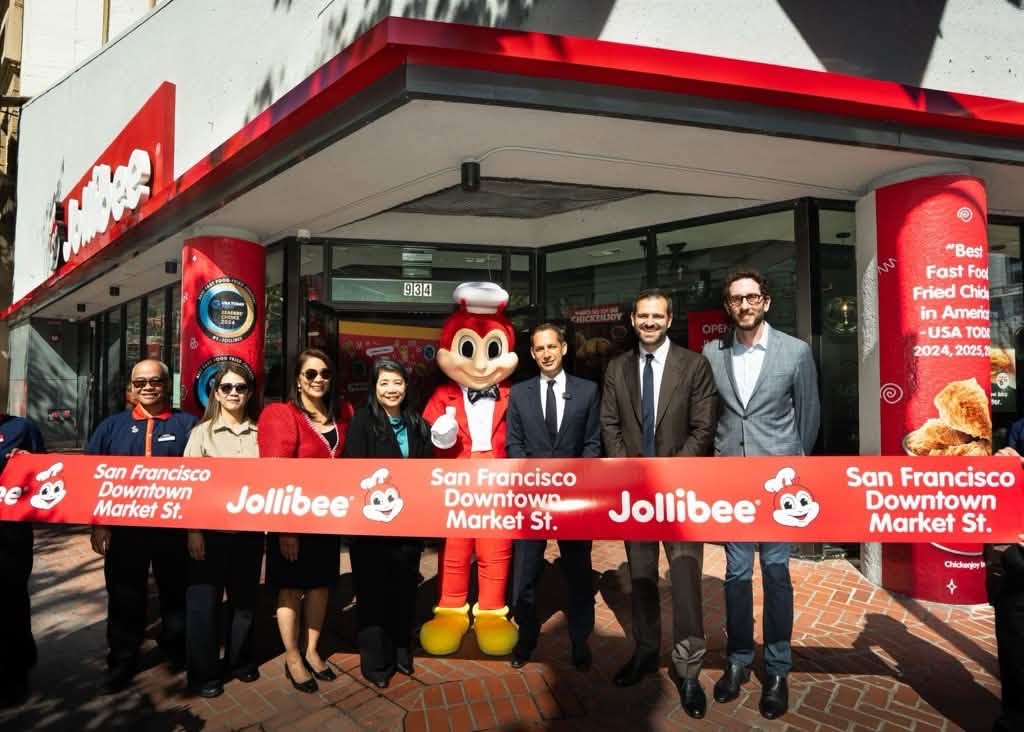
Almost 30 years later, Jollibee shows no signs of slowing down its North American expansion. On Friday, it opened its Downtown San Francisco branch — an occasion celebrated by the Philippine Consulate General in San Francisco, San Francisco Mayor Daniel Lurie, and members of the Filipino American community.
“This dynamic city is a milestone location for us as we continue to accelerate our growth across California,” said Beth de la Cruz, president of Jollibee North America, in a press release.
Matejowsky credited Jollibee’s ability to break into the American fast-food space to “diaspora marketing.” The approach involved catering to communities that had ties to the Philippines, such as those on the West Coast with a large population of Filipinos and overseas Filipino workers. As a result, Jollibee had a built-in market of customers who were already familiar with the brand and its offerings.
Catering to American tastes
Still, the company sought to broaden its appeal beyond the Filipino diaspora. Reporting by Bloomberg last year showed that 60% of Jollibee’s customers in the US are non-Filipino.
According to Matejowsky, Jollibee’s success with American customers can be partly ascribed to the popularity of its signature chicken dish, Chickenjoy.
Last month, USA Today named Jollibee the number one fast-food fried chicken for the third consecutive year. It earned this achievement through popular vote.
The company has also made efforts to win over American customers by tweaking its menu. While it kept local favorites like its peach mango pie, palabok and famously sweet-tasting Jolly Spaghetti, it also began to offer biscuits as a side at some locations.
Kim said while he wishes Jollibee’s American branches offered set meals with rice like they do in the Philippines, he thinks its dishes are still able to retain their familiar taste.
“They’ve done a good job keeping the spirit of Filipino food, while also changing to the needs of an American market,” he said. “Just look at their menu. What American hates chicken tenders? What American doesn’t like hamburgers?”
Another component in Jollibee’s recipe for success, Matejowsky said, is social media and the power of reputation.
Izzie Penn, Kim’s fiancée who hails from Texas, said that she knew of Jollibee before she even visited it through content she saw online.
“I would hear about it through YouTube sometimes. I would be like, ‘Oh, Jollibee, that’s the Filipino chicken place,’” Penn said. She also mentioned seeing videos of the mascot dancing on social media, which made the brand memorable to her.
Along with Jollibee’s outsized social media presence, Matejowsky described a strong general interest in Asian food and culture in the US as a boost to its success. He pointed to the spread of boba tea shops in the country and said he saw Jollibee’s popularity as a sign of Filipino culture getting its time in the sun.
“It feels like many of the other cuisines of Southeast Asia, like Vietnamese food and Thai food, had their moments, and it was always kind of disappointing for Filipino food not to have that,” he said. “But now I think you can readily see that it’s meeting the moment.” – Rappler.com
Erika is a Rappler intern based in the United States. She is taking up a Master’s degree in political and foreign affairs journalism at Northwestern University. She has finished internship programs at CNBC, CNN, and Capitol News Illinois, where she did articles related to business and technology.
Popular Products
-
 Classic Oversized Teddy Bear
$23.78 -
 Gem's Ballet Natural Garnet Gemstone ...
$171.56$85.78 -
 Butt Lifting Body Shaper Shorts
$95.56$47.78 -
 Slimming Waist Trainer & Thigh Trimmer
$67.56$33.78 -
 Realistic Fake Poop Prank Toys
$99.56$49.78