I Don’t Understand American Christians
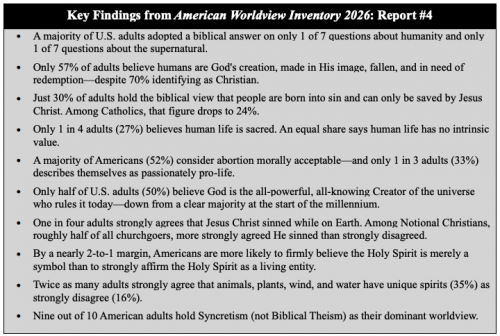
Barna has put out the results from a survey of American beliefs, and it bewilders me.
• A majority of U.S. adults adopted a biblical answer on only 1 of 7 questions about humanity and only
1 of 7 questions about the supernatural.
• Only 57% of adults believe humans are God’s creation, made in His image, fallen, and in need of
redemption—despite 70% identifying as Christian.
• Just 30% of adults hold the biblical view that people are born into sin and can only be saved by Jesus
Christ. Among Catholics, that figure drops to 24%.
• Only 1 in 4 adults (27%) believes human life is sacred. An equal share says human life has no intrinsic
value.
• A majority of Americans (52%) consider abortion morally acceptable—and only 1 in 3 adults (33%)
describes themselves as passionately pro-life.
• Only half of U.S. adults (50%) believe God is the all-powerful, all-knowing Creator of the universe
who rules it today—down from a clear majority at the start of the millennium.
• One in four adults strongly agrees that Jesus Christ sinned while on Earth. Among Notional Christians,
roughly half of all churchgoers, more strongly agreed He sinned than strongly disagreed.
• By a nearly 2-to-1 margin, Americans are more likely to firmly believe the Holy Spirit is merely a
symbol than to strongly affirm the Holy Spirit as a living entity.
• Twice as many adults strongly agree that animals, plants, wind, and water have unique spirits (35%) as
strongly disagree (16%).
• Nine out of 10 American adults hold Syncretism (not Biblical Theism) as their dominant worldview
• A majority of U.S. adults adopted a biblical answer on only 1 of 7 questions about humanity and only
1 of 7 questions about the supernatural.
What is a “biblical answer”? I don’t think there is such a thing — the Bible is a tremendous hodge-podge of archaic, conflicting, and fuzzy ideas. This is an assumption that there is a clear “biblical” position on everything, so I’m unsurprised that there is an absence of a coherent response. The survey returned results that don’t match Barna’s presupposition of what Americans should believe.
• Only 57% of adults believe humans are God’s creation, made in His image, fallen, and in need of
redemption—despite 70% identifying as Christian.
57% is still too damn high. I’m curious as to what the 43% believe.
• Just 30% of adults hold the biblical view that people are born into sin and can only be saved by Jesus
Christ. Among Catholics, that figure drops to 24%.
That’s just a fundamentally horrible belief. What is sin? What is it that a newborn is a sinner? I’m happy to see that belief is in decline.
• Only 1 in 4 adults (27%) believes human life is sacred. An equal share says human life has no intrinsic
value.
I believe that human life is valuable and should be protected, but I don’t believe in the “sacred,” so I guess I’m in the majority. A lot of people are becoming cynical if they think life has no intrinsic value.
• A majority of Americans (52%) consider abortion morally acceptable—and only 1 in 3 adults (33%)
describes themselves as passionately pro-life.
The pro-life movement has always been nothing but an ideological game that was ginned up in the 1970s. The Bible doesn’t say much of anything about abortion, and basically takes it for granted that it happens. Is this one of the things they score as a “non-biblical answer”?
• Only half of U.S. adults (50%) believe God is the all-powerful, all-knowing Creator of the universe
who rules it today—down from a clear majority at the start of the millennium.
Good. Let’s see that number continue it’s decline. The concept of an ominipotent supernatural agent is nonsensical.
• One in four adults strongly agrees that Jesus Christ sinned while on Earth. Among Notional Christians,
roughly half of all churchgoers, more strongly agreed He sinned than strongly disagreed.
I’ve never even thought about this idea! Why would anyone care about the sin-status of a rabble-rousing Jewish preacher who lived 2000 years ago? Apparently it’s a serious theological question, which is an indictment of theology.
• By a nearly 2-to-1 margin, Americans are more likely to firmly believe the Holy Spirit is merely a
symbol than to strongly affirm the Holy Spirit as a living entity.
Don’t you suspect that most people are confused about this whole business of a “holy ghost”? I know I was only exposed to the concept of the trinity as a grade school child, and found it absurd, so I’m sure theology has a more “sophisticated” muddle of excuses, but I suspect most Americans have the equivalent of my childish explanation.
To be a good Christian, must one believe in a nebulous space ghost?
• Twice as many adults strongly agree that animals, plants, wind, and water have unique spirits (35%) as
strongly disagree (16%).
“Spirits.” Stop there. When your survey is treating spirits as discrete entities that need to be evaluated, you’re lost.
• Nine out of 10 American adults hold Syncretism (not Biblical Theism) as their dominant worldview
OK, good. Ken Ham is thus rebuked.
I read the whole paper, and I’m mainly confused about why we should consider it significant that American religious belief is complicated and messy and does not conform to one particular view. There are tens of thousands of protestant denominations! I guess it’s nice that Barna is highlighting how incoherent religious belief is.
Popular Products
-
 Gas Detector Meter
$311.56$155.78 -
 Foldable Garbage Picker Grabber Tool
$93.56$46.78 -
 Portable Unisex Travel Urinal
$49.56$24.78 -
 Reusable Keychain Pepper Spray – 20ml
$21.56$10.78 -
 Camping Survival Tool Set
$41.56$20.78