Inside Tesla’s Hidden Supply Chain: How A Chinese Town Shapes The Modern World
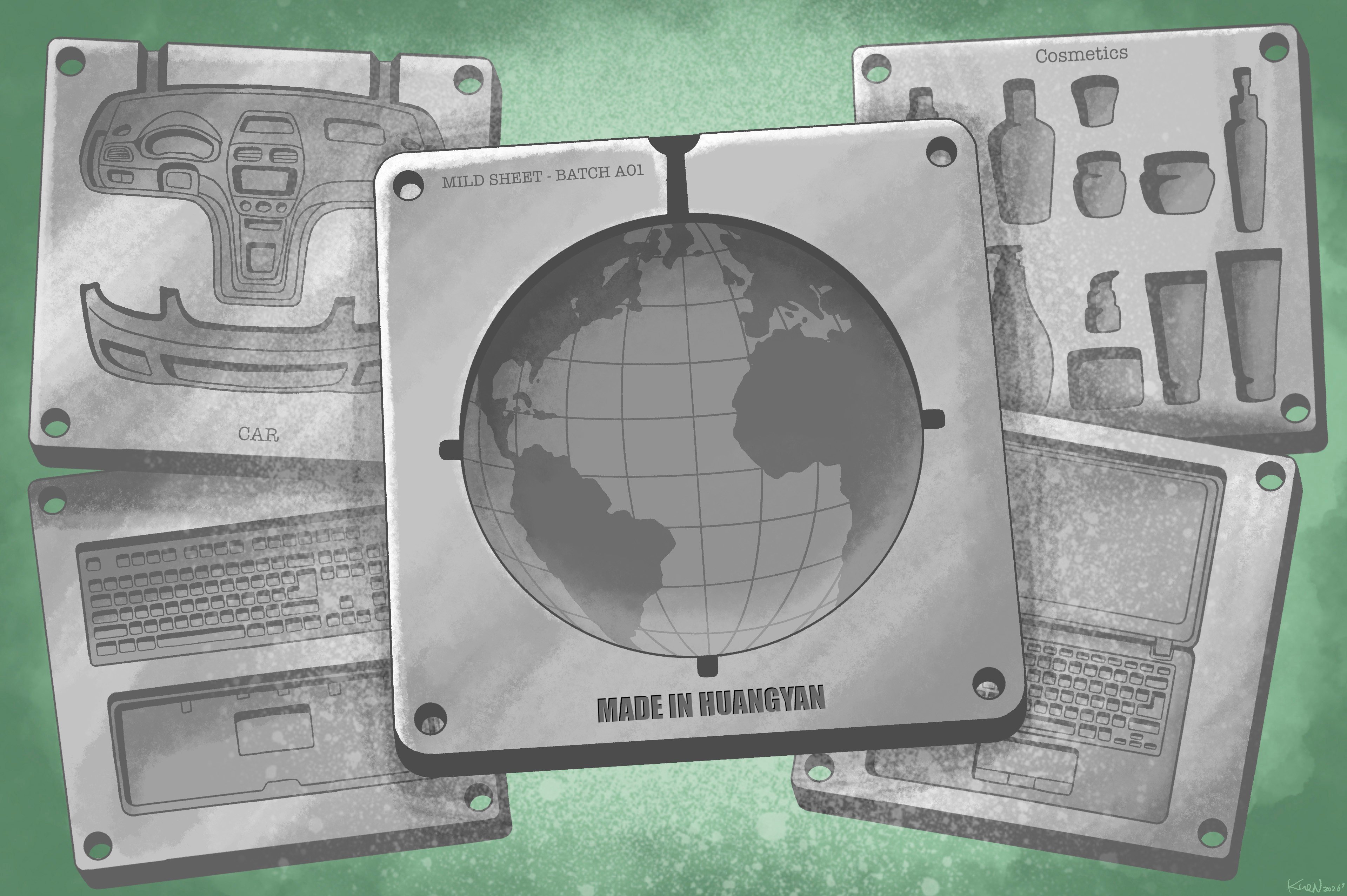
Few people have heard of Huangyan, a booming industrial district of Taizhou, a city in eastern China’s Zhejiang province. Yet without it, many cars would likely be heavier, more expensive and less energy efficient, while everyday household goods would probably cost more.
The town specialises in plastic components and moulding equipment – unassuming products that rarely make the news, but sit at the heart of modern manufacturing. For years, Huangyan’s producers have dominated this supply chain, leaving households and multinationals reliant on them.
In a world awash with plastic, the district’s importance is hard to overstate. Car interior trim, remote controls, keyboards, cosmetic packaging and many other goods are made with the versatile material. Many can be traced back to Huangyan’s factories, where resin pellets are shaped into a seemingly endless array of products.
“Without the factories here and the hidden champions of Chinese manufacturing more broadly, the world and many products that we’ve taken for granted, including Tesla cars, would be different,” said Huang Yue, secretary of the Huangyan Mould Industrial Association.
Long overlooked, the district’s manufacturers offer a snapshot of the depth and reach of Chinese industry – and, in the case of something as ubiquitous as plastic, how global consumers and companies have come to rely on the world’s second-largest economy.
But that dependence is mutual. Huangyan’s use of cutting-edge foreign equipment and technology reveals how deeply intertwined domestic and foreign players have become – and why talk of decoupling runs counter to realities on the ground.
The district’s indispensable role is especially visible in the automobile sector, one of the largest end markets for plastic moulds – identical, precise and complex parts that can be mass-produced at low cost.
Huangyan has built one of the world’s most comprehensive industrial chains for plastic injection moulding. Design, materials, precision machining and trial moulding are all clustered in a single ecosystem – invisible to consumers, yet central to China’s manufacturing prowess.
More than one-third of the moulded plastic parts in the Tesla units produced at the company’s Shanghai factory – for both the domestic market and export – were produced by suppliers in partnership with the district’s companies, Huang said.
“Their visibility may be low, since many ship products to Tesla’s first-tier suppliers rather than to the carmaker directly. But their irreplaceable role in the midstream supply chain is well known within the trade,” he said, noting that other auto giants such as Volkswagen, Ford, General Motors and Toyota share a similar degree of reliance.
Huang added that demand for plastic would only increase, as it reduces the weight of modern cars, allows for longer battery ranges and helps manufacturers meet emissions and efficiency standards.
More electric vehicles hit the road in China than petrol-powered ones at the end of 2025, according to government car registration data, while the country’s leadership role in the global auto sector’s electrification would further cement Huangyan as a crucial supplier of lightweight, customised injection-moulded parts.
Wang Ruocheng, owner of Tesla supplier Jingtian Mould Group, noted that a large share of the plastic parts in the cars assembled in Shanghai – including dashboards, consoles, door panels, bumpers, headlamp covers and battery housings – can be traced to just a handful of sources.
“[Tesla founder] Elon Musk might ultimately be worried if all the plastic and mould factories here halted production for a prolonged period of time, as the pause could ripple all the way up to affect Tesla’s operations at its Shanghai plant,” he said.
The town’s factories might even supply Tesla’s European plant near Berlin, Germany, which still imported Chinese plastic despite “localisation” efforts, Huang said. In January 2024, shipping disruptions in the Red Sea hit Chinese inputs, forcing Tesla to halt production in Germany.
Huangyan’s central role is most evident during peak production periods, such as the weeks before the Chinese New Year this February, when employees were set to leave their factories for the nine-day holiday. Many workers were asked in advance to increase efficiency and maximise output.
“The request usually comes from clients in the US anxious to ensure an uninterrupted flow of goods,” Huang said.
When the South China Morning Post visited several factories in early February, lorries were parked at factory gates, busy loading goods bound for Long Beach Port in California, the Port of New York, Tesla’s Shanghai Gigafactory and other American clients operating in China. Factory owners and customs officials said they had planned ahead to handle the pre-holiday rush and clear orders.
Qu Hongbin, former chief China economist at HSBC, said Huangyan is home to one of the world’s densest and most efficient industrial clusters.
“The strengths lie in the industrial cluster forming a tightly integrated ecosystem that pools together enterprises along the industrial chain,” Qu wrote in a note published in December.
“This ecosystem combines the niches and advantages of all members for scale, synergy and efficiency. This is a key advantage of Chinese manufacturing that is hard to find elsewhere.”
Local entrepreneurs agreed that the ecosystem would be hard to replicate. “If you have orders on hand, you can establish a mould factory here almost overnight, without worrying about talent or technology,” said Wang Jinman, president of Union Mould, a leading manufacturer.
“Here, we have a pool of technicians, complete with specialised design firms, processing services and full support – all in one ecosystem, sometimes as close as just across the street.”
In 2025, more than 4,000 businesses in Huangyan’s plastic and moulding sector employed over 100,000 people – one-seventh of the district’s population – generating output worth 30 billion yuan (US$4.4 billion), according to local government and Mould Industrial Association data. Production of plastic injection moulding, blow moulding and extrusion moulding accounted for 30 per cent, 75 per cent and 80 per cent of national output, respectively.
“In Huangyan’s ecosystem, if one factory cannot make a particular product, a referral can be made to the most competent producer next door or across the street, and sooner or later a solution can be found,” said Wang of Union Mould.
“This is how everything works … It cannot be easily copied and pasted elsewhere in China, let alone abroad, in just a year or two.”
China’s rise as a manufacturing superpower was in part made possible by overseas technology. And in Huangyan, a handful of foreign firms at the cutting edge of precision engineering play a crucial role in sustaining the town’s lead.
Local mould makers rely on premium, ultra-high-precision equipment imported from countries such as Japan, Germany, Switzerland and Austria. On a typical Huangyan factory floor, German brands like Arburg and KraussMaffei and Japanese brands like Sumitomo are common.
This reliance became clear during the coronavirus, when manufacturers scrambled to secure high-precision equipment to produce masks and other plastic medical products.
Japanese melt-blown equipment – critical for protective filters in N95 masks – was in particularly high demand. Domestic alternatives are improving, but local producers said they still cannot match the performance of certain imports.
The success of leading local companies shortlisted as China’s “little giants” – small but tech-driven manufacturers recognised by the Ministry of Industry and Information Technology for their supply chain competitiveness – likewise rests on sophisticated imported equipment.
These firms also buy special steels from Nippon Steel and Japan Steel Works for premium applications, including medical-grade and automotive-certified alloys and durable, long-life moulds.
“When the supply of this equipment from Europe and Japan is disrupted, the production of high-end plastic mouldings, an income pillar for many businesses here, may stop,” said Lin Ming, an analyst with the Huangyan Mould Industrial Park management committee.
“This is a vulnerability waiting to be addressed.”
At the same time, Lin noted that the widespread use of advanced foreign equipment shows how tightly China’s supply chains remain intertwined with foreign technology.
“It’s all about playing to each other’s strengths. For China, it’s about scale, efficiency and manufacturing capacity, while for foreign countries, it’s about China’s demand for advanced tech and stable goods supplies from China,” Lin said.
“When modest pieces of plastic from Huangyan are indeed a product of globalisation, decoupling is not realistic.”
Popular Products
-
 Orthopedic Shock Pads For Arch Support
$71.56$35.78 -
 Remote Control Fart Machine
$80.80$40.78 -
 Adjustable Pet Safety Car Seat Belt
$57.56$28.78 -
 Adjustable Dog Nail File Board
$179.56$89.78 -
 Bloody Zombie Latex Mask For Halloween
$123.56$61.78