One Token, Any Chain: How We Became The First Self-custodial Crypto Wallet To Collapse Blockchain…

One token, any chain: How we collapsed blockchain networks into a unified crypto wallet UI
— This case-study is for 2024 —
A deep-dive case study on eliminating multi-chain cognitive load and why progressive disclosure, not simplification, is the real answer.
The Problem Nobody Talks About
Open any major self-custodial crypto wallet today. Look at your USDT balance. Depending on your wallet, you might see: USDT (ERC-20), USDT (BSC), USDT (Arbitrum), USDT (Avalanche), USDT (Polygon)...????
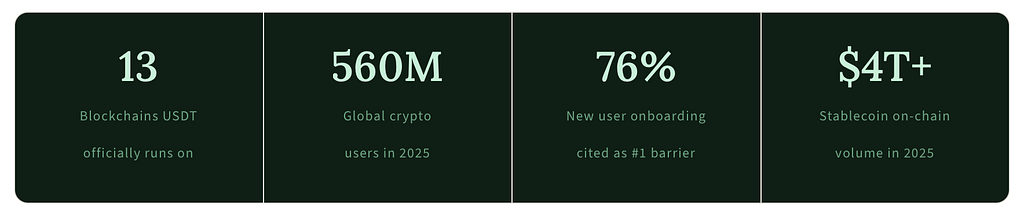
Six line items! Same dollar-pegged token. Different labels, different network icons, different balances, different fee structures. If you’re a developer who lives on crypto Twitter, you parse this in under a second. If you’re one of the 560 million people who own crypto in 2025 but aren’t deeply technical; you are confused, frustrated, and likely about to make a mistake.
ℹ️ The core tension: Blockchain’s technical reality requires tokens to exist on multiple networks simultaneously. But users don’t think in networks. They think in tokens. “I have USDT.” Not “I have USDT on BSC plus some USDT on Ethereum plus some USDT on Arbitrum.”
This disconnect is not a minor UX footnote. It is the single largest preventable source of user error, transaction failure, and wallet abandonment in the self-custodial space. And until now, no self-custodial wallet had solved it at the UI layer.
“A survey found that more than three-quarters of respondents identified new user onboarding as the primary obstacle to adoption.”
???? What the Research Says?
THE EVIDENCE IS OVERWHELMING
Academic research has been ringing this alarm for years. A 2020 study published in the proceedings of the International Conference on Cyber Security and Computer Science examined usability issues across five major cryptocurrency wallets using cognitive walk-through methodology.
The findings were damning: both mobile and desktop wallets “lack good usability in performing fundamental tasks.” A follow-up finding noted that 22% of participants had lost money due to security breaches or self-induced errors meaning they made mistakes the UI failed to prevent.
“The cognitive complexity of using cryptocurrency applications for beginners represents a significant barrier. Many users, especially novices, struggle with understanding the basic concepts of blockchain and cryptocurrencies — leading to difficulty in managing wallets and lack of understanding of transaction mechanisms.”
SCIENTIFIC RESEARCH JOURNAL (SCIRJ), VOLUME XII, AUGUST 2024
The multi-chain problem specifically compounds this cognitive load in a unique way. Unlike single-chain crypto wallets, which merely require users to understand one network’s fee structure and confirmation times, multi-chain wallets introduce an entire taxonomy of parallel token versions. In 2025, USDT alone officially runs on 13 blockchains including Ethereum, Tron, Solana, Avalanche, Polygon, Arbitrum, and others.
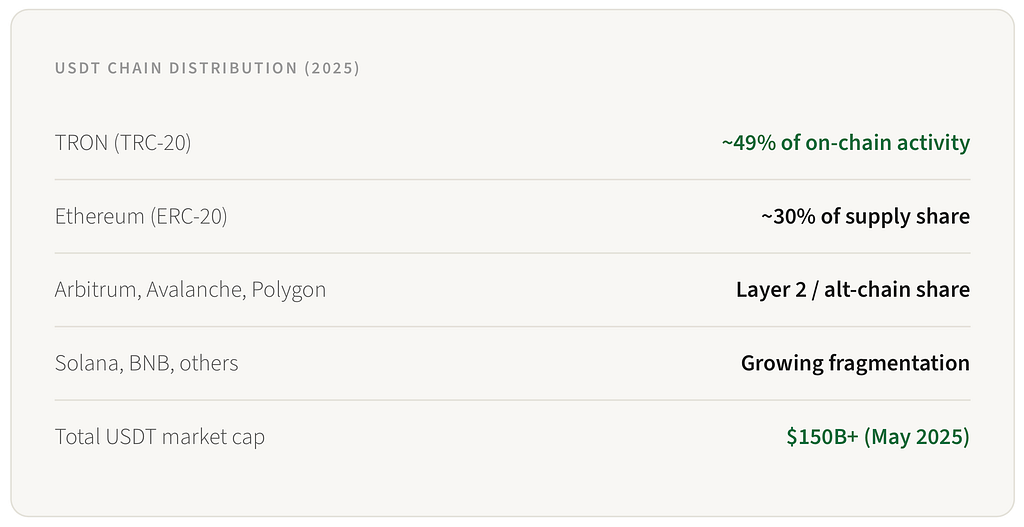
What does this mean for a user? It means that even for a single token (the most-used, most-liquid stablecoin in the world) their balance is effectively fragmented across up to 13 distinct ledgers, each with different gas tokens, confirmation speeds, and bridging requirements. Sending USDT from the wrong network to an exchange that only accepts TRC-20 is one of the most common and costly mistakes in crypto.
Why Existing Wallets Make It Worse
The prevailing design philosophy across self-custodial wallets has been to expose chain information as a transparency feature.
The assumption: informed users make better decisions.
The result: new users are confronted with interface complexity they’re not equipped to parse.
Common wallet UX patterns that perpetuate the problem:
- ⚠️ Network-first display: showing “Ethereum Network” or “Tron Network” as the primary organizational layer, requiring users to mentally map networks to tokens
- ⚠️Per-chain token balances : listing USDT (ERC-20) and USDT (TRC-20) as separate line items with separate balances users must mentally aggregate
- ⚠️Manual network selection for sends: forcing the user to know and choose which network version of a token to send before the transaction
- ⚠️No smart routing: even advanced wallets that show a unified balance often still require manual chain selection in the send flow
- ⚠️Inconsistent terminology: “Network,” “Chain,” “Protocol,” and “Version” used interchangeably with no guidance
“Users interact across Ethereum, Solana, and dozens of other chains each with different rules and token standards. Switching networks confuses even experienced users. This is where chain-agnostic UX comes in handy the goal is to let users interact seamlessly:
They shouldn’t need to know which chain they’re on to get value.”
PURRWEB UX RESEARCH, 2025
The field broadly acknowledges the problem. What it has lacked is a working implementation especially for self-custodial wallets, where no intermediary can silently handle network routing without the user’s knowledge. Building this in a non-custodial context is the genuine hard part.
Our Solution: Chain-Collapsed UI
We built what we’re calling a chain-collapsed interface a UI paradigm where blockchain networks are merged at the display layer while remaining fully accessible (and non-custodially controlled) at the interaction layer.
The principle is simple to state and genuinely difficult to execute: users see tokens, not chains.
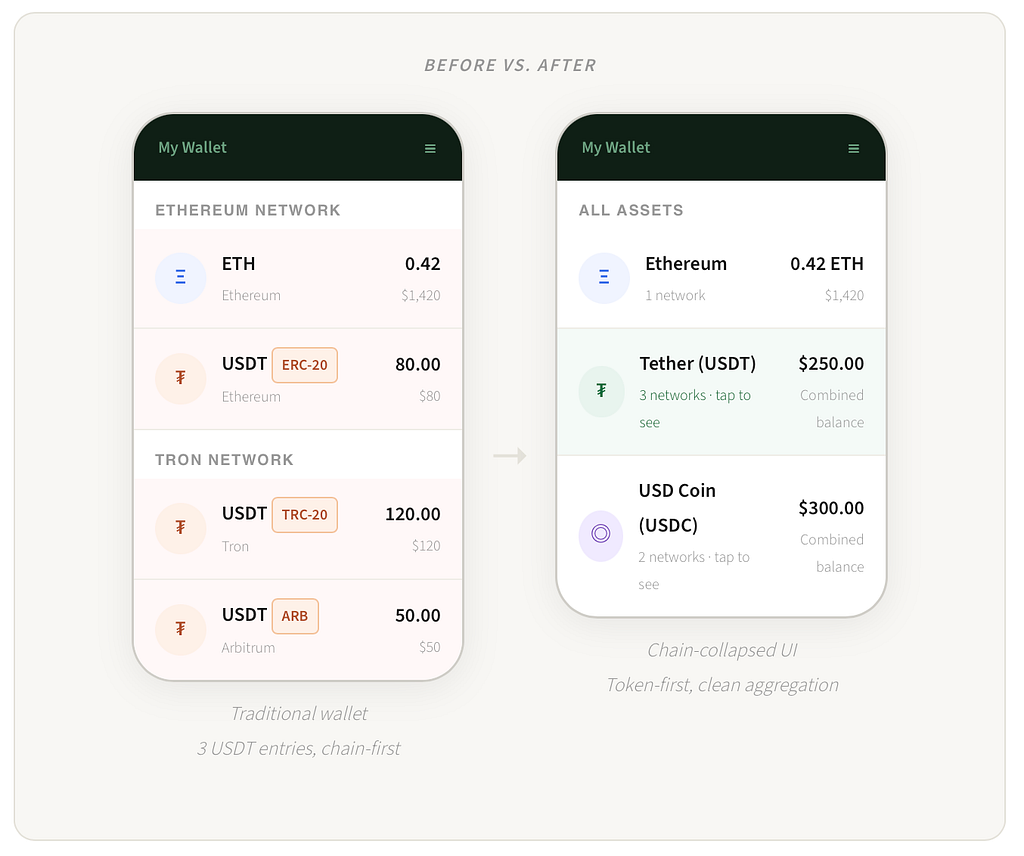
In our wallet’s home screen and throughout the application, all networks for each token are merged into a single line item. A user with USDT on Ethereum, USDT on Tron, and USDT on Arbitrum sees one entry: Tether (USDT) $250.00. A subtle secondary label indicates how many networks are involved, available to expand but never pushed into the primary reading experience.
This is not a simplification that sacrifices correctness. The underlying data — which network holds which amount — is fully preserved and accessible. What changes is the hierarchy of information presentation.
How Progressive Disclosure Makes It Safe
The critical design question for a self-custodial wallet is: how do you simplify the surface without removing user control? Custodial products can silently route transactions because they hold the keys.
We don’t. Every transaction must be explicitly signed by the user’s private keys, which means the user must always know — at some level — which network they’re transacting on.
Our answer is progressive disclosure through a two-layer architecture.

Here’s how the send flow works in practice:
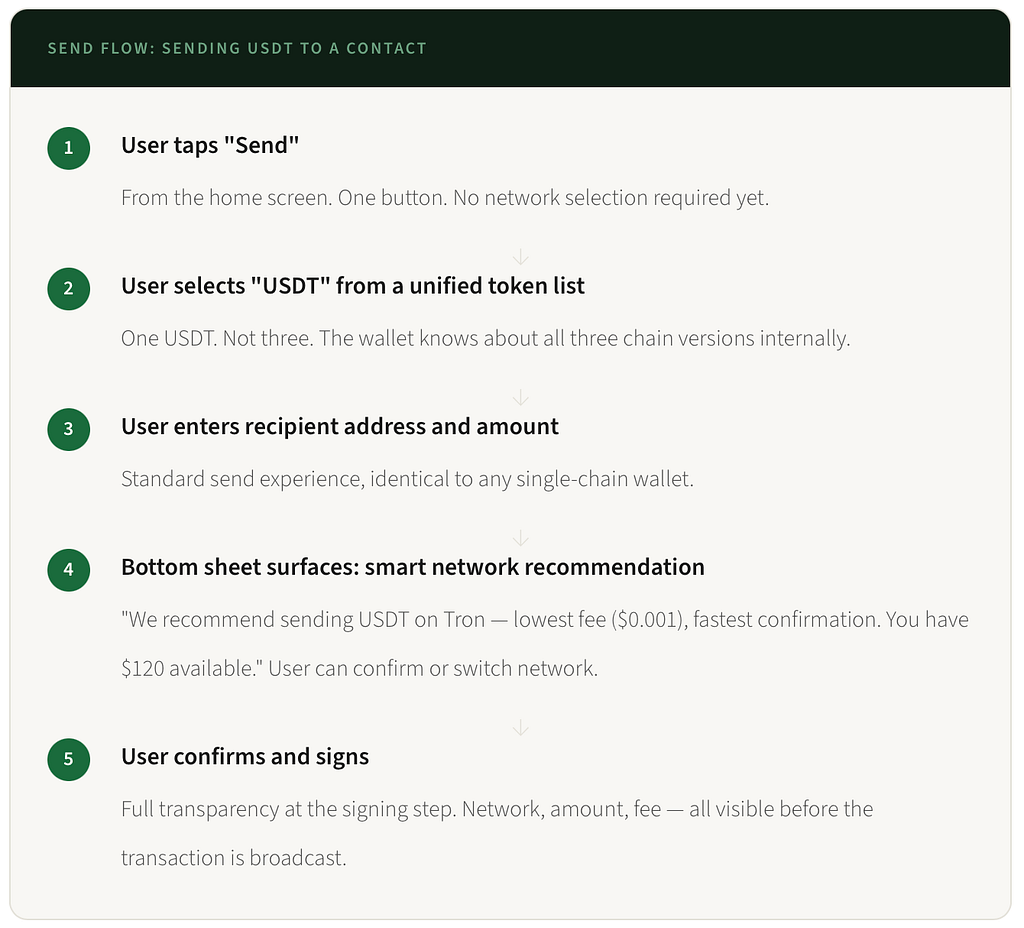
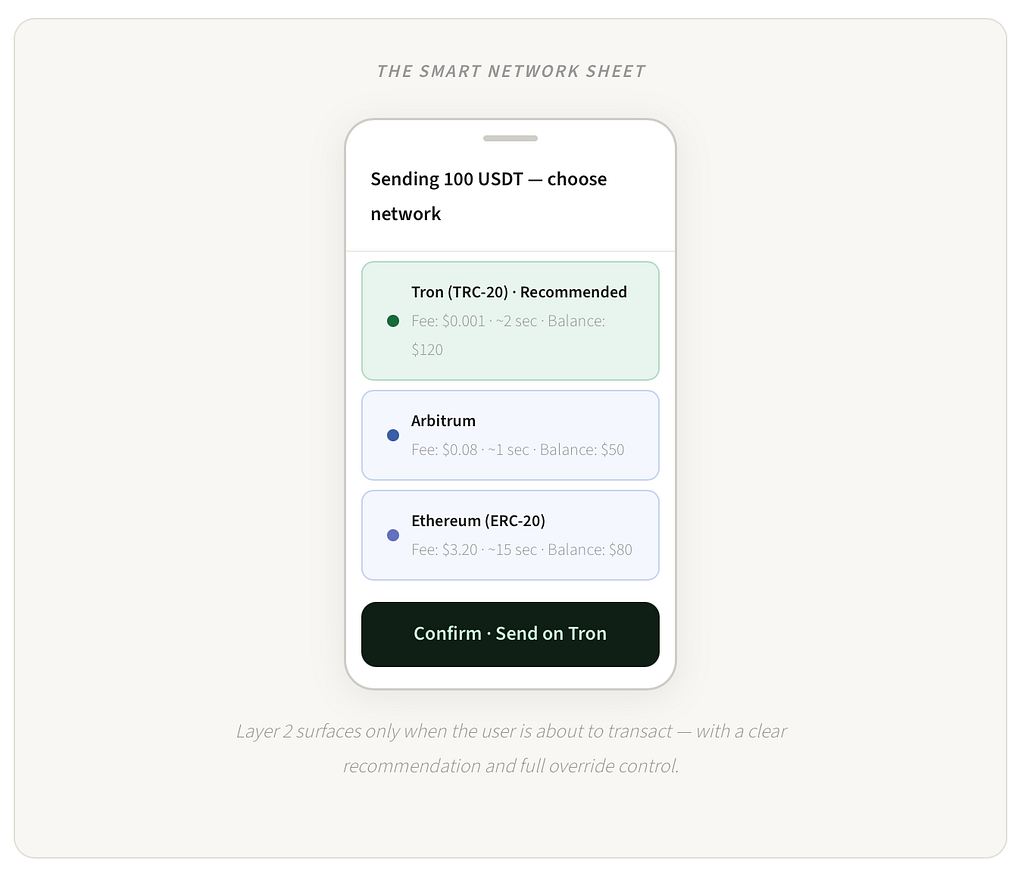
This architecture preserves a core truth of self-custody: the user always controls their keys and their network choice. We’ve simply reorganized when that choice appears pushing it to the moment it’s actually needed, not as a first screen that must be navigated before the user can even articulate their intent.
“Placing frequently used functions on the main screen and designing and arranging buttons and links intuitively can help users find what they need quickly and effortlessly — designing an experience-based rather than function-based information architecture.”
INSPIRE X, MEDIUM · THREE CHALLENGES IN CRYPTO WALLET UX DESIGN
The Swap Experience
The same chain-collapse architecture extends naturally to token swaps and in some ways, the benefit is even more pronounced there. In a traditional multi-chain wallet, swapping USDT for ETH requires the user to first decide: Which USDT am I swapping? Which network is the destination ETH on? Does this require a bridge or an on-chain swap?
In our implementation, the swap screen presents tokens — not chain-specific token instances. The user selects “USDT → ETH.” In the background, the wallet evaluates available liquidity, bridge routes, and gas costs across all chains where the user holds either token. A smart routing engine selects the optimal path. The bottom sheet — identical in structure to the send flow — surfaces the recommended route with transparent fee breakdown before the user confirms.
ℹ️ What this unlocks: Users who would previously have abandoned a swap — confused about whether to bridge first, or which version of a token to use — now complete the transaction. The intelligence is in the product, not in the user’s head. That’s the right allocation of cognitive labor in 2025.
The result is a swap experience that feels closer to Venmo than to a DeFi dashboard while remaining fully non-custodial at every step.
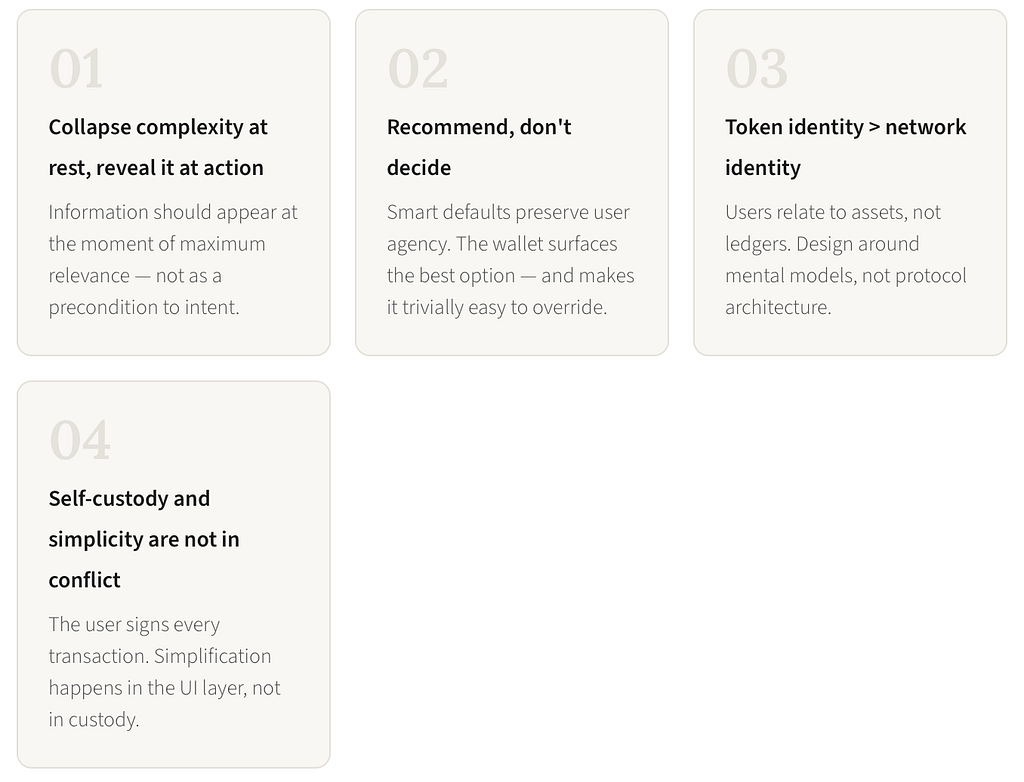
Design Principles We Derived
What We Learned
The most counterintuitive finding: simplifying the interface actually increased user trust, not reduced it. When users could see a single, coherent USDT balance — one number they recognized as “their USDT” — they felt more confident about their holdings. The fragmented multi-entry view had paradoxically made them feel like something was missing, or that their funds were somehow less real because they were spread across unfamiliar network labels.
The bottom-sheet recommendation layer was initially a concern internally would users feel railroaded into a network choice they didn’t make consciously? In practice, the reverse was true. Because the sheet surfaced the recommendation transparently, with clear rationale (fee, speed, available balance), users who did want to override felt equipped to do so. The choice became legible, not invisible.
What makes this genuinely new isn’t the concept of chain-agnostic UX that’s been discussed in the industry for years. What’s new is implementing it in a self-custodial product where every technical constraint of non-custodial key management must be respected. Custodial exchanges have always been able to abstract away chain complexity because they control the routing. Doing it without custody requires a fundamentally different architecture and a willingness to put the complexity in the product, not in the user.
“If Web3 is to grow, it must hide the complexity. The next wave of Web3 growth won’t be driven by faster blockchains or shinier tokens alone. It will come from apps that feel effortless, trustworthy, and intuitive.”
LCX · BLOCKCHAIN UX: WHY USER EXPERIENCE WILL MAKE OR BREAK WEB3 ADOPTION, 2025
Crypto adoption grew 33% year-over-year between 2023 and 2024, reaching 560 million users globally. Stablecoin transaction volume hit $4 trillion in the first half of 2025 alone. The infrastructure is mature. The demand is real. The remaining barrier is the experience and chain complexity is the most preventable piece of it.
We didn’t invent the principle of progressive disclosure. Jakob Nielsen described it in 1990. What we did was apply it, faithfully and completely, to the hardest UX problem in self-custodial crypto: the multi-chain wallet. And we did it without taking custody of a single satoshi.
Decentralization is a property of the protocol, not a requirement of the interface. Users deserve both.
About Me
I’m Mostafa Esmaeili, a Product Design Director specializing in fintech, Web3, and decentralized applications.
I share insights on product strategy, UX design, and emerging technologies.
Let’s connect: Linkedin | X | Portfolio
- Case study: Mobillet, Personal Financial Management Feature
- Designing for Fintech: From Usability to Business Goals
- Scaling Small: Effective Design Team Management and Task Distribution
FURTHER REFERENCES
→ Progressive disclosure — Nielsen Norman Group
→ Tether transparency report — tether.to
→ 2024 global crypto adoption index — Chainalysis
→ Crypto wallet UX: three key challenges — Purrweb
→ ERC-20 token standard — ethereum.org
→ Stablecoin market data — CoinGecko
→ How swaps work across chains — Uniswap docs
→ The state of crypto UX in 2024 — Law of the Level
……
???? Stay inspired every day with Muzli!
Follow us for a daily stream of design, creativity, and innovation.
Linkedin | Instagram | Twitter


One Token, Any Chain: How We Became the First Self-Custodial Crypto Wallet to Collapse Blockchain… was originally published in Muzli - Design Inspiration on Medium, where people are continuing the conversation by highlighting and responding to this story.
Popular Products
-
 Fake Pregnancy Test
$61.56$30.78 -
 Anti-Slip Safety Handle for Elderly S...
$57.56$28.78 -
 Toe Corrector Orthotics
$41.56$20.78 -
 Waterproof Trauma Medical First Aid Kit
$169.56$84.78 -
 Rescue Zip Stitch Kit
$109.56$54.78