Rainbows In Revolt On A Mission To Make Lgbtq Artists’ Voices Heard
Last month’s Pride celebration in D.C. was so fun. Walking around my first Capital Pride with a $15 lemonade I was loving the madness and the color. Artists and small businesses battling banks you’ve never heard of collecting your personal information so you can spin a wheel to snag free merch. Great music blaring, people actually smiling and enjoying themselves, the “Great” American State Fair could never!
The Monument Stage was on Pennsylvania Avenue, directly in front of the National Gallery of Art and I can’t think of a better venue to see live music. How does someone get on the lineup for Pride? How do we accelerate the visibility of the most talented voices in our community to perform in places like this?
There is certainly not a talent gap, but there is a visibility gap. Chappell Roan went from playing for two people in a parking lot to owning the main stage at Coachella in one year. Whether it is shadowbanning or bias in AI, algorithms have been shown to suppress queer artists. In a digital age, how can queer people break through and show the world how talented they are?
Allison and Matt of Rainbows in Revolt are on a mission to make openly LGBTQ+ artists’ voices heard. Their goal is to find “musicians whose queerness is central to their identity as an artist,” and accelerate them to a place where they can actually reach fans.
The only time queer events seem to be in the spotlight is June, but this should be year round, according to Allison and Matt. Rainbows in Revolt wants to act as a “nucleus” for different sub-communities, finding common ground in the universal language of music.
Matt and Allison founded Rainbows as a way to make cheaper, higher quality merchandise for queer artists. While Rainbows has already pledged 20% of their profits to the LGBTQ+ community, with 10% to Whitman-Walker Health and 10% to LGBTQ+ organizations in need, this is just the beginning of the work that they do.
Rainbows “does the dirty work” that artists normally struggle to do on their own with limited resources. Interviews, artist profiles, social promotion, playlist discovery, radio outreach, and merch-funded support. This work is normally expensive, time consuming, and requires lots of different skills. Musicians don’t want to be editing clips to post online. Standup comedians don’t want to make graphics for their tour dates. They want to write more. They want to focus on their craft.
In addition to helping artists find their audience, Rainbows has built other digital tools to help queer people connect, including an interactive Safe Space Map for most major cities. It is hard to know which places are truly safe and supportive just from a simple Google search. Attitudes and actions change, and there should be a simple way for queer people to find other places that align with them. The Safe Spaces Maps are all up to date, and are tagged and filterable. Instead of relying on forums and word of mouth, Rainbows has created a centralized way to find authentic community quickly.
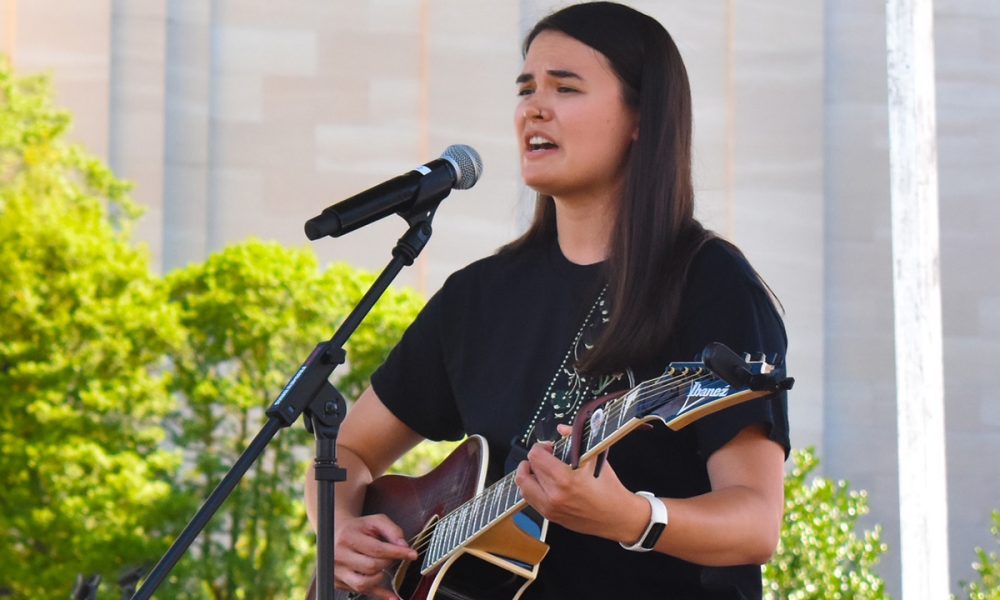
I had a chance to talk with Allison and Matt at Pride where Lily Erin, one of their signature artists, was performing on the Monument stage. Lily Erin is a folk singer who is familiar and forging her own path. Her bittersweet sound echoes through Acadia, and her garb mirrors the New England athletes I grew up with. Gorp Core meets streetwear. A graphic tee, hiking shorts, and creamsicle Jordans.
Her debut single, “Bus Stop,” tells a sad story about unconditional love, and the conditions that still seem to come with it. Graduating into lockdown, Erin needed a new way to connect with herself and others. Lily made “Bus Stop” without an intention to share it, but doing so was a liberation. People have been responding to her honesty around queer-ness, family, and the “ghosts which haunt us” even in the daytime.
Rainbows in Revolt has helped Lily Erin go from bars and backyards to The Monument Stage at Pride. This is a meteoric rise, and a testament to both Erin’s talent and the work of Rainbows to promote her. “A little encouragement goes a long way with early artists,” and by “planting a seed” Rainbows is already seeing their artist garden grow. Community is power, and Erin is a perfect example of how effective simple modern techniques of promotion can be.
A next step for Rainbows is putting on shows themselves. On Oct. 3, Rainbows in Revolt will host an Evening with Ray Boltz at the National City Christian Church. Boltz grew up in the Catholic Church and for many years was the soundtrack to many services, youth camps, and church groups. He was celebrated by millions until he came out in 2008. Allison remembers her community “never playing his music again.”
Rainbows in Revolt is helping him to return to the church, and proving that identity does not need to be exclusive. We live in a complicated world with complicated lines being drawn. Boltz proves that these lines don’t exist, and will be breaking down barriers to bring together communities. To Allison, “a trans woman standing next to a straight white man in church is a powerful teacher.”
The Safe Space maps bridge all types of spaces, and one of the unlikely ones is, perhaps, churches. Matt said that “BYU has only nine safe spaces around their campus and seven of them are churches.” Not all churches are anti-gay, and many times they are the only place for people to find community.
Rainbows in Revolt is just getting started bridging gaps and building community.
The post Rainbows in Revolt on a mission to make LGBTQ artists’ voices heard appeared first on Washington Blade: LGBTQ News, Politics, LGBTQ Rights, Gay News.
Popular Products
-
 Classic Oversized Teddy Bear
$23.78 -
 Gem's Ballet Natural Garnet Gemstone ...
$171.56$85.78 -
 Butt Lifting Body Shaper Shorts
$95.56$47.78 -
 Slimming Waist Trainer & Thigh Trimmer
$67.56$33.78 -
 Realistic Fake Poop Prank Toys
$99.56$49.78