Real Cities Have Bodegas
There are four things that define a great city. (1) It doesn’t require a car for mobility. (2) It’s a microcosm of the whole world (some neighborhoods or businesses are Latino, some Black, some Jewish, Arab, Polish, Chinese, and so on). (3) It has lots of parks. And (4) it provides a public kitchen for all classes. by Charles Mudede
Illustrations by Carlos Roqués
There are four things that define a great city. (1) It doesn’t require a car for mobility. (2) It’s a microcosm of the whole world (some neighborhoods or businesses are Latino, some Black, some Jewish, Arab, Polish, Chinese, and so on). (3) It has lots of parks. And (4) it provides a public kitchen for all classes.
We have cities that rise to each point in the US. New York City is one; Chicago another. But we struggle more on the West Coast. Portland would be perfect if it wasn’t wanting in the second requirement. Los Angeles has a lot to work on as regards the first requirement. Seattle is almost there with the first, struggling (thanks to gentrification) with the second, receiving excellent marks on the third. And, to the point I wish to speak to now: This city is embarrassingly weak when it comes to the fourth.
Seattle kitchens cater primarily to those with high incomes (even its dive bars demand between $15 and $20 for a hamburger, and it’s almost impossible to leave a restaurant without spending at least $100). But perhaps most importantly, you can’t have cheap food in a city without a thriving street food culture and bodegas.
Indeed, the reason why it’s cheaper to eat in New York City is because there’s a bodega or food cart practically on every corner, many of which provide excellent hot food at reasonable prices. Which means that, while in Seattle it’s hard to find a breakfast sandwich that costs below $15, in New York, you can order one in a bodega, have it made in a few minutes, and be on your way after paying around $7.
Think only of the convenience store that recently replaced Flowers Bar and Restaurant on the Ave, Flowers Market. It’s located next to a major Link station but, despite having a kitchen left by the former owner, only offers “top-tier vape and smoke essentials” and some grocery items.
This would never have happened in a city that celebrates, and enables, a quick, cheap meal. That corner should be blessed with a bodega that has practically everything you need. Hot food, cold food, booze, smokes of every kind, avocados, nail clippers, chargers for phones, perhaps some flowers.
So why does Seattle have so few bodegas?
According to King County’s public health department, the total cost for a grocer or convenience store to get a permit to sell hot food is $947 a year. They emphasized that it’s only, by their estimation, 1.2 percent of the overall startup cost for a convenience store. But even that seems to be a real barrier because the margins for bodegas are so small.
There’s a grocer on First Hill that has a respectable wine selection and an excellent premade cold Cuban sandwich, but no hot food to go. The owner told me that the city’s permits and fees for a small deli or kitchen are too expensive. I heard the same complaint from the owner of the 3rd Little Pig, a convenience store in a quiet but dense section of North Beacon Hill. If the city made permits cheaper, he says, he would sell Korean food in a minute.
The cost, it seems, is at least in part the reason that Seattle lacks corner stores that offer more than a few basic items, and the structural consequence is that our food culture is dominated by establishments devoted to people with deep pockets.
That said, there are five bodegas in Seattle that I love.
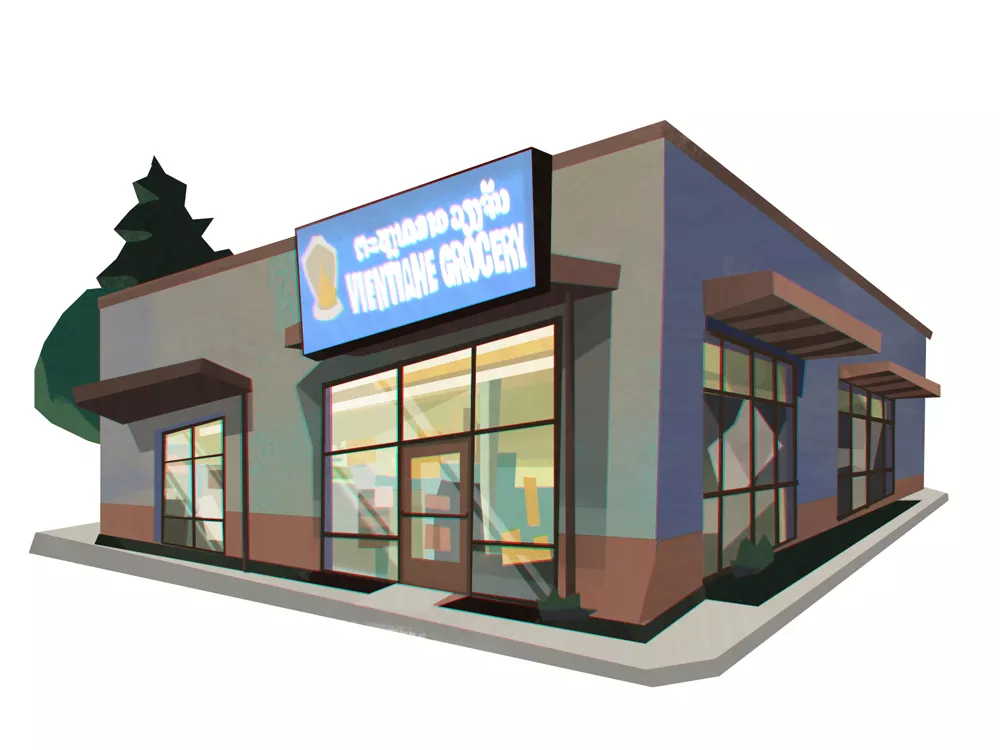
Vientiane Grocery
(3828 S Graham St)
If you live within walking distance from this Hillman City bodega, consider yourself a lucky person. It’s the real deal. You happen to live in a real city. Vientiane has a great kitchen, which is located opposite the entrance, and the food, which is Lao and Thai, is excellent and prepared in a matter of minutes. My favorite dish on the menu is the Lao Sausage, which costs $10 and is also available in the frozen meat section of the charmingly packed grocery. Vientiane also sells Kiwi knives, Dao coffee, canned sardines from Morocco, bright yellow flowers, golden statues of Buddha, a variety of Southeast Asian clothes, and small Laotian flags. The downside of this place is it closes at 6.
Gambia International Inc.
(5903 Rainier Ave S)
The minute you walk into this Rainier Avenue business, the smell of African spices overwhelms you. It’s as if you left the US by a magic door and ended up in coastal West Africa. There are so many goods in the small space that it’s hard to concentrate on one. But what you do is head to the refrigerator in the back and find cold meals prepared at another location. The best thing there is the Chicken Yassa ($12). It is just perfect and addictive. I always buy two bowls, take them home, and heat them up and, voilà, I got an authentic African meal in minutes. Every bite of this yassa recalls the words of Young Dro: “We in da city.”
45th Stop N Shop & Poke Bar
(2323 N 45th St)
One night, when I was complaining about the lack of bodegas in Seattle, the bartender at Lottie’s Lounge recommended that I visit this Stop N Shop in Wallingford. It’s a bodega that has, in the bartender’s estimate, the best poke in town. When I happened to be in that neighborhood, which, regrettably, is not near a Link station, I popped in and found a small business packed with all the basic groceries and, at the back, a poke bar with a few tables. I ordered a fish bowl ($21) and a bowl of udon ($8.99). Both were ready in a matter of minutes, but I had to take them all the way back to Columbia City, which took forever. Nevertheless, both bowls were superb, particularly the poke.
Beacon B.B.Q. Grocery Deli & Food TOGO
(4886 Beacon Ave S)
I will be honest. This place is a bit skimpy when it comes to the grocery part. Ideally, it would sell more things (combs, cellphone accessories, brooms). That said, Beacon B.B.Q. has the best roasted duck in this city. This is no exaggeration. It’s not super salty, the meat is soft and juicy. The man behind the counter chops the bird with the smoothness of that butcher in one of my favorite Chinese parables, “Cook Ding,” by the fourth century BCE philosopher Zhuang Zhou. “At every touch of his hand, every heave of his shoulder, every move of his feet, every thrust of his knee — zip, zoop! He slithered the knife along with a zing, and all was in perfect rhythm.” You can also buy good dim sum here, but if you have the time to sit and eat, I recommend visiting the Dim Sum House, which is around the corner. The dim sum there is superb.
Madrona Market and Deli
(3309 E Union St)
This is as close to a classic NYC deli as you can get. But there is one big difference: It has an excellent selection of wine and top-tier nonalcoholic spirits (Wilderton, Pathfinder). Most NYC delis sell just beer, White Claw, and Chateau Diana “wine product.” But Madrona Market does make solid sandwiches with Boar’s Head’s deli meats and cheeses—each is around $12— and little hot potato samosas and corn dogs on the side. Plus, the grocery has everything for your basic needs. Now, if we had more Madrona Markets in Seattle, then the grip of corporate supermarkets would be weakened. Imagine if there was a bodega near 23rd and Jackson. Then the recent closing of Amazon Fresh, which replaced one of Seattle’s Black institutions, Promenade Red Apple Market, would not be a disaster for ordinary people. They are now forced to take long trips for even the basics.
Popular Products
-
 Adjustable Shower Chair Seat
$107.56$53.78 -
 Adjustable Laptop Desk
$91.56$45.78 -
 Sunset Lake Landscape Canvas Print
$225.56$112.78 -
 Adjustable Plug-in LED Night Light
$61.56$30.78 -
 Portable Alloy Stringing Clamp for Ra...
$119.56$59.78