Rest In Power Dolores Huerta: La Lucha Sigue! The Fight For Equality And Dignity For Farmworkers Continues
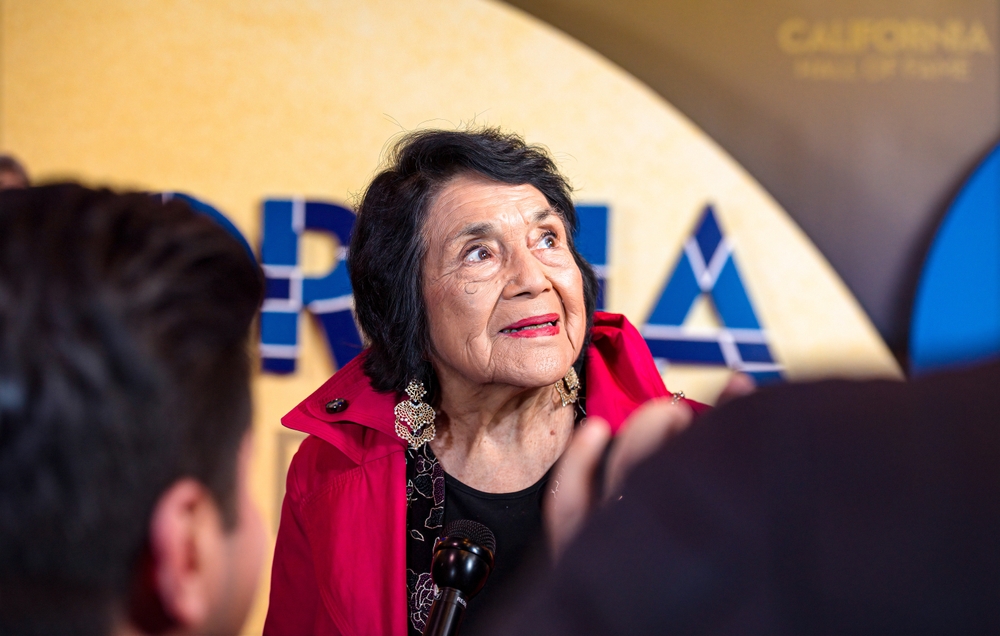
Yesterday, the world lost Dolores Huerta, a pioneering labor leader, organizer, and activist who made her mark on the world by advocating for some of poorest and most exploited workers in the United States: the farmworkers who cultivate, pick, and package the food we all eat. She continued fighting for social change until her death at age 96.
Her lasting impact on the lives of farmworkers is almost impossible to overstate. Farmworkers are notoriously some of the most difficult workers to organize because of extreme poverty and language and immigration status barriers, and because farm jobs are seasonal and unstable. Nevertheless, Huerta set out to organize them by starting the Agricultural Workers Association in 1960 and two years later co-founding the United Farm Workers Association, which became the United Farm Workers (UFW) in 1972—one of the few farmworker unions in the country. She masterminded successful strikes and boycotts against wealthy farm owners and businesses and negotiated the first-ever collective bargaining agreement with an agricultural employer, which won farmworkers long-overdue raises and newfound benefits.
Her advocacy extended far beyond the fields and negotiating rooms, helping win major policies that reshaped the legal landscape for farmworkers in California and showed the rest of the country what was possible. Perhaps the most notable is the 1975 Agricultural Labor Relations Act (ALRA), which gave farmworkers in California the right to organize and bargain collectively. The ALRA also created the Agricultural Labor Relations Board, which operates similarly to the federal National Labor Relations Board (NLRB) by conducting union elections and adjudicating unfair labor practice charges—standing in for the NLRB because farmworkers are excluded from the federal law that governs labor rights. Throughout her life, Huerta also pushed for policies that would, for example, protect farmworkers from pesticide exposure, provide disability insurance for injured farmworkers, and expand voter and language access for Latinas and Latinos.
She lobbied for months in Washington, D.C. for passage of the Immigration Reform and Control Act (IRCA) of 1986, which is perhaps one of the most impactful immigrant rights laws ever passed. Through IRCA, an estimated 2.7 million undocumented immigrants ultimately became eligible for green cards and were put on a path to citizenship, 1.1 million of whom were farmworkers eligible through IRCA’s Special Agricultural Workers program. The granting of status via IRCA had significant economic benefits for workers—including reducing poverty rates and raising wages by as much as 20%.
Huerta never got full credit for her efforts on IRCA, as the New York Times recently reported. She was sent to Florida under false pretenses so that she would not be present for a news conference to celebrate its passage, allegedly so that the male-dominated leadership at the UFW could take the credit. This exemplifies the darker side of what Huerta faced. She encountered repeated retaliation for her organizing: She was severely beaten by a police officer who left her with broken ribs and a ruptured spleen, she was arrested 22 times, and she was put under F.B.I. surveillance for alleged ties to communism.
While putting her life on the line to improve conditions for workers, she constantly faced discrimination, sexism, and abuse—including by her closest allies—and as we all sadly discovered near the end of her life, she was raped.
All of us who strive to improve conditions for workers are indebted to her for her trailblazing leadership, remarkable achievements, and many sacrifices. I’m personally grateful to her for giving me someone to look up to when I was younger. As a Mexican-American kid growing up in a small farming town in the rural California Central Valley—just 45 minutes from where Huerta grew up and began her organizing and activism—people like me had few role models who shared our background, had similar upbringings, and came from similar places.
But I sincerely hope that one of her legacies now will be to remind us all that “la lucha sigue” (the fight continues), because there is much more to do to ensure decent conditions for farmworkers. Despite the monumental strides made, farmworkers are still some of the lowest-paid workers in the U.S. labor market and the victims of rampant wage theft and other workplace violations. Farmworkers also suffer some of the highest rates of injury and death because the vast majority work in dangerous, toxic, and unsafe conditions. Well over half of farmworkers also lack full workplace rights because so many are undocumented or employed with temporary H-2A visas, which are controlled by employers. Lacking an immigration status or having a precarious, temporary status leaves farmworkers virtually powerless and fearful of retaliation. They cannot report employer abuses, join a union, or even talk with worker advocates without risking their livelihoods.
Congress has failed to protect farmworkers—excluding them from key elements of the two main federal laws governing workers’ wages, working conditions, and union rights. It’s an infuriating legacy rooted in racist policy dating back to the 1930s, when most Black workers in the South were either farmworkers or domestic workers. Huerta helped fill the gap left by Congress through winning reforms at the state level. But while California has the ALRA and a law requiring that farmworkers be paid for overtime hours, nearly all states have opted not to enact overtime pay and collective bargaining rights for farmworkers, and many exclude or limit them from coverage under minimum wage laws.
Farmworker advocacy has never been more important or more challenging, with a presidential administration hell-bent on terrorizing and impoverishing immigrants, as well as accelerating climate disasters and new disease outbreaks like COVID-19 and avian influenza that impact farmworkers first. There are too few influential voices out there fighting to protect farmworkers’ rights. The world now has one fewer, and she will be missed.
Popular Products
-
 Gas Detector Meter
$311.56$155.78 -
 Foldable Garbage Picker Grabber Tool
$93.56$46.78 -
 Portable Unisex Travel Urinal
$49.56$24.78 -
 Reusable Keychain Pepper Spray – 20ml
$21.56$10.78 -
 Camping Survival Tool Set
$41.56$20.78