South Africans Are Leaving The Electricity Network – But Are Solar Mini-grids A Fair Solution?
South Africa’s electricity system is changing. After years of blackouts until 2024, the state-owned energy company Eskom is being unbundled into smaller companies, and the sector is increasingly open to private investment.
Households, businesses and municipalities are finding ways to rely less on the national grid and switch to renewable energy – a process known as off-gridding.
Meanwhile, South Africa has raised US$13.7 billion to move away from coal-fired electricity (to be spent on renewable energy projects).
But urban households that have never been connected to the national grid (such as shack settlements) are largely absent from these plans. This creates a policy blind spot where solar mini-grids could play a critical role.
I’m writing a PhD on off-gridding and what it means for higher- and lower-income households in South African cities. I interviewed local government officials in Cape Town and Johannesburg, private sector energy generators and distributors, and households across income groups in both cities to find out how the energy transition is happening at different scales.
My research found that decentralised energy transitions, away from a central provider like Eskom to smaller suppliers, do not automatically lead to just outcomes. Instead, they can reproduce long-standing inequalities embedded in cities, infrastructure and governance – because some can leave the grid and switch to green energy and others cannot afford to.
What is off-gridding?
Going “off-grid” is often imagined as a single act: cutting ties with the electricity network and becoming self-sufficient. In practice, it is a range of practices that sit alongside – and interact with – the grid. In my research, I describe these as secession, marginalisation and supplementation.
Secession (a complete break) happens when households and businesses install solar systems, equipped with batteries, allowing them to leave the grid entirely. Secession is reserved for wealthier consumers due to high costs.
Read more: South Africans are opting to go off-grid: how they’re being helped, and hindered, in their efforts
Supplementation is where households are connected to the grid but use alternative energy too. This can be small-scale solar, generators, or batteries. This is often incentivised by the state. The exact number of households who supplement their grid connection in South Africa is unknown as many solar home systems are unregistered.
Marginalisation is experienced by millions living in informal or shack settlements. Many of these settlements have no grid connection or if they do, their residents can’t afford electricity. These households often rely on hazardous energy sources, such as paraffin, candles, or informal (illegal) grid connections, exposing them to the risk of fires, electrocution and indoor air pollution.
Together, these forms of off-gridding show that the transition to green energy is not just technical but deeply political. Who is supported, constrained, or ignored in these transitions reveals how “the grid” itself is being reconfigured by the state, the market and urban residents.
My research looks at how solar mini-grids could include those who are marginalised from the transition.
How solar mini-grids can help
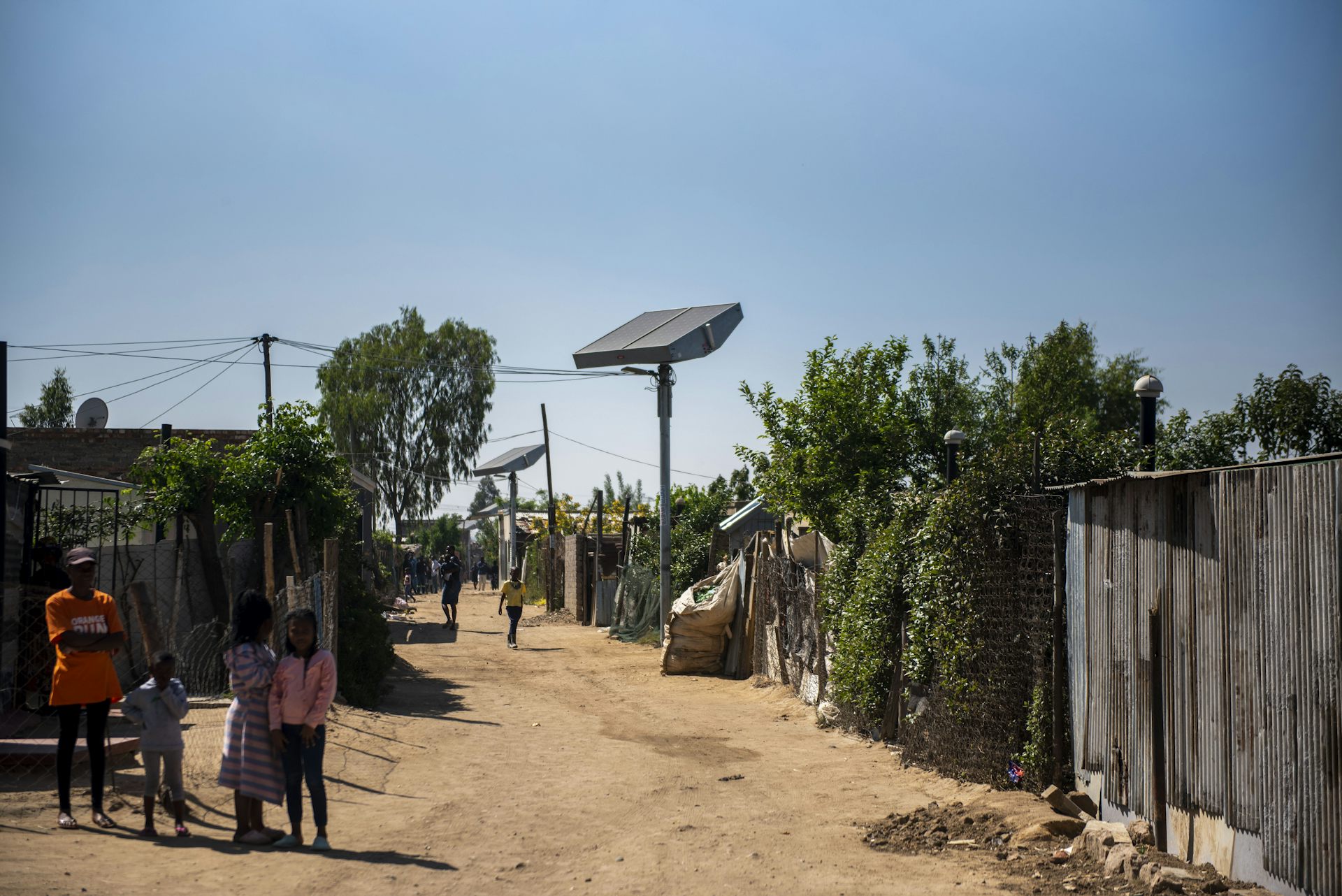
Mini-grids consist of a solar panel, connected to a battery, connected to and electrifying a small number of households in shack settlements, where the unemployment rate is high and families generally cannot afford their own solar systems.
They’re often set up by private firms and funded by university grants, aid, research agencies or private capital.
My research focused on two sites – Qandu Qandu, an informal settlement in Khayelitsha township in Cape Town, and Diepsloot, a township in Johannesburg with a significant number of informal dwellings – where solar mini-grids are provided by small businesses.
Working with local fieldworkers, I surveyed households that were connected to mini-grid infrastructure, and those that weren’t, to find out what energy sources they used, how much this cost and how interested they were in joining a mini-grid. This is information that is not routinely collected by local government.
Three findings stood out clearly:
First, mini-grids reduce risk. None of the households connected to mini-grids reported having illegal electricity connections. They also relied on fewer hazardous energy sources, such as coal or wood, than households without mini-grid access. Households without mini-grid access said they’d like to stop using these hazardous fuels if they could get connected to a mini-grid.
Second, demand for mini-grids is high. Most homes were not connected to mini-grids and 84.9% of the people I surveyed in Qandu Qandu and 74.2% in Diepsloot said they would like a connection.
Third, affordability is not the only, or the biggest, barrier. People said they were not unwilling to pay for electricity, since they already spent a significant amount on paraffin, gas, informal electricity, and other energy sources.
What needs to happen next
Mini-grids show great promise. But they operate in precarious funding and regulatory landscapes. Private providers face uncertainty over licensing, tariffs and long-term support. They also struggle to attract investment to scale or sustain operations.
One provider told me that their operations would change if they had more support through policy and regulation:
If there were a really concrete policy, a bankable policy that you know is going to exist in five, ten years’ time that you can build into your business model and you can use that to go and access financing because it’s guaranteed.
Municipalities lack clear guidance on how alternative energy provision fits within their constitutional mandate to provide basic services. A Free Basic Alternative Energy policy exists at the national level, but municipalities are often unclear on how to fund and implement it.
Regulations enabling private mini-grid providers to operate would give municipalities more options, including ways to subsidise costs through small co-payments.
Some municipalities, including the City of Johannesburg, have recently tried to connect informal or shack settlements to mini-grids. But this has not addressed the uncertainty facing private providers. As a result, the way the energy market is being opened up makes the transition fair for some and not others.
The result is that wealthier households are actively supported through incentives such as the solar tax rebate to supplement their grid connections. But people whose homes the state has failed to electrify remain excluded from solar energy because they cannot afford their own home solar systems.
If South Africa’s energy transition continues along this path, it risks becoming a two-speed system: clean, decentralised energy for some, and continued risk and exclusion for others.
Joanna Watterson has received funding from the Economic and Social Research Council, the National Research Foundation of South Africa, and the Smuts Memorial Fund.
Popular Products
-
 Orthopedic Shock Pads For Arch Support
$71.56$35.78 -
 Remote Control Fart Machine
$80.80$40.78 -
 Adjustable Pet Safety Car Seat Belt
$57.56$28.78 -
 Adjustable Dog Nail File Board
$179.56$89.78 -
 Bloody Zombie Latex Mask For Halloween
$123.56$61.78