Subpoenaing Stephen Miller Is Not How Congress Will Investigate
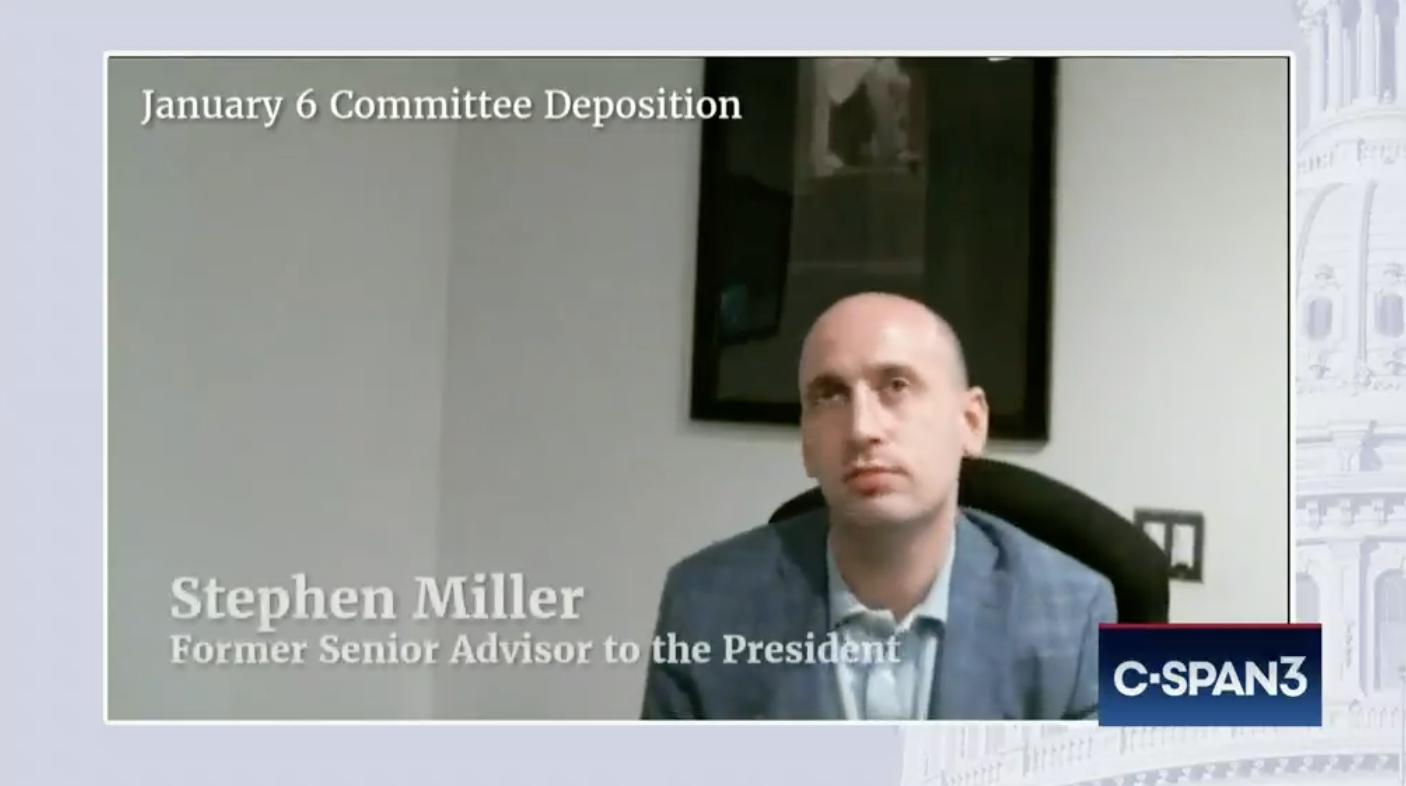
Stephen Miller will never testify before Congress — at least not in the 120th Congress that starts in January, and probably not even in the 121st, after President AOC or President Ossoff or President Kelly takes over.
That won’t prevent Democrats from investigating his crimes. It will dictate how that investigation happens.
There are a number of legal barriers that will prevent compelled testimony from top Trump aides in the short term.
First, over the years, Republicans have claimed and expanded an Absolute Immunity for senior White House officials from testifying before Congress under separation of powers. It arose out of Congress’ investigations of the US Attorney firing scandal of 2006, when Congress subpoenaed Harriet Miers (among others). The House sued to enforce that subpoena, only to have John Bates punt parts of Miers’ claim to be immune in 2008. Then in 2019, a Democratic Congress again sued to enforce a subpoena to Don McGahn related to the Mueller investigation, first prevailing, then losing, then dismissing the fight. Both of those cases ended inconclusively. But the lesson from both is that without a precedent that Congress can enforce subpoenas on senior White House officials via the courts, it would take too long to enforce a subpoena.
DOJ, including under Democratic Administrations, has adopted that view. My read of why Steve Bannon and Peter Navarro were prosecuted for blowing off January 6 Committee subepoenas and Mark Meadows and Dan Scavino did not is because Trump invoked Executive Privilege for the latter two and both made modest efforts to cooperate.
Last August, OLC tried to expand that protection to people outside of the White House, in that case to protect Boris Epshteyn from testimony in the American Bar Association’s lawsuit against Trump’s attacks on lawsuits. Hopefully, the preexisting lawsuit will jumpstart any effort from Congress to get such testimony.
Even investigating Trump’s businesses will be hampered somewhat by the SCOTUS opinion in Mazars, which mandated that a separation of powers analysis occur there, too.
The one place where investigators have had some success overcoming these privileges was in the January 6 investigation. The Committee was able to get documents from NARA first, by Joe Biden making individualized waivers of Executive Privilege, and with that, defeating Trump’s effort to kill the request at SCOTUS. DOJ was able to get testimony from senior Trump officials — including both Stephen Miller and Mark Meadows — by first subpoenaing them (this process started in June 2022, before the first public J6C hearing), then convincing Chief Judge Beryl Howell to override privilege invocations. The process took ten months total. But it relied on having someone else in the White House to waive privilege.
And the atrocity of Trump v US may also undermine Congress’ ability to conduct investigations at all, as Lawfare laid out here.
These fights need to be fought, and won. I hope Congress conducts investigations into two matters — Trump’s abuse of pardons and the impact of Trump v. US on rule of law — that might accelerate this process. But as this great discussion of Congressional oversight with Andy Wright explains, this is very time-consuming. Few of these efforts will be won in the next two years. Some of them will not be won until you fix SCOTUS.
But while those fights are going on in the background, Congress has abundant means to conduct oversight and raise the cost of what will surely be Stephen Miller’s intransigence.
The place to start is with the people who’ve been fired. I’ve been laying out how Margaret Donovan’s lawsuits on behalf of fired FBI Agents and prosecutors will provide Jamie Raskin and Sheldon Whitehouse a map for investigations into Trump’s abuse of DOJ. Mary Comans’ lawsuit to clear her name after Elon Musk fired her on false pretenses, which led to a remarkable opinion last month effectively confirming she was fired on false pretenses can jumpstart another investigation. Social Security whistleblower Charles Borges first filed a protected whistleblower complaint and then fought his termination; a televised hearing with him and other witnesses to DOGE’s invasion of Americans’ privacy will make it far harder for right wingers to protect DOGE (and Elon Musk) anymore. There are a slew of lawsuits by fired USAID workers who similarly can jump start an investigation into the crimes Trump committed.
And not everyone who was fired has sued. Whether or not someone wants to go public, they have a great deal of information about what has really happened.
There are similarly disgruntled business partners who’ve been involved in Trump’s graft. Joel Riddle, the CEO who resigned from Trump’s effort to develop Alaska’s natural gas fields out of concerns about hidden Russian involvement in the project, will likely make a spectacular witness. And given the sheer scale of Trump’s fraud on his MAGAts, some of them are likely to want to vent now too.
Two other groups who are likely to cooperate in Congressional investigations without (much) litigation are corporations that, for reasons of fiduciary duty or reputational protection, cannot afford to fight Congress’ inquiries that aggressively. That’s why, I suspect, Jamie Raskin has already alerted the law firms that capitulated to Donald Trump they will be testifying; there are entire law firms on the hook for bribery allegations! I expect Congress will make far quicker work of the DHS-related graft by investigating corporations — hopefully starting with that CoreCivic prison contract in Minnesota that proves the biggest fraud in the state is Stephen Miller — rather than subpoenaing Trump’s crooks directly. WaPo has already liberated the list of donors to Trump’s Bunker-Ballroom, which includes a number of publicly held companies. Chris Coons has already promised to scrutinize a top donor, Nvidia CEO Jensen Hwang, whom NYT and WSJ reported was targeted by a Chinese honeypot, and the Bunker-Ballroom will follow on that.
And given the electoral success of Democrats in the states, there is likely to be some productive division of labor, too. Minnesota has looked at that CoreCivic contract, too. And Texas Attorney General-elect Nathan Johnson ran on investigating the corrupt deals Texas gave Musk.
Many outlets describe the installation of Stephen Miller as Chief of Staff as a signal that Trump will play hardball on investigations. But that was always going to be true.
There are, nevertheless, such an embarrassment of threads to pull on that that won’t slow Congress down that much.
The post Subpoenaing Stephen Miller Is Not How Congress Will Investigate appeared first on emptywheel.
Popular Products
-
 Classic Oversized Teddy Bear
$23.78 -
 Gem's Ballet Natural Garnet Gemstone ...
$171.56$85.78 -
 Butt Lifting Body Shaper Shorts
$95.56$47.78 -
 Slimming Waist Trainer & Thigh Trimmer
$67.56$33.78 -
 Realistic Fake Poop Prank Toys
$99.56$49.78