Suze Orman Says To Leave Home Equity Out Of Your Net Worth. For The Typical Household 65 To 74, $431,900 Drops To $140,300
The post Suze Orman Says to Leave Home Equity Out of Your Net Worth. For the Typical Household 65 to 74, $431,900 Drops to $140,300 appeared first on 24/7 Wall St..
Suze Orman asks people to run a test most of us skip. “I ask you to look at what your net worth is without the equity in your home,” she told listeners of her “Women & Money” podcast in 2023. Her reason: “You are going to live in that house, hopefully for the rest of your life.”
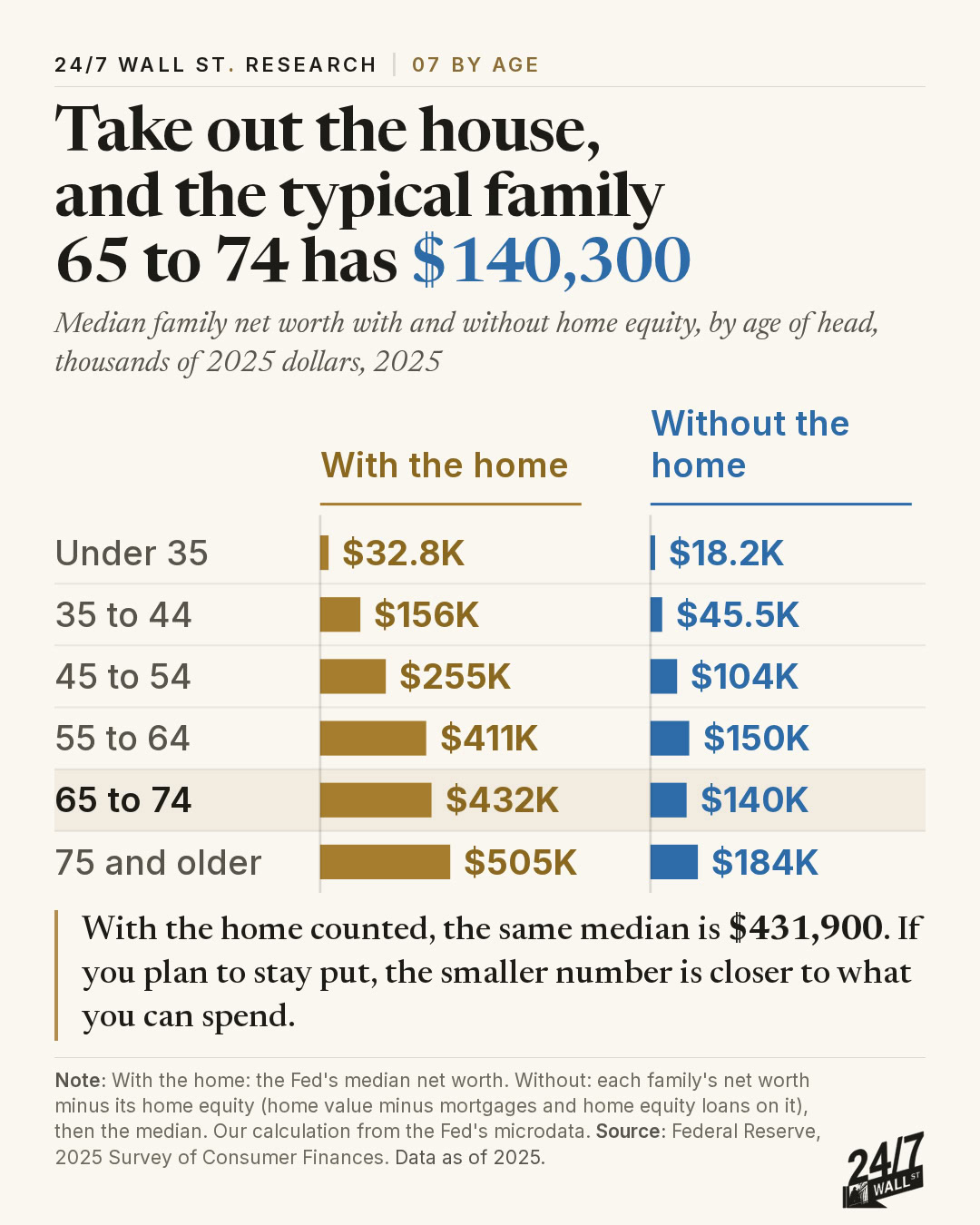
Picture a 72-year-old widow who did everything right. The mortgage is nearly gone, the roof is new and moving isn’t in the plan. If her finances sit right at the midpoint for people her age, her net worth is $431,900. Run Orman’s test and it drops to $140,300. The house accounts for the $291,600 difference, or 68% of everything she owns.
That smaller number pays for groceries, the property tax bill and the next car. If you own your home and plan to stay, it’s the one to know for yourself too.
The figures come from the Federal Reserve’s 2025 Survey of Consumer Finances and from 24/7 Wall St.’s new research report “The State of the American Household.” The Fed publishes the median net worth with the house counted. The medians without home equity are a 24/7 Wall St. calculation from the Fed’s public data.
How to run Orman’s test on your own balance sheet
You need four numbers and a pen.
1. Your net worth. Add up everything you own: your home at what it would sell for, bank and brokerage accounts, retirement accounts, cars, any business or other property. Subtract everything you owe.
2. What your home would sell for. A recent appraisal or the sale price of a similar place on your street works.
3. What you owe against it. The mortgage balance plus any home equity loan or line of credit.
4. Your equity. Subtract line 3 from line 2. Then take that equity out of your net worth from line 1.
What’s left is your net worth without the house. It still counts your car and anything else you own, so some of it would be slow to turn into cash.
Where you stand without the house, by age
Each figure below is a midpoint: half of households headed by someone that age have more, and half have less.
If you’re under 35, it’s $18,200 without the house and $32,800 with it. The two numbers sit closest together here: the gap between them is 45% of the larger one, the smallest share on the list.
If you’re 35 to 44, it’s $45,500 without the house against $156,000 with it. No decade is more tied up in its home: the with-home figure is 3.4 times the other one, and the gap is 71% of it.
If you’re 45 to 54, you’re at $103,500 without the house, against $254,700 with it. The without-home number more than doubles from the decade before.
If you’re 55 to 64, it’s $150,400 without the house and $411,300 with it. No working-age decade has more outside the house.
If you’re 65 to 74, you’re at $140,300 without the house and $431,900 with it. The without-home figure is $10,100 lower than in the decade before, as people start living on what they saved. The gap between the two numbers is 68% of the larger one.
If you’re 75 or older, it’s $184,000 without the house and $504,600 with it, the highest on both counts.
Read down the without-home figures and they climb until 64, dip in the first decade of retirement, then rise again after 75. The with-home figures rise at every step.
Three moves if you’re staying put
My read of these numbers: if you plan to live in your home for good, the without-home number is the one your retirement income comes from. Equity can’t pay the electric bill unless you sell, borrow against it, or move.
For the widow, and for anyone in her spot, that leads to three moves.
Budget from the smaller number. Plan spending from the $140,300 plus Social Security, and treat the property as a place to live. Even the full $140,300 at a 4% yearly withdrawal would pay about $468 a month, and that assumes the car could be turned into cash too.
Fund the repairs first. When most of your wealth is a building, most of your big bills come from it. A furnace or a roof comes out of the smaller pile, so set part of it aside for upkeep.
Keep the equity as a reserve. It’s real wealth, and it stays put. It covers a move to a smaller place or care later on, and it’s an estate after that. Spending against it now leaves you short at the moment you need it most.
When 24/7 Wall St. wrote about Kevin O’Leary’s $5 million bar on Nov. 21, the couple in that story counted only bank and investment accounts outside the home. The measure here is broader: it keeps cars, businesses and other property, which is why the 65-to-74 figure comes out higher.
Run both of your numbers tonight. If your home is more than two-thirds of your net worth, you’re in the same spot as the typical household 65 to 74, and the smaller number decides how you live. Orman’s test gives you the budget you actually have.
We follow the retirement rules that matter every weekday in The Daily Profit, our free email. Sign up and get our Top 10 stocks report too.
Released: The Definitive Guide to Retirement Income
(Sponsor) Most people spend their entire working lives focusing on one thing: growing a pile of money. Then they retire and discover the skill they actually need is close to the opposite. Turning that pile into steady income, year after year, through good markets and bad, without ever running out.
It may be the least discussed and most consequential transition in personal finance, and plenty of otherwise careful investors walk into it with no real plan. That is exactly what The Definitive Guide to Retirement Income helps answer. It is a free guide from Fisher Investments covering what your retirement will really cost, where the cash flow should come from, and how much you can safely withdraw each year. Learn more here. Learn More Here ›
The post Suze Orman Says to Leave Home Equity Out of Your Net Worth. For the Typical Household 65 to 74, $431,900 Drops to $140,300 appeared first on 24/7 Wall St..