Toyota’s Electric Hilux Sounds Tough Until You See The Range And Towing
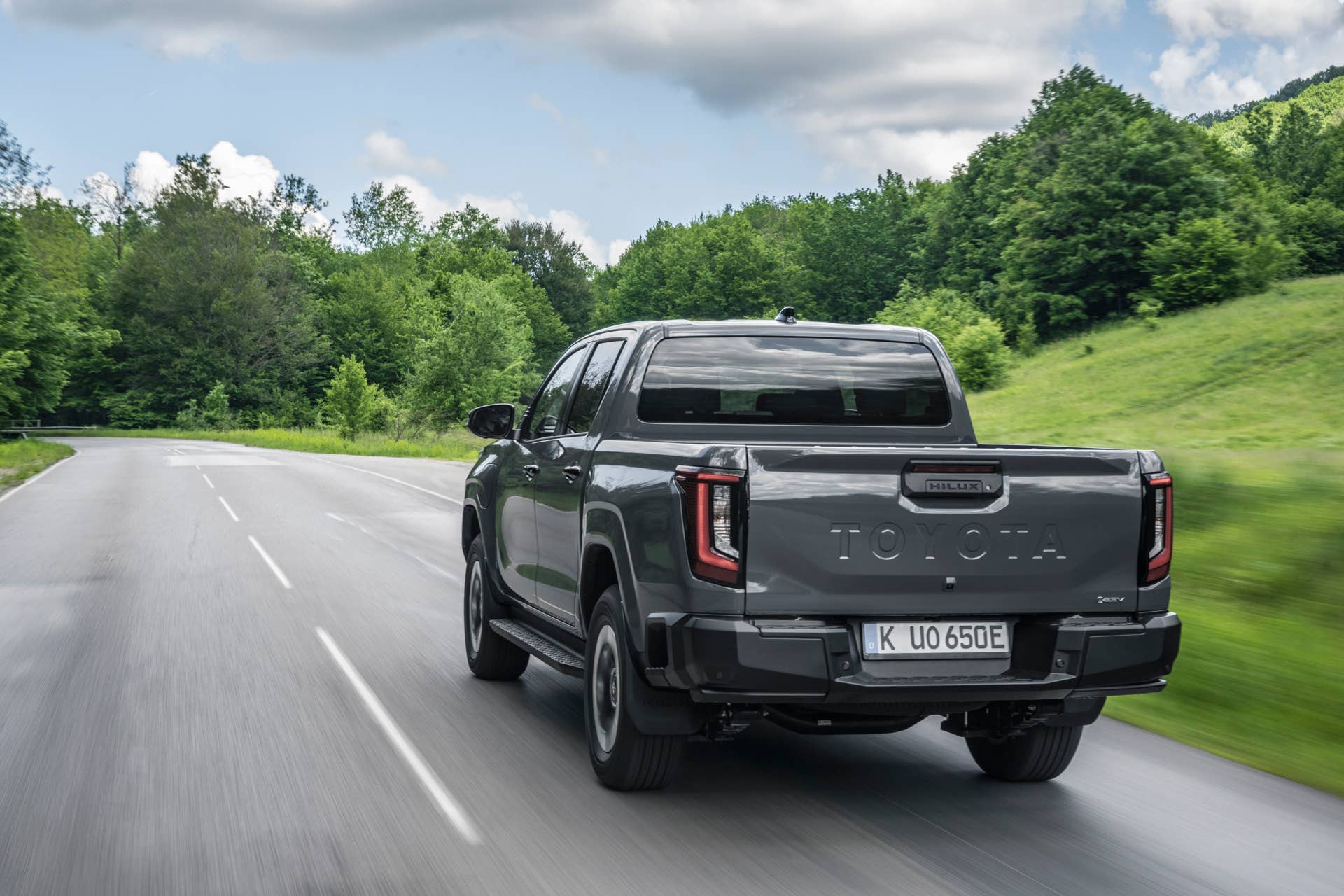
After decades of building some of the most indestructible internal combustion drivetrains on the market, the Japanese automaker is opening order books for its first body-on-frame electric vehicle: the Toyota Hilux BEV.
The BEV Toyota Hilux is priced from $56,500 in the UK before additional taxes, and starting at $51,500 in Australia, this electric iteration of the legendary ninth-generation mid-size pickup aims squarely at fleet operators making the zero-emission jump. Due to steep import tariffs and a lack of standard Hilux market presence, this model won't be seeing American asphalt, but are Americans really missing out?
Toyota
The Cold Hard Numbers
Under the floor sits a 59.2 kWh water-cooled lithium-ion battery feeding a dual-motor, permanent all-wheel-drive powertrain. It generates 278 horsepower and 348 lb-ft of torque. Toyota equips the Double Cab Hilux BEV with an electronic Multi-Terrain Select (MTS) system and heavy-duty eAxles, maintaining the standard truck's impressive 700 mm wading depth. Ground clearance drops slightly to 212 mm to accommodate the battery pack.
Here is where the severe compromises are. The WLTP driving range is capped at a modest 160 miles, extending to 236 miles on the city cycle. Towing capacity maxes out at just 3,700 lbs, and payload sits at roughly 1,576 lbs. For a nameplate built on hauling heavy equipment across unforgiving terrain, these figures represent a steep drop from its diesel counterpart, which effortlessly tows over double the weight. When it comes time to plug in, a 125 kW DC fast charger will get the battery from 10 percent to 80 percent in 30 minutes. For a car built on utility, these numbers fall significantly short of benchmarks.
How Does It Compare?
Toyota
The electric mid-size pickup segment is young, with the only non-Chinese presence being the BEV Hilux and the upcoming electric Ford compact truck. As for existing competition, the Hilux faces direct market competition from the Maxus T90EV, made by the Chinese firm SAIC, and Korea's KGM Musso EV - the firm formerly known as Ssangyong. While the Maxus suffers from a rear-wheel-drive-only setup and lackluster off-road chops, it does manage to edge out the Toyota in pure payload capacity. Both the Maxus and KGM outperform the Toyota with respect to driving range.
Meanwhile, upcoming plug-in hybrids like the Ford Ranger PHEV and the BYD Shark 6 offer a compelling alternative: zero-emission city driving coupled with uncompromised internal combustion range and towing limits. Hybrids, lately, seem like the more rational next utilitarian vehicles rather than battery electric.
Does The BEV Hilux Stand A Chance?
Toyota
This truck is not built for the cross-country tradesman towing heavy machinery, especially not at this price point. It is surgically targeted at local fleet operators, municipal services, and businesses running predictable daily routes. In that confined arena, Toyota's unmatched reputation for reliability will secure corporate contracts that the Chinese upstarts simply cannot touch.
However, for the traditional buyer looking for a rugged, do-it-all utilitarian beast, the restricted towing capacity and limited range make internal combustion—or hybrid—models the only viable option. The Hilux BEV is a highly competent, well-engineered first draft of an electric truck, but it is not yet a complete replacement for traditional or PHEV power. As for Americans, the Rivian R1T offers a far better overall package, offering higher range, payload capacity, and tow rating. So, to answer the question of whether or not there is a fear of missing out, the answer is a resounding "no".
Popular Products
-
 Wireless Health Tracker Smart Ring - R11
$131.56$65.78 -
 Electric Hair Straightener and Curlin...
$161.56$80.78 -
 Pet Oral Repair Toothpaste Gel
$59.56$29.78 -
 Opove M3 Pro 2 Electric Massage Gun
$901.56$450.78 -
 Portable Electric Abdominal Massager ...
$45.56$22.78