With An ‘uptick’ In Youth Firearm Cases In Denver, Is It Time To Rethink Youth Sentencing Laws?
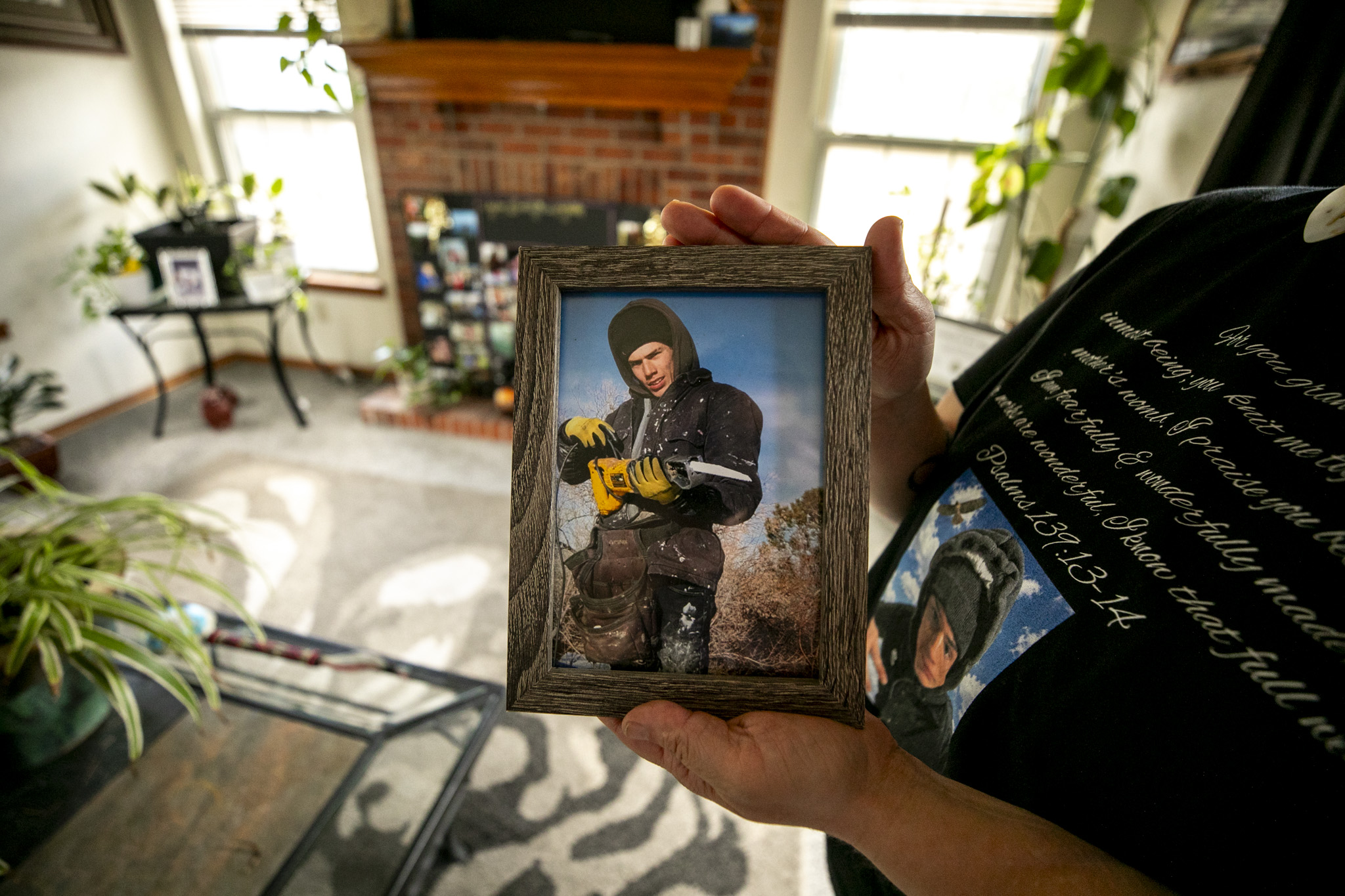
In each corner of Ramona Trombley’s home, there are memories of her son, Jaylan Moton. From photos of the construction jobs he worked to the tapestry hanging in the living room, the Trombleys are always thinking of their son, who was killed at the age of 20.
Moton was shot in 2025, one day after his 20th birthday. According to police, two teenagers lured him and a friend into a parking lot to rob them. A 14-year-old pulled the trigger.
The teenager who killed Moton received a four-year sentence in a youth correctional facility, one year less than the maximum allowed under Colorado law.
Now, data show that juvenile crimes are becoming more severe. More kids are carrying and firing guns in some areas, like Denver. The presence or use of a weapon can dramatically add to sentences. In the wake, how to sentence kids at these young ages becomes a bigger question. Are the lenient consequences of juvenile crimes part of the problem?
The Trombleys think so. They believe the consequences in Colorado’s juvenile justice system don’t match the severity of the crime.
“We have to live with the consequence of my son never coming to my doorbell and singing to me in the doorbell, never wanting to race his dad. We’ll never have our son back,” Ramona Trombley said.
But some prosecutors and youth justice advocates think that incarceration won’t prevent violence from happening, and that lenient sentences and a focus on the circumstances that led to a person committing a crime is part of the solution. They say it’s simple: Kids should not be tried or convicted as adults.
Sentencing disparities
With credit for time served, Trombley expects her son’s shooter to be released in 2029.
In adult court, the same crime carries a maximum sentence of 48 years. Ryan Brackley, the assistant district attorney for the 18th Judicial District Attorney’s office, which charged the 14-year-old, said there’s certainly a disparity in the sentencing ranges.
He’s concerned that youth sentences for teenagers might not deter them from committing more crime. He gives a hypothetical — if a 16-year-old commits first degree murder in a particularly aggravated crime.
“And that case stays in juvenile court for whatever reason, we’d be looking at that juvenile getting back out onto the streets at a very, very young age in his or her early 20s,” he said.
“While the goal of juvenile justice is reformation to help someone get to where they need to be as an adult, we wonder whether or not that five or seven year maximum term really helps us get there. Is that enough time to rehabilitate?”
Rehabilitation is one of the goals of the juvenile justice system. But sometimes, a crime is so severe that prosecutors try to move it into adult court, said Denver District Attorney John Walsh.
“We’re not in the business of throwing young people away. At the same time, when we have the most serious offenses, homicides and things of that sort, that there’s an allegation that a juvenile committed, we’ve got to take that into account too,” he said.
Walsh is currently trying to move a case of a 12-year-old accused of murder to an adult court.
Judicial discretion
A judge decides whether a juvenile case should move to adult court after hearing arguments at a transfer hearing.
For example, in the 17th Judicial District, there was a case against teenager Lourease Wilson. He was 16 when he was accused of robbing people and stealing their cars with a group of others, with a gun in hand. A shot was fired at a school building, but no one was injured. He was acquitted of all the charges in adult court.
There was a push to move his case out of adult court. A member of an action committee, who came to Wilson’s September hearing in Adams county, said he didn’t belong in adult court.
“He’s a juvenile. His brain won’t be developed for another eight years. So he’s already served 13 months in jail. If he gets sent to adult prison at his age that he’s at, statistics show he’s not going to come out very well,” said Miles Thompson, the chair of the Denver Aurora Community Action Committee. “We’re out here because kids should not be tried as adults.”
Travanti Wheelock, a 16-year-old from Montbello who has a friend that’s currently in a youth correctional facility, said he thinks in serious cases where there was harm, there should be a punishment. But putting the kids on the right path should also be a priority.
“I feel like with them being so young, it may be that they don’t know what’s right and what’s wrong. I feel like there’s definitely a way to go about it, not necessarily giving them their freedom back, but not necessarily putting them all the way away to where they can’t have that freedom at all,” he said.
Trombley understands that point, but she thinks the sentence should match the crime, no matter the age.
“I’m not saying I want this kid to spend the rest of his life in prison, but I want him to be outside the juvenile system and in the adult system and face some kind of consequence to feel what real prison feels like,” Ramona Trombley said.
More serious crimes
The overall number of juvenile cases hasn’t increased in Denver, but the DA’s office is seeing more serious offenses, particularly those involving firearms, said Denver District Attorney John Walsh.
“Where we have seen sort of a stubborn continuing presence and even a bit of an uptick is youth firearm cases,” Walsh said.“We’re concerned about the fact that we’re seeing this uptick … in these most serious offenses.”
According to data from the Denver District Attorney’s office, the types of crimes committed by youth they’re seeing in the office are becoming more violent. The number of firearm-related cases has remained relatively steady with roughly 500-600 cases filed yearly, up from a low of 371 in 2021.
Data according to each Judicial District Attorney’s office. Violent crime charges reflected in the data include charges of homicide with a firearm, attempted homicide with a firearm, assault involving a firearm, felony menacing with a firearm, aggravated robbery/robbery with a firearm, illegal discharge of a firearm and any other firearm related form of youth violence.
“The types of cases that we frequently see committed by juveniles, it’s motor vehicle theft … it’s a juvenile in possession of a firearm, menacing, which is with a firearm almost always, aggravated robbery, again, frequently with firearm,” Walsh said. “And in 2026, we’ve seen an uptick in attempted murder and homicide cases.”
Denver prosecutors handled 576 juvenile firearm cases in 2025, compared with 371 in 2021, according to data from the Denver DA’s office.
The trend of firearm cases in Denver isn’t reflected across the state. The 21st Judicial District, which covers Mesa County, the 4th Judicial District of El Paso and Teller counties and the 10th Judicial District, which includes Pueblo, have all seen significant declines in the number of cases filed.
Denver is trying to address the issue. There are plenty of efforts to reduce violence among youth. Community organizations, like the Struggle of Love, for example, opens its doors to young people and is a space for gathering.
The district attorney’s office in Denver also has a diversion program and handgun intervention program, both of which work with youth who’ve been charged with crimes, to prevent them from entering the system again.
Push for change
With the metro area struggling to reduce the numbers of young people committing serious and many times violent crimes, the Trombleys want state juvenile sentencing laws to adapt and reflect the severity of the crimes.
Ramona Trombley wants to fix the system for other families.
“I do not want to continue to have other families feel like how we feel every single day,” she said.
She reached out to Rhonda Fields, an Arapahoe County commissioner and former legislator whose son died in a shooting in 2005. After hearing the Trombleys’ story, Fields said she thinks the legislature should reconsider the sentencing ranges.
“We’re constantly moving the criminal code statute based on our societal norms,” she said. “It might’ve been a good idea at the time, but now, hearing from victims who’ve been impacted. Maybe it’s time for us to look at it again and make some adjustments.”
She recommends the audit committee look at the last three to five years, to get data on juvenile sentencing.
“How many times have kids been sentenced? What is the length of their sentence? What is their recidivism rate? How many of these people after they get sentenced and they’ve done their time, they re-offended again?” she said. “Having some research behind either this is working or it’s not.”
Trombley, while still grieving the 21st birthday that Jaylan never got to see, hopes youth sentencing reform will come up in the legislative session that starts in January.
Popular Products
-
 Gas Detector Meter
$311.56$155.78 -
 Foldable Garbage Picker Grabber Tool
$93.56$46.78 -
 Portable Unisex Travel Urinal
$49.56$24.78 -
 Reusable Keychain Pepper Spray – 20ml
$21.56$10.78 -
 Camping Survival Tool Set
$41.56$20.78