“why We All Suck At Talking: The Psychology Of Saying Everything And Still Being Misunderstood”
/the-psychology-of-communication-and-why-we-keep-getting-it-wrong
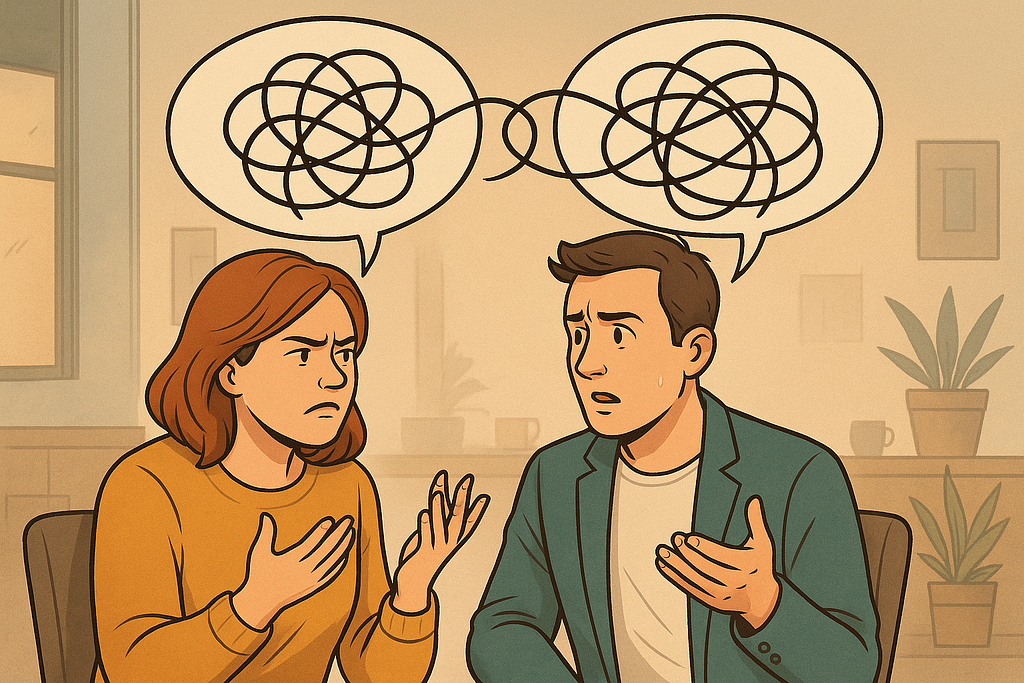
“Sometimes the words are fine — it’s the knots between us that need untangling.”Think you’re good at communication? Think again. From “I’m fine” that means war to “K” that starts one — this witty deep-dive unpacks why humans keep misunderstanding each other. A brutally funny take on psychology, ego, silence, and emotional Wi-Fi problems.
Communication.
Such a simple word. Such a complicated disaster.
It’s what we do every day — at work, at home, on WhatsApp, and in those dreadful “quick sync” meetings that could’ve been a nap.
And yet, despite all our diplomas, LinkedIn endorsements, and emojis, most of us still communicate like toddlers fighting over the last French fry.
Everyone says, “Communication is key.”
Nobody tells you the lock changes every five minutes.
The Shy Communicator
These are the people who rehearse what they’ll say 47 times in their head, open their mouth… and instead of words, a sigh escapes.
They spend half their life worrying: “What will people think if I say this?”
And the answer is usually: “Nothing. They’re too busy checking Instagram.”
But the shy ones don’t believe that.
Their brain plays a nonstop horror movie called “The Day I Said Something Dumb.”
Psychologically, this comes from an ancient script in the brain called “Survive at all costs.”
Your brain thinks silence keeps you safe — but all it does is make people think you’re mad, mysterious, or malfunctioning.
The Ego Communicator
These ones don’t talk. They broadcast.
You could be mid-sentence, and their ego’s already designing a counter-argument with fireworks and a marching band.
They say, “I don’t argue.”
But their tone says, “I’m ready to emotionally suplex you.”
They call it confidence. The world calls it noise.
Psychologists call it defensive dominance — that primal part of your brain that mistakes “being wrong” for “being attacked by a tiger.”
So instead of listening, they roar.
We all have a little of this creature inside us.
Some of us just dress it better.
The Misunderstood Saint
Sometimes you say something nice like,
“Let’s talk later, I’m tired.”
And somehow it translates to:
“I hate you, your cat, and your taste in Netflix shows.”
Why?
Because every sentence you say goes through the listener’s amygdala — the brain’s threat detector.
If their amygdala’s in a bad mood, your compliment sounds like an insult.
That’s why “You look nice today” can sound like “You usually look like roadkill.”
You’re not a villain. They’re not crazy.
It’s just biology, baby.
The Bandwidth Problem
Communication has bandwidth.
Face-to-face is HD.
Texting is pixelated.
You send “Fine.”
They read “FINE? WHAT DID I DO?”
You write “K.”
They hear thunder, divorce papers, and emotional collapse.
Because tone doesn’t travel through screens.
We’re trying to run emotional software on devices built for memes.
You can’t hug someone with a GIF.
(Well, you can, but it just looks desperate.)
The Timing Tragedy
Right words, wrong timing — the unofficial anthem of every argument ever.
Saying “calm down” when someone’s angry? Congratulations, you just detonated a bomb.
Telling your partner “you’re overreacting” mid-fight? That’s not bravery. That’s a death wish.
Even truth has bad timing.
The trick isn’t to speak more — it’s to wait smarter.
Because sometimes silence fixes what sentences break.
The Silent Assassin
Silence.
The most misunderstood form of communication.
Sometimes it means peace.
Sometimes it means war.
Sometimes it’s just buffering.
You can’t decode silence without context —
just like you can’t decode “fine” without the facial expression attached.
Used wisely, silence shows power and restraint.
Used poorly, it’s emotional ghosting with Wi-Fi.
The Script Clash
Every person has a private script for how conversations “should” go.
Your script says, “I’ll stay calm.”
Theirs says, “Raise volume = victory.”
Your script says, “Honesty is healing.”
Theirs says, “Honesty is humiliation.”
When these scripts collide, logic dies.
That’s why two people can say the same sentence, mean different things, and end up emotionally bankrupt.
The only way out?
Stop arguing about who’s right and start asking what actually helps.
The Office Edition (Where Communication Goes to Die)
Boss: “Can you finish this quickly?”
Translation in your head: “Work until your soul leaves your body.”
You: “I’ll try my best.”
Translation in their head: “This person is lazy.”
Workplace communication is like a bad marriage — full of assumptions, half-truths, and forced smiles in PowerPoint slides.
Slack messages are the modern smoke signals: urgent, vague, and often misread.
Everyone’s “aligning” — but no one’s really aligned.
Welcome to corporate communication — where meaning goes to get HR approval.
The Relationship Edition (The Olympics of Misinterpretation)
You: “I need space.”
Them: “You don’t love me.”
Them: “I’m fine.”
You: “We’re breaking up, aren’t we?”
Half of adult relationships are just two people saying,
“I’m not mad,”
while both are definitely mad.
It’s not miscommunication. It’s emotion translation failure.
Love languages were supposed to help.
Now we just have people saying, “My love language is being left alone.”
The Third-Person Superpower
When all else fails, go third-person.
Not like a weirdo — just observational mode.
Imagine you’re watching two humans argue.
No villains. No heroes. Just two nervous systems trying to survive.
One’s tired.
One’s scared.
Both want peace but speak different dialects of chaos.
That’s how empathy starts — not by “being right,” but by seeing the whole circus.
The Responsibility Flow
Communication collapses when everyone’s obsessed with winning.
Real connection begins when at least one person asks:
“What moves this moment forward?”
It’s not about surrender — it’s about wisdom.
Because sometimes maturity is choosing peace over power, even when your ego’s yelling, “Rock on, dude.”
The Great Communication Gym
Think of communication like going to the gym.
Every “pause before reacting” — that’s mindfulness cardio.
Every “I understand how you feel” — that’s empathy strength training.
Every “I’m sorry” — that’s flexibility (and pain).
You lift awareness.
You stretch patience.
You build tone control.
And you sweat honesty.
Soon, you’ll realise:
Communication isn’t about being impressive — it’s about being understood.
So next time someone says, “You’ve changed.”
Just smile and say, “No, I finally learned how to talk without fighting myself first.”
???? WhatsApp Hook (short, conversational, shareable)
Ever sent a “K” and accidentally started World War III?
This piece explains why we keep saying the wrong things, hearing worse things, and still pretending it’s “fine.”
Funny. Brutal. Too real.
????️ Tags
#Psychology
#Communication
#Relationships
#WorkplaceCulture
#SelfAwareness
#MediumWriters
(Medium’s algorithm prefers 4–6 relevant tags — these hit humour + insight + psychology audiences.)
“Why We All Suck at Talking: The Psychology of Saying Everything and Still Being Misunderstood” was originally published in Write A Catalyst on Medium, where people are continuing the conversation by highlighting and responding to this story.
Popular Products
-
 Brightening & Hydrating Rose Facial C...
$154.99$107.78 -
 Pheromone Long Lasting Attraction Per...
$88.99$61.78 -
 Crystal Glass Rose Table Decoration w...
$137.99$95.78 -
 Mini Facial Hair Trimmer with Replace...
$15.99$9.78 -
 Whitening & Spot Removal Skincare Set...
$201.99$140.78