People Who Grew Up Watching One Parent Manage The Other Parent’s Mood Became Adults Who Can Feel A Room Shift Before Anyone Speaks. They Don’t Call It Hypervigilance. They Call It Being Considerate. It’s Neither.
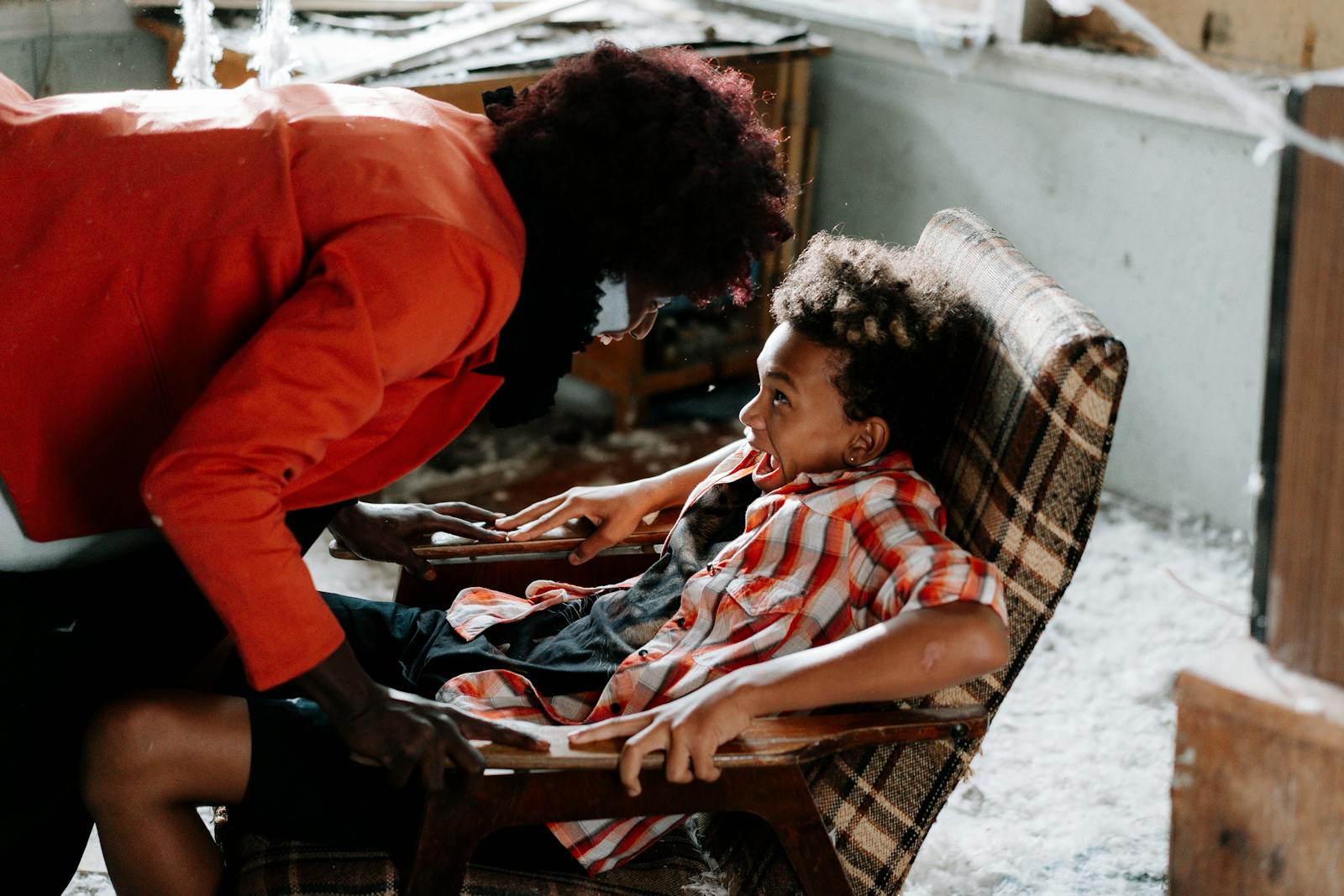
I spent the better part of three decades believing I was just perceptive. Good at reading people. A gift, I thought, the way some people can do mental math or identify birdsong. It took me an embarrassingly long time to understand that what I was actually doing, every time I walked into a room, was conducting a threat assessment. Not for physical danger. For mood. For the slight tightening around someone’s jaw that meant the evening was about to go sideways.
The Training Nobody Signs Up For
Children who grow up in homes where one parent’s emotional state governs the household climate learn something early: the atmosphere is your responsibility. You don’t get taught this in words. You get taught it in the way your mother’s shoulders drop when your father’s car pulls into the driveway. In the micro-calculations you perform before dinner: Is it a good night or a quiet night? Is this the kind of silence that means peace, or the kind that means the next sentence will detonate something?
Psychology has a term for the reversal of caregiving roles between parent and child. Research indicates that this dynamic occurs when a child becomes the emotional caretaker for one or both parents. The child doesn’t give care because they’re generous. They give care because the system won’t function unless someone does, and the adults have opted out.
The child who monitors a parent’s mood is performing sophisticated work. They’re tracking vocal pitch, body language, the cadence of footsteps on the stairs. They’re doing this at seven, at nine, at twelve. And they’re doing it so automatically that by the time they’re adults, they’ve forgotten it was ever a learned skill. It feels like personality.
Hypervigilance Dressed Up as Good Manners
Here’s where the relabeling happens. The child who spent years scanning for emotional danger grows up and enters the world with a finely calibrated social antenna. They walk into a meeting and immediately sense that the boss is in a mood. They sit down at a dinner party and know within thirty seconds which couple had an argument in the car. People praise them for it. You’re so thoughtful. You always know what someone needs.
They don’t call it hypervigilance. They call it being considerate. And the distance between those two things is exactly the distance between a choice and a compulsion.
Considerate people notice others because they want to. Hypervigilant people notice others because they have to. The machinery was installed in childhood, and it runs whether you need it or not, burning energy in safe rooms, scanning for threats that left the building decades ago.
Research has examined how early emotional environments shape a child’s regulatory capacities, with downstream effects that persist well into adulthood. The patterns are set early, reinforced through repetition, and eventually disappear into the background of who you think you are.
The Cost of Knowing What Everyone Feels
There’s a price to being the person who reads every room. The obvious one is exhaustion. The less obvious one is that you never actually arrive anywhere. You’re too busy working the perimeter.
I wrote recently about the hardest conversation in a long marriage, the moment when someone says I don’t think you actually know me. What I’ve come to understand since is that the person on the receiving end of that statement is often someone who was so busy managing their partner’s emotions that they never had the bandwidth to actually learn who that person was. You can be exquisitely attuned to someone’s mood and completely ignorant of their inner life. Those are different skills.
The hypervigilant partner knows when you’re upset before you do. But ask them what brings you joy, what you dream about when you’re staring out the window, and they might not have an answer. They were trained to detect storms, not sunshine.
It took me roughly thirty years to learn that my wife Donna doesn’t want problems fixed. She wants them heard. That distinction seems small on paper. In practice, it required me to shut down an entire operating system that was built around identify the threat, neutralize the threat, restore equilibrium. Listening without fixing felt, for a long time, like negligence.
The Parental Dynamic That Sets It All in Motion
The specific architecture matters. This pattern doesn’t typically emerge from homes with two emotionally volatile parents. It comes from homes where one parent is unpredictable and the other parent becomes the manager, the buffer, the translator. The child watches the managing parent closely. They learn the playbook: anticipate, accommodate, smooth over.
Related Stories from Silicon Canals
- I’m 38 and I ended my coffee routine with a male colleague not because anything happened, but because I caught myself putting on lipstick in the car beforehand and realized I hadn’t done that for my husband in years
- I’m 62 and I finally understand that my father wasn’t angry. He was terrified every single day that he couldn’t provide enough, and the only language he had for fear was volume, and I carried resentment toward a man who was drowning while I kept score from the shore.
- If a coworker who used to join group lunches suddenly starts eating alone every day, something more important than introversion is happening. They’ve likely hit the point where the gap between who they are at work and who they actually are became too expensive to maintain over a sandwich.
Studies have shown how disagreement between parents about roles and responsibilities creates measurable developmental effects in children. The child absorbs not just the content of the conflict but the meta-lesson: someone in this house needs to be the emotional air traffic controller, and the position is now open.
Research suggests that the quality of parental engagement shapes a child’s capacity to process and regulate their own emotional experiences. When that engagement is itself distorted by one parent managing the other’s mood, the child’s emotional development bends around the distortion like a tree growing around a fence post.
In my recent piece about realizing why I never respected my father, I wrote about the quiet contempt that builds when you watch one parent carry everything while the other drifts. That contempt is one outcome. The hypervigilant caretaker is another. Sometimes the same child carries both.

What It Looks Like in Adult Relationships
The adult version of this pattern is remarkably consistent. You become the person who adjusts their energy to match whoever they’re with. Happy people get your enthusiasm. Sad people get your gentleness. Angry people get your calm. You’re a thermostat, not a thermometer, constantly regulating the temperature for everyone else.
Your friends say you’re easy to be around. Your partners say you’re steady. Your therapist, if you ever get one, says you have no idea what you actually feel because you’ve spent forty years tracking what everyone else feels instead.
The relational consequences are specific and predictable:
You over-function in relationships. You take responsibility for emotional climates that aren’t yours to manage. You interpret your partner’s bad day as something you caused or failed to prevent. You apologize reflexively. You struggle with conflict because conflict, in your original household, was the thing you were hired to prevent.
And here’s the part that’s hardest to see from the inside: you often choose partners whose moods need managing. The system seeks what it knows.
The Difference Between Awareness and Recovery
Naming this pattern is the easy part. Social media is full of people who can identify their attachment wounds with clinical precision and still repeat them every six months. Awareness without behavioral change is just a more articulate form of stuckness.
The actual work is slower and less photogenic. It involves learning to sit in a room where someone is upset and not make it your project. It involves tolerating the discomfort of someone else’s bad mood without rushing to fix it, soothe it, or preemptively apologize for it.
For me, the work showed up in small, unglamorous ways. Learning to sit on the floor and play dolls with my granddaughters without monitoring the emotional weather in the next room. Learning that my sons didn’t need a drill sergeant. They needed a father who asked them how they were feeling, which required me to believe that feelings were a legitimate category of experience, which required me to dismantle a lifetime of believing they weren’t.
That last part has been the hardest project of my life, frankly. Unlearning the idea that real men don’t talk about their feelings. The irony is thick: I spent decades being exquisitely sensitive to everyone else’s emotions while maintaining that my own didn’t warrant discussion.
Being Considerate Is Beautiful. Being Compulsive About It Is Something Else.
I want to be careful here. Sensitivity to others is genuinely valuable. The world needs people who notice when someone is struggling, who can read a room, who show up with care. I have no interest in pathologizing kindness.
But there’s a question worth asking, and it’s a question only you can answer honestly: Can you stop?
Can you walk into a gathering and simply be there, without inventorying every face for signs of distress? Can you let your partner be irritable without launching an internal investigation into what you might have done wrong? Can you sit in a room where the energy is slightly off and just let it be off?
If you can, then what you have is consideration. A beautiful quality, freely given.
If you can’t, if the scanning is automatic, if the absence of it produces anxiety, if you feel physically uncomfortable when someone near you is unhappy and you haven’t yet intervened, then what you have is a survival strategy that outlived the environment it was designed for.
The good news, if you want to call it that, is that strategies can be updated. The room you’re reading so carefully isn’t the room you grew up in. The people around you are not, in most cases, one wrong word away from an eruption. You are allowed to put down the clipboard. You are allowed to stop working the perimeter and actually sit down at the table.
It will feel irresponsible at first. It will feel selfish. That’s the old programming talking. The child in you who learned that relaxing was dangerous is going to need some convincing.
But the men and women I know who’ve done this work, who’ve slowly dialed down the scanning and dialed up the actual living, tend to say the same thing: the world didn’t fall apart when they stopped holding it together. It just kept going. And for the first time, they were in it instead of orbiting around it.
Feature image by cottonbro studio on Pexels
Undercurrent — our weekly newsletter. The sharpest writing from Silicon Canals, curated reads from across the web, and an editorial connecting what others cover in isolation. Every Sunday.
Free. No spam. Unsubscribe anytime.
Popular Products
-
 Aqua Peel Facial Deep Clean & Dermabr...
$138.99$96.78 -
 Custom Engraved Gift Box - Black Paper
$50.99$34.78 -
 Smart Notebook Wireless Graphics Tablet
$175.99$135.78 -
 Enamel Heart Pendant Necklace
$49.56$24.78 -
 Women's Custom Name 18K Gold Plated N...
$68.99$47.78