People Who Were Parentified As Children Don’t Struggle With Responsibility — They Struggle With The Bizarre Sensation Of Someone Else Handling Things

The Direct Message
Tension: Adults who were parentified as children are universally praised for their competence and responsibility, yet their deepest struggle isn’t handling too much — it’s the panic and identity loss they feel when someone else handles something for them.
Noise: Conventional trauma narratives assume damaged childhoods produce incapable adults. Parentification produces the opposite: hyper-capable adults whose entire sense of self collapses when the one thing they know how to do — carry everything — is taken away, even gently.
Direct Message: The parentified adult’s real wound isn’t a lack of capability. It’s that their identity was fused to being needed, so receiving help doesn’t feel like relief — it feels like disappearing. Healing means learning to stand empty-handed and discovering you’re still someone.
Every DMNews article follows The Direct Message methodology.
Most people assume the lasting wound of a difficult childhood is an inability to handle adult life. The assumption runs something like this: broken homes produce broken adults who can’t manage bills, relationships, deadlines, or themselves. But for a specific category of adults, the ones who grew up managing their parents’ emotions, refereeing family conflicts, and keeping households functional before they were old enough to drive, the opposite is true. Responsibility is the one thing they never had trouble with. What destabilizes them is the unfamiliar, almost disorienting experience of someone else picking up the weight.
This isn’t a quirk of personality or a minor adjustment problem. It is evidence of something the psychological literature is only beginning to fully articulate: parentification doesn’t just assign children adult tasks, it fuses their identity to the act of carrying those tasks. The result is an adult who doesn’t merely prefer to be in charge but who experiences the removal of responsibility as a threat to the self. Understanding this fusion, between who these adults are and what they were forced to do, is the key to understanding why recovery asks something far more radical of them than most people realize.
Nadia Cortes, 34, a project manager in Philadelphia, describes it with unusual precision. She can run a twelve-person team through a product launch without breaking a sweat. She thrives under pressure. She volunteered to manage her family’s finances at fifteen, after her mother’s depression made it impossible for her to keep track of utility payments. Nadia doesn’t struggle with responsibility. She struggles with the feeling she gets when her husband says he’s already taken care of something. Not annoyance, exactly. Something closer to vertigo.
That reaction makes little sense under conventional psychology-of-trauma logic. But it makes perfect sense under the framework of parentification, a concept describing what happens when parents delegate parenting roles to their children. The parentified child doesn’t grow up irresponsible. She grows up with her identity fused to responsibility itself. And when that responsibility is removed, even gently, even lovingly, her sense of self begins to wobble.
The psychological literature on parentification has deepened considerably over the decades. Researchers have explored what has been called the imbalanced ledger of give-and-take between parents and children. The child gives too much, too early, and the family never balances the account. As The Guardian documented in an extensive investigation of parentification, researchers have since charted the phenomenon across cultures, and the inventory of consequences is remarkably consistent: hypervigilance, chronic self-reliance, difficulty receiving care, and a deep, private exhaustion that rarely shows on the surface.
Deshawn Keller, 41, a high school principal in Atlanta, recognizes himself in every line. He was the oldest of four children. His father left when he was nine. His mother worked double shifts at a hospital. By ten, Deshawn was cooking dinner for his siblings, checking their homework, and walking the youngest to daycare before school. Teachers called him mature for his age. Nobody asked whether he wanted to be.
This is the internal architecture that parentification builds. The child learns, through thousands of small repetitions, that her value is measured by what she manages, prevents, or fixes. Caring for others becomes synonymous with survival. Psychoanalysts have described a phenomenon called the “false self,” a constructed identity that the child builds to meet the demands of her environment. In parentified children, that false self is typically organized around competence, emotional attunement to others, and ceaseless vigilance. Underneath it, the child’s authentic needs, her desire to play, to be uncertain, to ask for help, go unexpressed because expressing them is met with frustration, anger, or emotional withdrawal from the very parents she is trying to save.
The false self isn’t a mask the child puts on and takes off. It becomes load-bearing. It holds up the family. And because it holds up the family, the child concludes, reasonably, that it holds up her. Dismantle it, even partially, and she doesn’t feel freed. She feels structurally unsound.
Research on parentification suggests these individuals develop heightened sensitivity to others’ emotional needs. Some describe their childhood role as anticipating and meeting a parent’s needs before being asked, similar to a surgical nurse predicting what instruments a surgeon needs.
The radar doesn’t shut off when the child grows up. It just finds new frequencies to scan.
Meredith Cho, 29, a veterinary technician in Portland, Oregon, didn’t realize anything was wrong until her roommate organized a surprise birthday dinner for her. The evening was lovely. Meredith went home and couldn’t sleep for hours. Nothing bad had happened. Something good had happened, and she didn’t know how to be inside of it. She wasn’t ungrateful. She was experiencing what happens when a person built around giving care is suddenly, without warning, positioned to receive it. The identity that had kept her safe since childhood had no instructions for this.
Research on childhood adversity has found substantial rates of traumatic experiences among adults. A University of Sydney-led study published in the Australian and New Zealand Journal of Psychiatry found that 42 percent of Australian adults, more than eight million people, experienced a traumatic event as children. Those affected showed a 50 percent higher risk of developing a mental health or substance use disorder than the wider population. Lead researcher Dr. Lucy Grummitt, a post-doctoral research associate at the Matilda Centre for Research in Mental Health and Substance Use, has noted that researchers have described findings on childhood adversity as deeply concerning and requiring urgent attention. Studies have shown that much of this childhood trauma occurs at very young ages.
But the specific wound of parentification often falls through the cracks of these larger studies. It doesn’t always register as abuse. There’s no bruise. There’s frequently no poverty, no divorce, no dramatic rupture. Research has examined “normal” families with two available parents, sufficient financial stability, and no diagnosed parental illness, because the harder question is how parentified adults make sense of their childhood when there is no obvious excuse for the sense of burden.
This absence of an obvious narrative is part of what makes parentification so psychologically stubborn. Deshawn has no villain in his story. His mother was exhausted and doing her best. Nadia’s mother was clinically depressed. Meredith’s parents were lovely people who happened to fight constantly, then pretend nothing had happened by morning. The child in these homes doesn’t develop resentment toward a monster. She develops a quiet confusion about why she feels so tired all the time, and why a simple question about how she’s doing can sometimes undo her entirely.
The confusion extends into adult relationships. Writing in The Conversation, psychologists note that when dysfunctional family dynamics are normalized, opportunities for intervention are often missed, and the impact on children goes unrecognized. When the family considers itself normal, the child has no framework for saying something is wrong. So she builds her entire identity around the idea that nothing is wrong, that she simply happens to be very capable, very organized, very good at handling things.
Then someone tries to handle something for her and the scaffolding shakes.
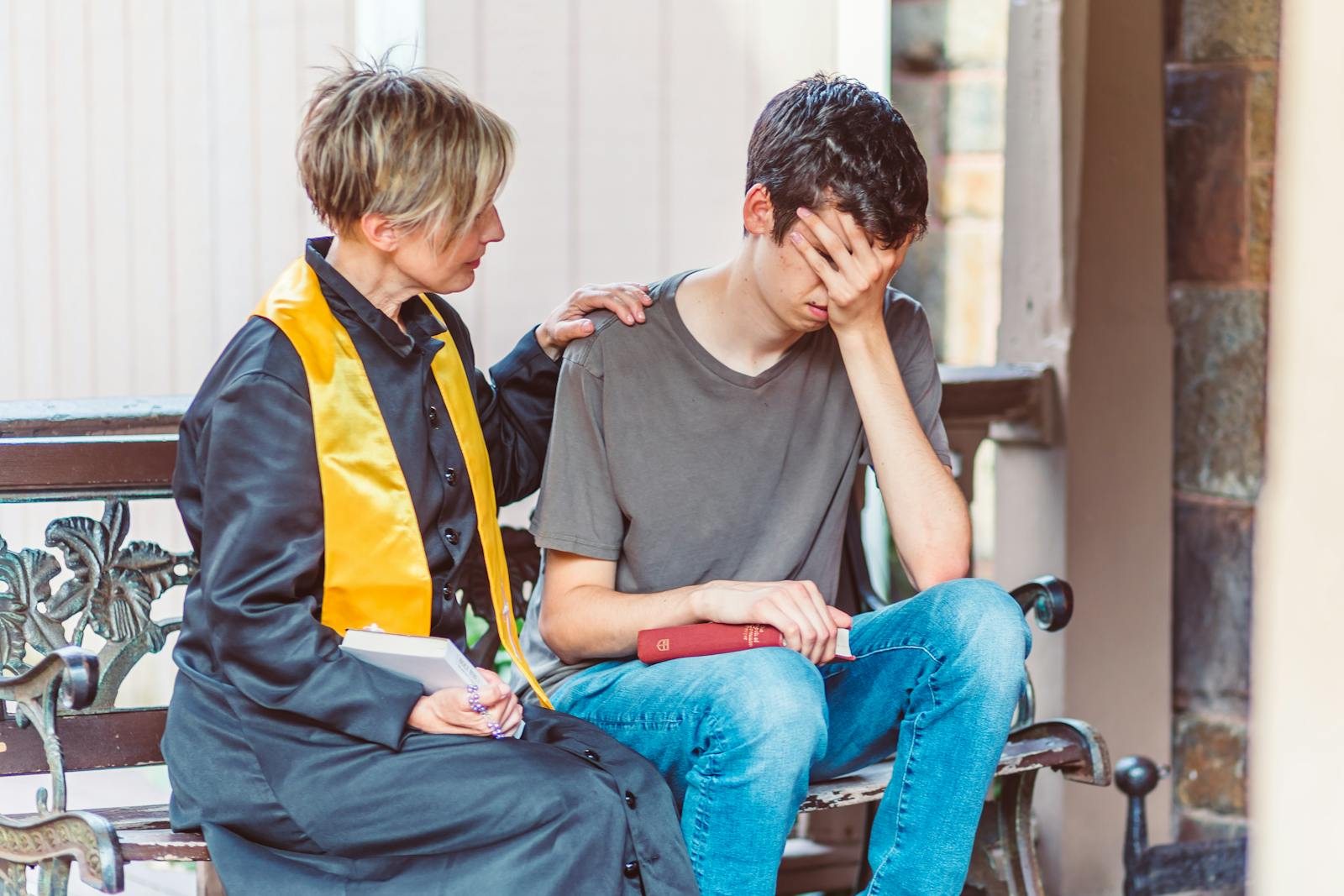
What’s happening in that moment isn’t ingratitude. It isn’t control. It’s a kind of identity threat. When responsibility has been your organizing principle since childhood, someone taking it away, even a single task, forces a confrontation with a terrifying question: If I’m not the one holding everything together, who am I?
This is the crux of what makes parentification distinct from other childhood adversities. Other forms of trauma leave people struggling to function. Parentification leaves people struggling to stop functioning, because the functioning is the self. The competence isn’t a skill the person developed alongside a stable identity. The competence replaced a stable identity. And that substitution, made in childhood out of pure necessity, is what makes every offered hand feel less like support and more like erasure.
Recent research from Michigan State University adds a fascinating dimension to this picture. Psychologists Andrew Jaros and William Chopik examined whether adults’ reports of adverse childhood experiences remain stable over time or shift in response to current life circumstances. They found that when participants experienced greater-than-usual support from their parents, including periods of lower-than-usual relationship strain in the family, they reported fewer childhood adversities, particularly emotional abuse and neglect. Research suggests that current relationship quality can influence how people remember past experiences, with positive relationships potentially softening difficult memories.
The implication is profound. Memory isn’t a tape recording. It’s a living process, shaped by the quality of relationships in the present. For parentified adults, this means that entering relationships where someone genuinely shares the load can, over time, change not just their daily experience but the emotional texture of their past. The memories don’t vanish. But they lose some of their sharpness. The narrative can shift from a sense of isolation in surviving trauma to recognition of present support.
But getting to that point requires something that parentified adults are specifically not trained for. It requires sitting with discomfort without immediately converting it into action. The parentified adult’s entire nervous system is organized around the principle that discomfort is a signal to do something. Someone is upset? Fix it. A bill is due? Handle it. A room is tense? Smooth it over. The idea that discomfort might simply pass, that someone else might address it, that the appropriate response might be to do nothing at all, registers as dangerous.
Nadia’s therapist asked her once to sit with the feeling of her husband handling something without intervening. Just sit with it. She lasted about forty seconds before she got up to reorganize the kitchen cabinets. The sensation wasn’t impatience. It was something more primal, the feeling of watching a load-bearing wall get removed from a house she was still standing inside.
Deshawn describes a parallel experience. When his vice principal offered to cover his administrative tasks for a week so he could attend a conference without distraction, Deshawn spent the first two days calling the office to check on things. By day three, he realized he wasn’t checking because he thought things were going wrong. He was checking because the silence felt wrong. Without a problem to solve, he couldn’t locate himself.
This is what clinicians working with relational trauma call the cost of hyperadaptation. Research on reparative experiences in trauma recovery suggests that healing doesn’t happen through insight alone. It happens through repeated corrective relational experiences, moments where the old pattern fires (someone is handling something, I need to intervene) and the expected catastrophe doesn’t arrive. The dish gets done. The bill gets paid. Nobody falls apart. Slowly, painfully, the nervous system updates its predictions.
But the process is slow precisely because the original wiring was installed so early. Research has shown that childhood trauma often occurs at very young ages. When a young child learns that she is the load-bearing wall of her family’s emotional structure, that lesson doesn’t sit in her conscious memory. It sits in her muscles, her breathing patterns, her instinctive reach for the handle of every problem in the room. Adults shaped by these early patterns can intellectually understand that they deserve help. Receiving it is a different project entirely.
Meredith has been working with her therapist for two years. She says the breakthrough wasn’t understanding her childhood. She’d understood it for a long time. The breakthrough was letting her roommate cook dinner on a Tuesday and not offering to help. She sat on the couch with her hands in her lap and felt, she says, like she was doing something reckless. For a child who learned that inaction meant catastrophe, sitting still while someone else cooks pasta is an act of enormous psychological courage. It is the body being asked to believe something the mind has known for years: you are allowed to put the weight down.
The parentified adult’s struggle was never about capability. It was never about discipline, or work ethic, or responsibility. Those qualities arrived early, uninvited, and stayed permanently. The real struggle is the one this piece has been tracing: that responsibility, for these adults, was never just a behavior. It was an identity. It was the answer to every question the family couldn’t ask and the child couldn’t refuse. Who will hold this together? I will. Who will make sure nobody falls apart? I will. Who are you? I am the one who holds things together.
Recovery, then, is not the addition of a new skill. It is something closer to an identity crisis, willingly entered. It requires the parentified adult to dismantle the very structure that kept her safe, to stand in the disorienting openness that follows, and to discover, perhaps for the first time, that she is not the weight she carries. That the self she built around responsibility was a magnificent act of childhood survival, but it is not the whole of her. That the question who am I if I’m not holding everything together has an answer, even if it takes years to hear it.
And the work of healing isn’t learning to carry more. It’s learning to stand there, empty-handed, and find out that you’re still someone worth knowing.
The post People who were parentified as children don’t struggle with responsibility — they struggle with the bizarre sensation of someone else handling things appeared first on Direct Message News.
Popular Products
-
 Brightening & Hydrating Rose Facial C...
$154.99$107.78 -
 Pheromone Long Lasting Attraction Per...
$88.99$61.78 -
 Crystal Glass Rose Table Decoration w...
$137.99$95.78 -
 Mini Facial Hair Trimmer with Replace...
$15.99$9.78 -
 Whitening & Spot Removal Skincare Set...
$201.99$140.78