Polaroid’s ‘the Best Of Summer Is Analog’ Makes A Strong Case For Living Offline
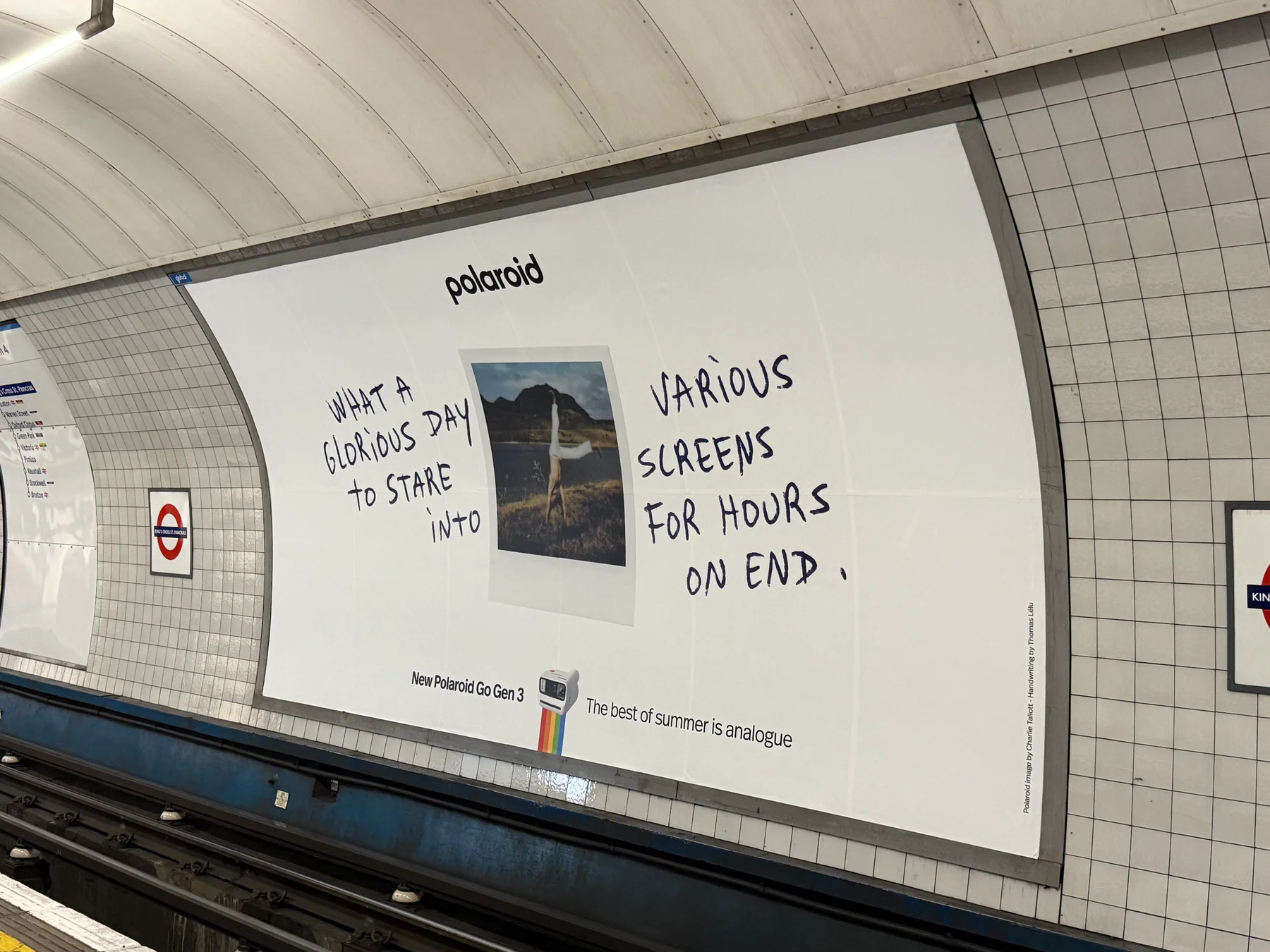
Most brands spend the summer competing for attention. Polaroid is asking people to give some of it back.
Its latest campaign, The best of summer is analog, doesn’t rely on flashy technology, oversized product shots or endless feature lists. Instead, it fills beaches, Underground stations, street corners and city walls with handwritten thoughts, instant photographs and just enough branding to remind people what the campaign is really about.
Supporting the launch of the new Go Generation 3 camera, the work stretches across New York, London and South Korea. While each execution stands on its own, together they build a remarkably consistent creative platform, one that argues the best moments of summer are the ones spent away from screens.
One campaign, many canvases
At first glance, the campaign feels almost understated.
A single Polaroid photograph sits at the centre of every execution. Around it, handwritten copy does the talking. The Go Generation 3 appears quietly near the bottom, while generous white space lets every message breathe.
Whether it appears as a giant billboard overlooking Coney Island beach, a station takeover at King’s Cross, wild postings around Bethnal Green, street murals in New York or large-format placements elsewhere in London, the visual language barely changes.
That consistency is one of the campaign’s biggest strengths. Rather than adapting the idea for different media, Polaroid allows the same creative system to travel across every location.
The result is instantly recognisable without ever feeling repetitive.
The copy does what the camera doesn’t
Most camera advertising begins with megapixels, lenses or image quality.
Polaroid barely mentions the camera.
Instead, the campaign relies on short observations that feel more like notes scribbled beside a photograph than advertising headlines.
“You can’t bask in blue light.”
“Less getting tracked. More getting lost.”
“What a glorious day to stare into various screens for hours on end.”
“Dance like nobody is recording.”
“Go jump in some water before the data centers drink it all up.”
Each line gently questions habits that have become part of everyday life. None of them asks people to stop using technology altogether. Instead, they encourage something much simpler: spending a little more time experiencing the world before documenting it.
That restraint gives the campaign an authenticity that conventional product advertising often struggles to achieve.
The beach billboard everyone talked about
Among the campaign’s many executions, one quickly became its defining image.
Installed directly on Coney Island beach, a giant billboard carried the line:
“Go jump in some water before the data centers drink it all up.” The placement is what gives the message its impact.
People arrive at the beach to enjoy summer, only to encounter a headline referencing one of today’s most discussed technology debates. According to Polaroid, the line uses data centre water consumption as a metaphor for a much broader conversation about over-digitalisation and the growing need to step away from screens.
Seen on its own, the billboard is provocative.
Seen alongside the rest of the campaign, it becomes another chapter in the same story.
The product is almost secondary
One of the most unusual aspects of The best of summer is analog is how little attention it gives the product itself.
Across nearly every execution, the Go Generation 3 camera appears discreetly beneath the headline.
That decision feels intentional.
Rather than asking audiences to admire the camera, Polaroid spends its energy reminding them why moments matter in the first place. The camera simply becomes the tool for holding onto those moments.
It is a subtle shift, but an effective one.
The campaign sells a way of seeing before it sells the device that captures it.
The same philosophy continues beyond outdoor
The outdoor campaign is only part of the story.
To extend the idea, Polaroid invited twelve creators to temporarily step away from social media. Through handwritten notes shared with their followers, they announced they would be taking a break from posting online while spending time pursuing the activities they are best known for in real life.
One example highlighted by the brand is creator @berniemor, who exchanged giving dating advice through a screen for going on dates in person.
For media and influencers, Polaroid also created a sensory seeding experience designed around birdsong, natural scents, moss and wildflowers. Hidden at its centre was the new Go Generation 3 camera, reinforcing the campaign’s focus on experiences that engage more than just sight.
Rather than feeling like separate activations, each extension follows the same creative philosophy introduced by the outdoor work.
Campaign analysis
Many campaigns promote analog photography by celebrating nostalgia.
Polaroid takes a different approach.
The best of summer is analog isn’t asking people to return to the past. It suggests that as more of everyday life becomes digital, the value of real-world experiences naturally increases.
That idea is reflected in every creative decision.
The handwritten typography feels personal rather than polished. The instant photographs remain the emotional centre of every layout. White space replaces visual clutter. Even the product is deliberately understated, allowing the campaign’s message to take precedence.
Creative Director Patricia Varella explained that the team stopped asking how to make instant cameras appealing to Gen Z and instead asked why Polaroid should exist in an AI era. According to Varella, the brand is not anti-digital. It is firmly pro-human.
That perspective gives the campaign its clarity.
Instead of criticising technology, Polaroid celebrates everything technology cannot replace: spontaneous adventures, unplanned conversations, imperfect photographs and the memories that exist long before anyone reaches for a camera.
By the time the Go Generation 3 appears, the campaign has already made its most convincing argument.
Not for a product, but for a way of spending the summer.
Credits
Concept: Polaroid Creative Studio
Creative Director: Patricia Varella
Brand Manager: Dovile Banyte
Copywriter: Rowan Hudson
Art Director: Veronika Radeva
Graphic Design: Ryan Esquivel
DTP: Alvaro Almeida
Project Manager and Producer: Galini Zachou
Senior Art Buyer: Suzanne Tromp
Senior In-house photographer: Harriet Browse
Polaroid pictures: Charlie Tallott & Alicia Karsonopoero
Handwritting: Thomas Lélu
Image editing: Loupe
Polaroid Media Team: Igor Zadorozhnyy & Tania Tysh
OOH Partner: Billups
Creator Agency: Brainlabs
This campaign is about:
Polaroid, The Best Of Summer Is Analog, Polaroid Go Generation 3, OOH Campaign, Outdoor Advertising, Billboard Campaign, Instant Camera, Creative Advertising, Experiential Marketing, Creator Marketing, Digital Wellbeing, Offline Experiences, Coney Island, London Advertising, King’s Cross, Bethnal Green, Creative Print Ads.
Popular Products
-
 Personalized PU Leather Engraved Wallet
$80.99$55.78 -
 Voice Control Wooden Digital Alarm Clock
$33.99$22.78 -
 Large Dial Stainless Steel Women’s Watch
$33.99$22.78 -
 Adjustable Custom Projection Couple Ring
$44.99$30.78 -
 Stainless Steel Custom Photo Necklace
$44.99$30.78