Tír Na NÓg
I. Electric Guitars
I don’t often review recent articles, but David Cain just put one together that hit that sweet spot between “this is a classic thought” and “this is a novel take.” So I find myself bubbling with thoughts about it. You can find it linked below:
Social Media is the Opposite of Social Life.
I have been following David Cain’s work for fifteen years now. David has a unique superpower: every article he writes feels like it applies immediately, viscerally, to my life. There are no other writers I know who so consistently track my personal experience.
Now, I’m not a fool. I don’t believe that Cain has a literal superpower that allows him to know exactly what it is that James Horton, PhD needs to hear on a given day. No, Cain’s superpower is… what’s a good word?
Ah. Resonance.
When David reacts honestly to the world, his base frequency resonates. Readers close their eyes and nod, and say to themselves “hey, this guy is my vibe.” At the same time, he is also just discordant enough that his writing adds a bit of contrast—enough to roughen his texture. The effect is electric.
Actually I think “electric” is the perfect word here: Underlying both Cain’s writing and the magic of that Fender electric guitar you bought, back when you were a teenager, is the principle of gain, or how much signal your audio input picks up. David is a master of gain, the king of audio-in. He picks up every little sound in the room, with the result that he can make walking across a parking lot feel like a guitar solo.
II. Is Social Media the Opposite of Social Life?
Anyhow Cain’s thesis in his latest article is simple: Social media promised to connect us but has done the opposite because real human connection is a body thing.
Social media, on the other hand, is not a body thing. It replaces the squishy, bodily, time-bound interactions that meat-creatures like us require in order to actually connect to other meat-creatures. You know what I’m talking about. Complex meat skills, like eye contact, reading emotions, pacing, taking turns, listening attentively. The list goes on.
That’s the core of it: You may be a demigod who juggles the lightning of awareness across a quadrillion synaptic gaps, but also? You’re made of bacon. Sorry, but you can’t escape baconspace: The bacon makes the lightning.
And the internet? It’s all lightning, no bacon. Spend too much time there and you will forget how to go back to your bacony ways.
The simplest example of this is eye contact. Far from simply removing eye contact from conversation, social media works against eye contact by allowing you to exist in a world of messages that arrive without eyes. In order to make up that gap you have to mentally emulate the person on the other end.
The more body-free conversation you have, the more you have to fill in the blanks using your imagination, but if you’re not making regular contact with people out in meatspace your imagination starts to slip out of tune.
One side effect of this is you can have people who vibe purely on the platonic level of words and ideas who do not vibe as two bodies sharing a room — hence the perennial e-dating advice; meet them in real life, quick, or you’ll never know how much of them is a fantasy you projected onto your screen.
But it’s not just your expectations that slip out of alignment. You can slip out of alignment, too. That de-tuning effect can extend to your whole life, weakening your connection to everything.
III. Baconspace
I don’t agree entirely with Cain. He argues that social media is the opposite of social life, but I think the reality is more complex: Connection is a multi-channel problem and you can’t focus too much on one channel without neglecting another. For example, it’s possible for this dissociation to go in the opposite direction: As a certain class of very beautiful, very active people often find out, there are people out there who are electric at the body-to-body level but you can’t much talk to them about anything.
So I’m skeptical about using the language of opposites. It falls apart when you slot social media into its rightful place in the larger body-to-mind spectrum.
On one end you have pure body language, absent any words at all, where our communication is at its most animal; where eye contact means only that you plan to fight or rut. A step beyond that is the human realm, the golden mean, where our body and soul are both present and conversations unfold amid gestures and glances and negotiations over who gets to hold the popcorn during the movie.
Beyond that ideal space you can subtract out the body one part at a time, and each subtraction leaves you with a well known form of communication that we engage in every day:
Remove physical presence and the in-the-room-ness of bodies and you’ve got video chats.
Remove visuals from your videos and you have telephone calls.
Remove the voices but keep your words and you have texting and messenger apps.
Remove the temporal synchrony of your messenger apps—the part where two people are communicating at the same time — and you have message boards. This is social media in the form that Cain envisions.
But you can go a step further even. You can remove the two-ness of conversation. Turn yourself into a simplified homunculus — a lone ear, listening; a single throat, speaking — and suddenly you are in the realm of… books! Books and blogs, where Dostoevsky and David Cain write (or wrote) for nobody in particular, and millions of people listen to words that weren’t meant for them but that reached them by happenstance. And yet those aimless messages sometimes produce genuine soul-to-soul resonance when they reach the right person.
This is why I object to the “opposites” framing. What seems to matter, at least as much as the modality of the communication, is the quality of the soul that passes through it.
There is, I think, a better metaphor. If I had to pick one, I would lean on the metaphor of nutrition. Your body is designed to thrive on any number of diets but if you leave out certain vital nutrients that it can’t compensate for it will start to break down in predictable ways. Similarly, I think a soul can thrive as long as it gets a good balance of life across the vital channels we’re meant to live in. As long as we get enough.
The catch, I think, is that last part. An enormous number of us are not getting enough and we are feeling it keenly, like a ravenous gnawing in our bellies. And I think that for some reason in the past few years a large number of people have been trying to get back out into the real world and are finding that some part of them has withered from neglect.
There are a hundred small rules governing face-to-face interaction with other people, all of which you get worse at if you’re away for too long. The deficiencies accumulate and leave you feeling like a fraud, LARPing at real life instead of participating in it.
So, maybe that’s why David Cain feels like social media is the opposite of social life. Who wouldn’t feel that the thing which stole that social grace from them—that marked them with the scarlet letter—was the enemy? The opposite?
It’s a natural conclusion. Easy as breathing. Or as looking someone in the eye.
IV. The Land of the Young
In Irish mythology there was an island off the western coast of Éire where the gods — the Tuatha Dé Danann — lived. The island went by many names, Tír Tairngire (the Land of Promise), Mag Mell (the Plain of Delight), or Ildathach (the Multicoloured Place) but its most emblematic name is Tír na nÓg, the Land of the Young.
In the old tale of Tír na nÓg the warrior poet Oisín, son of Fionn mac Cumhaill, king of the Fianna, is visited by the faerie maiden Niamh, daughter of the sea god Manannán mac Lir. She invites him to the island of Tír na nÓg. Taken in by her incredible beauty, he follows.
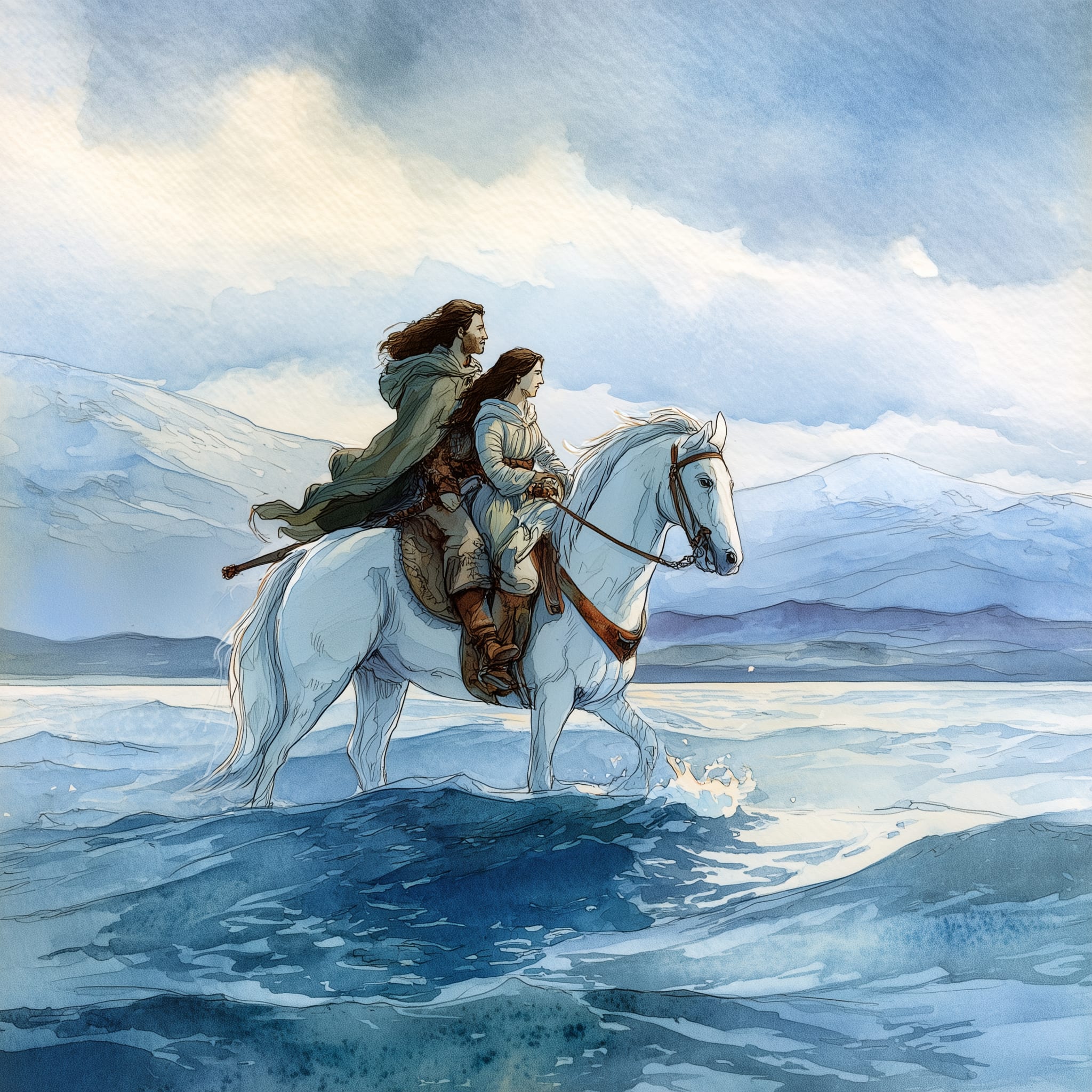
They marry, have children, and live blissfully: The days are full of hunts and the nights full of stories. But time passes and Oisín begins to long for home, and one day he tells his wife of his desire to visit his family. Niamh, pensive, agrees to loan him her white horse so that he can make the trip across the sea, but she warns him that he must not touch the ground of Éire, or he will never be able to return.
He agrees, and thunders across the sea on the white horse, elated at the thought of seeing his family again, but when he arrives everything has changed. The Fianna are gone: Where their castle once stood, there are only ruins; where their town had been the buildings are now abandoned. He learns that the time he spent in Tír na nÓg, which felt to him like a short three years, was in fact three hundred. He has been gone for centuries. His family has passed away. His people have moved on. And so he leaves, heartbroken. On the way home he encounters farmers trying to move a boulder in the road. He tries to help them, but in doing so he loses his balance and is cast from his horse, hitting the ground.
The moment he touches the ground the white horse flees back to Tír na nÓg and leaves him beihind. The weight of the three hundred years he had been gone catches up to him. He ages rapidly, becomes decrepit and bedridden, and dies shortly afterwards, telling stories of who he had been; of the Fianna; of the princess Niamh and the Tuatha Dé; of the land of Tír na nÓg.
V. Tír na nÓg
Katherine Dee is probably one of the few people on the internet who actually understands the internet. She’s also the first person I know of who made the explicit connection between the internet and the spirit world, as well as to the myth of Tír na nÓg. You can find her article, The Internet as the Astral Plane, at this link.
The structural parallels between the internet and cultural representations of the afterlife are surprising. If you’re conscientious about I think you can make the case that psychologically the two have the same “shape” — in ancient times people spent great amounts of time imagining the pleasures and perils of a world free from the shackles of the body. About thirty years ago the internet actually gave us that world, and when we explored it we found that many of those ancient intuitions were true, and they haunted us.
I think what is happening in David Cain’s essay is that we are porting old intuitions over to the digital age. Many cultures treat the world of spirit and the world of flesh as opposites. It’s an old intuition, and a resonant one — the same that makes people wary (or derisive) about those who spend too much time reading books.
The reality is more nuanced. But the principle of neglect is true: Spirit and body may not be true opposites, but to neglect one puts all of you at peril, and if you’re not careful you won’t know until it’s too late.
What’s happening now, I think, is that many of us are growing tired of this digital otherworld that has kept us suspended and ageless for so long. We’re hungering for the wild grass of Éire, and the memories of being strong once, and brave. And when we do go back—quite literally, when we touch grass—we have to reckon with the weight of those lost years as they lay themselves upon our shoulders.
The biggest mercy is that unlike Oisín our debt is measured in decades, not centuries. We don’t have to crumble to dust. There’s still time to build, to tell new stories alongside the old, to make sense of who we are and where we are going.
If you made it this far, you should subscribe. ;-)
,
Popular Products
-
 Personalized PU Leather Engraved Wallet
$80.99$55.78 -
 Voice Control Wooden Digital Alarm Clock
$33.99$22.78 -
 Large Dial Stainless Steel Women’s Watch
$33.99$22.78 -
 Adjustable Custom Projection Couple Ring
$44.99$30.78 -
 Stainless Steel Custom Photo Necklace
$44.99$30.78