The Last Upheaval: Fahrenheit 451 Meets Kingsnorth’s Against The Machine
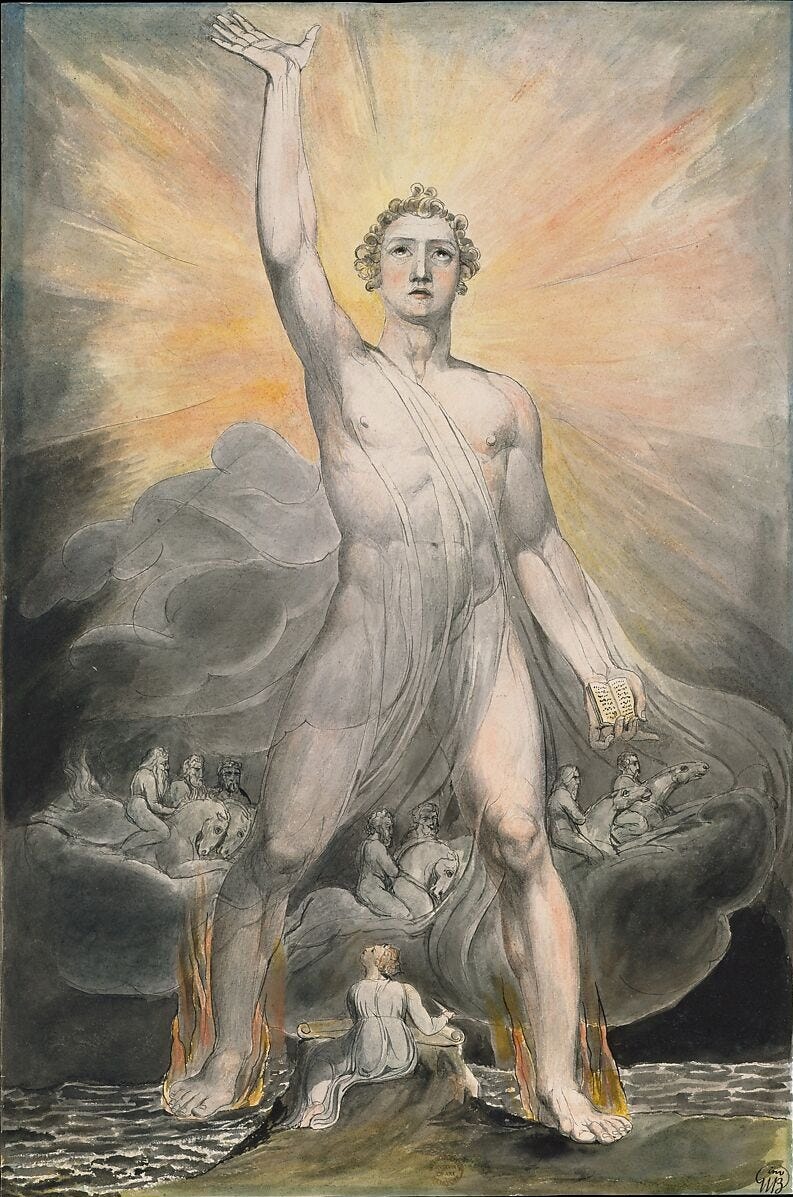
Peco and I are currently working on an upcoming piece (“How to Prepare for the Future, in Alphabetical Order”) and hope that you’ll enjoy today’s new release from School of the Unconformed Press!
Over the last few weeks newsmakers, pundits, and industry insiders informed the public that “p(doom)”—the probability that AI will wipe out humanity—is not mere fiction. A quick look over recent headlines creates an ominous collage:
Amid this maelstrom of headlines and opinions, it’s hard to know what is really happening, or how we might best respond. One way to solve the problem is to read more headlines and more opinions. The other is to read more fiction. While news approaches the world by attracting eyeballs on trending topics, fiction approaches it by bringing us back to the fundamentals of human life. Or as Ralph Waldo Emerson more clearly put it, “fiction reveals truth that reality obscures.”
You cannot hope to understand the potential impacts of AI if you don’t read science fiction. I stress the word “read.” Distant memories of watching 2001: A Space Odyssey, The Terminator, and The Matrix don’t count. -
Long-time readers of School of the Unconformed know that we don’t deal in doom, but in all our work aim to provide insight and hope. And sometimes hope comes in the form of a book:
I’m excited to announce that today we’re launching The Last Upheaval! Fahrenheit 451 meets ’s Against the Machine in this gripping sci-fi thriller that confronts our AI moment through the lens of a dystopian future eerily close to our own.
What if the technological and spiritual worlds start colliding?
What if the Apocalypse isn’t what everyone thinks it is?
What if the battle for AI supremacy is ultimately a battle for the human soul?
The Last Upheaval is a stand-alone prequel to the well-received dystopian sci-fi novel Exogenesis.
The Last Upheaval is a novel about the perils of technology in a society in decline, and one man’s battle to protect his family. Since I typed the first words of the story four years ago, we have witnessed the emergence of AI, humanoid robots that run faster than Usain Bolt, and biological computers wired with human brain cells.
Our times are so strange, and moving so fast, that all our reference points are changing. For a decade and more through 20-teens and early 2020s, we complained that smartphones were distracting us—and they still are. And yet to say you are “distracted” is to know you are distracted from something: you still have a notion that you have moved off a normal baseline into something not normal. Now our baseline feels like distraction itself.
We expect to be constantly google-tasking, talking to AI, looking at a screen, and we notice it less and less. In 1991 Mark Weiser observed that “the most profound technologies are those that disappear. They weave themselves into the fabric of everyday life until they are indistinguishable from it.” We are becoming increasingly blind to the very things causing upheaval in our lives.
If we are to survive the future as fully human, we need to recover our sight. This is why I wrote The Last Upheaval. Not to just regale readers with yet another sci-fi dystopia of the near-future, but to turn the pages of fiction into lenses with which to see more clearly the world before us, and how we might respond.
Ideas govern our choices, and woven throughout the novel is an idea from William Blake’s poem, “The Tyger”: Did the same God who created good also create evil?
This is an old question, a moral paradox—why would a “good” Creator create evil? And to ask this question seriously is to risk a more disturbing question: Is there any Creator at all? Maybe there’s just us, chance-evolved bipeds with three-pound brains making a mess of things with our insane innovations?
The Last Upheaval is my answer, shaped by a Christian worldview. And one of the biggest parts of this answer is that we can’t have all the answers, that the search for certainty in any age is hard, but in a digital age is like finding a needle in a constantly growing haystack. But that doesn’t mean there isn’t hope. It does mean that to survive a time of tectonic (and tech-tonic) change, we must do more than just the practical things like “adapting” as best we can—while storing up cash, dry goods, and fuel for the generator in case things take a turn for the worst. Adaptation is all well and good. But beyond that—and this gets to the heart of the story—we need prayer and humility and unyielding determination in the face of great odds and overwhelming doubts. Even if it breaks us.
And maybe especially then. Because that’s when the miracles happen.
“To read fiction means to play a game by which we give sense to the immensity of things that happened, are happening, or will happen in the actual world. By reading narrative, we escape the anxiety that attacks us when we try to say something true about the world. This is the consoling function of narrative — the reason people tell stories, and have told stories from the beginning of time.”
— Umberto Eco
“This book is tech dystopia meets re-enchantment. It’s Fahrenheit 451 meets The Screwtape Letters. And it works. If you want to get a taste of the types of places the AI boosters might take us, and how we can resist, read this book.”
— , Headmaster at All Saints Classical Academy, furniture-maker, author of Education’s End, and co-author of Are We All Cyborgs Now?
“Peco Gaskovski’s novel is contemporary Bradbury with a classical Christian heart. I hesitate to use “Christian” in this context, lest I cast the wrong idea. Most Christian works are kitsch, religious baubles attempting to odorn banal stories regurgitated in sanitized, clichéd prose. But The Last Upheaval is genuinely humanizing without being shrill. It will compel you to stare into the mirror of modern machine culture and confront the real Mereman. Similar to Leontius, the son of Aglaion, you won’t be able to tear your eyes from its pages despite the growing lump in your throat.” — Dr. , , author of Becoming Classically Educated
“The Last Upheaval is a chillingly plausible glimpse into a world enslaved by The Machine - a powerful call to reclaim our humanity before it’s too late. Gaskovski writes with the same unflinching insight that made Exogenesis unforgettable, weaving faith and spirituality into a story that refuses to let readers stay passive observers. This science fiction with a soul is a warning we’d be wise to heed.” — ,
“This book is much deeper than a merely dystopian tale of the danger of technology...the books’ real genius lies in its examination of the societal and human damage of a world connected and dependent on a technological utopia that fails to build resilience and must resort to terror and cant.” — , Historian, author, educator
Many more reviews on the way….
A new era of publishing has arrived, with trust front and center. The Wall Street Journal proclaims that publishing is in turmoil and that there will be a “reckoning over creativity, trust and the future of the industry”. Fully human writing matters, and by supporting our work you can help us take a stand now.
AI will not be a tool, to be used and then locked up in the cabinet when we are done, nor just an obsequious digital assistant who keeps popping out of our screens with cheerful advice. It will be an invasion of chatbots and robots and myriad babbling devices, swarming over every part of society, taking over jobs, teaching our youth, giving dating advice, writing novels, preaching sermons, making movies, and churning out essays faster than we ever could.
And it will challenge our ability to trust each other like no other invention in human history.
This is why School of the Unconformed Press places reader trust at the core. We stand behind human authors who reject the use of AI in all aspects of the writing process.
To read a book is to commune with the mind of another. We publish fiction and non-fiction that speaks to the most urgent questions of our time, yet is timeless. Our goal is to ensure that you, as a reader, are communing with minds you can trust, and that leave you more human when you turn the last page.
If this work speaks to you, and you want to support fully human creations, pledge your support for our Kickstarter, which will help fund The Last Upheaval and many more future projects! The wonderful thing is that you can pledge any amount, starting at $1 :)
As a special THANK YOU, everyone who pledges their support by the end of launch day 11:59PM EST, September 25th, will be entered in a draw for a School of the Unconformed Press tote bag!
The front of the tote displays the SUP logo1 and the back features one of my all-time favorite Wendell Berry quotes:
“I am saying, then, that literacy—the mastery of language and the knowledge of books—is not an ornament, but a necessity. It is impractical only by the standards of quick profit and easy power. Longer perspective will show that it alone can preserve in us the possibility of an accurate judgment of ourselves, and the possibilities of correction and renewal. Without it, we are adrift in the present, in the wreckage of yesterday, in the nightmare of tomorrow.”
So, get your hands on a copy of The Last Upheaval by pledging your support:
Books these days mainly gain traction via social media posting and word-of-mouth. *Liking*, Restacking, and sharing this post here and on other platforms is hugely helpful.
Popular Products
-
 Book Lovers Stainless Steel Openable ...
$45.99$31.78 -
 Custom Letter Bracelet with Heart Eng...
$37.99$25.78 -
 Personalized Eye Photo Bracelet with ...
$43.99$29.78 -
 Vintage Adjustable Hug Hands Ring
$35.99$24.78 -
 Personalized Leather Photo Keychain M...
$133.99$92.78