Write What Only You Can Write
I highly recommend reading this blog post by Maciej Cegłowski about Argentina’s unique food culture.
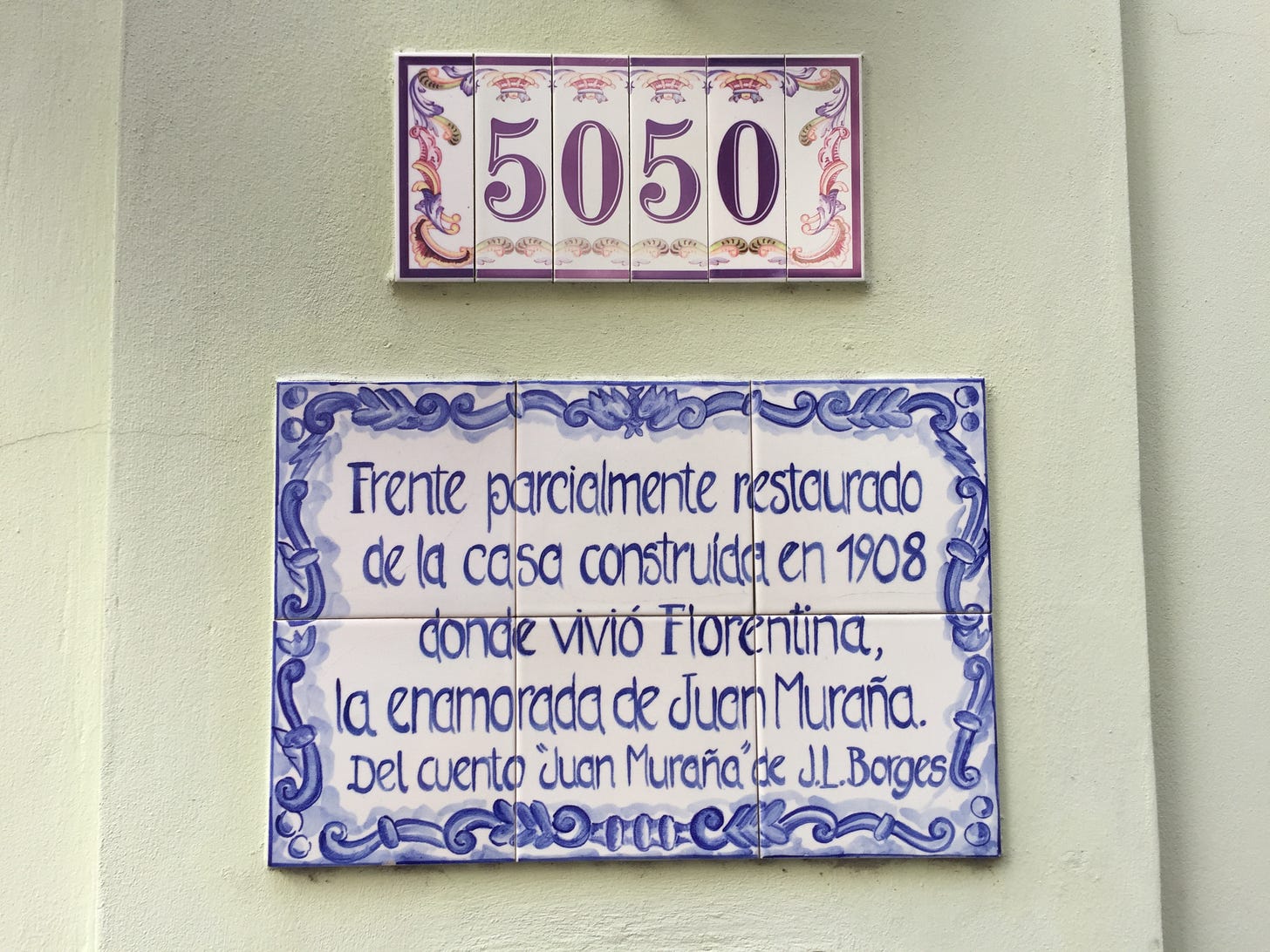
In 2019, my wife and I spent two months traveling through Argentina. We trekked through Patagonia, stumbled upon houses straight out of Borges short stories in the narrow alleys of Buenos Aires, and, yes, ate our fair share of steak.
But beyond summoning fond memories from our trip, what makes Maciej’s post worth reading? Why is it so good?
I believe the magic lies in how completely the author commits to only writing about what delights and interests him. Whenever we write something, there’s a chance that others will read it, and we often curtail our trains of thought to conform to what we imagine others will find acceptable.
Doing so sabotages our work, because the same armor that shields us from embarrassment also bars us against the very sense of connection that art aspires to engender. If we pretend to be normal, we doom all other weirdos to loneliness, forgetting that each of us is weird in our own way, and that what is weird about us is precisely what others find most interesting.
It doesn’t matter what medium you’re writing for. Jerry Seinfeld knew that leaning into his idiosyncratic point of view was the way to make the show good:
Q: You and Larry David wrote Seinfeld together, without a traditional writers’ room, and burnout was one reason you stopped. Was there a more sustainable way to do it? Could McKinsey or someone have helped you find a better model?
JS: Who’s McKinsey?
Q: It’s a consulting firm.
JS: Are they funny?
Q: No.
JS: Then I don’t need them. If you’re efficient, you’re doing it the wrong way. The right way is the hard way. The show was successful because I micromanaged it—every word, every line, every take, every edit, every casting. That’s my way of life.
Leave efficiency to the machines. As Adam Kirsch points out, in a world where computers can write prose, it is more important than ever for human writers to write the things that only they can write:
When photography was developed in the 19th century, it replaced painting for most utilitarian purposes; a camera could document what things looked like more accurately and cheaply than a painter could. But the art of painting didn’t die out. On the contrary, it entered a golden age: Freed from the obligation of realism, painters developed radical new ways of seeing, such as Impressionism, Cubism, and abstract expressionism. Now AI has the potential to liberate literature in the same way. In a world full of emptily competent prose, we need writers daring, challenging, and obstinate enough to tell us what it’s like to be human, “from the inside.”
Writing about whatever you’re uniquely obsessed is hardly a new approach, it’s the basis of all good writing. The only new thing is that writing about anything else is less valuable than it used to be, and it was never that valuable in the first place. Life is short. If you’re going to write, write something worth reading.
Write what only you can write.
A book I love that you might too
The Making of the Atomic Bomb by Richard Rhodes is one of the best history books I’ve ever read. So often, histories are either comprehensive or compelling, but Rhodes accomplishes both. The story follows the scientists who developed our understanding of the atom through theory and experiment, some of whom precipitated and then led one of the most ambitious national endeavors in the history of civilization, The Manhattan Project. Meticulously detailed and surprisingly propulsive, this book will change the way you think about science, war, and what humanity is capable of, for better and for worse.
Ukrainian honeypots
Ken Harbaugh’s Atlantic article reads like a techno-thriller:
For several months last year, a Ukrainian housewife, 35 and lonely in a marriage that had gone cold, traded WhatsApp messages with a Chechen commander, Achmad, stationed somewhere in Ukraine’s occupied south. They wrote about their days, their disappointments, what they hoped to do when the war ended. She asked about the front. He told her.
“Send me a picture,” she said. “I want to see your life.”
One afternoon, he obliged—a photograph taken inside the barracks, of himself and another soldier grinning for the camera. Behind them, pinned to the wall, was a map of the compound showing the unit’s position.
The housewife did not exist. “She” was a middle-aged officer named Serhiy working for Ukraine’s military-intelligence directorate, part of a concerted effort to draw secrets from the men sent to occupy his country.
“Serhiy was great at flirting,” his commander told me. “Guys in our team started asking him for dating advice.” Shortly after Achmad sent that photograph, the coordinates it revealed were struck by a Ukrainian drone.
Writing a novel for the first time, every time
Every time I write a novel, it feels as though I’m discovering how to write a novel for the first time.
This used to frustrate me because I figured I should have learned how to do it by now, but then I realized that’s just what learning feels like when you push yourself to do your best work.
Thanks for reading
We all find our next favorite book because someone we trust recommends it. So when you fall in love with a story, tell your friends. Culture is a collective project in which we all have a stake and a voice.
Best, Eliot
Eliot Peper is the author of twelve novels, including Foundry, Bandwidth, Cumulus, and, most recently, Ensorcelled. He is also the head of story at Portola and works on special projects.
“In an era of stories unspooling endlessly, loose and lazy, Ensorcelled is a tonic: tight, bright, spring-loaded. Here is proof that you can spin up a whole universe in 100 pages or less, and proof that a warm, encouraging tale can have teeth-clenching tension at its heart. Here is my favorite Eliot Peper book yet!”
-Robin Sloan
Popular Products
-
 Brightening & Hydrating Rose Facial C...
$154.99$107.78 -
 Pheromone Long Lasting Attraction Per...
$88.99$61.78 -
 Crystal Glass Rose Table Decoration w...
$137.99$95.78 -
 Mini Facial Hair Trimmer with Replace...
$15.99$9.78 -
 Whitening & Spot Removal Skincare Set...
$201.99$140.78