Yes, Being Richer Will Help You Get Married
There is a lot of dating advice out there. It is largely horrible. Today I will give you extremely good advice for falling in love with a wonderful person:
Earn more.
I know this will annoy people. “You shouldn’t marry for money.” “That’s shallow.” “Nobody wants to be loved for their money.” “That’s not exactly an easy thing to do.”
I agree with all of that. So before I show you the evidence that being less poor is the best thing you can do for your love life, I will first give you a mental model for thinking about how money matters for love.
Note: I had Claude to my math for this post, though I’ve done similar analyses myself many times in the past. I did not detail check all the analyses.
As usual, yes, there’s a paywall. Before the paywall you’ll learn why and how much money matters for love. After the paywall you’ll learn the extent to which money matters more than being hot and loving God, and some thoughts on if you can simply earn more money. One way to help me earn more money is to…
How Money Matters for Love
To understand how money matters for love, we need to understand how it doesn’t matter for love.
Most people marry their spouses before they are at peak income, and as a result most marriages will not be formed directly responsive to specific earnings. In the vast majority of cases, except the crassest of gold-diggery, most people don’t specifically select the objects of their romance through a direct income-weighting algorithm. They don’t, like, compare three candidates they are attracted to, then review their incomes, and settle on the richest one.
In fact, they tend to do the exact opposite! Usually, both men and women alike set an economic floor for their desires. How that set that floor varies. Maybe they use education as their proxy for economic resources. Maybe “coming from a good family.” Maybe race. These all amount to proxies for economic resources. How do we know this instead of the other way around (i.e. economic resources proxying for latent social status)? Well, it’s pretty simple— first, economic resources really do confer massive life advantages. Being married to somebody of aristocratic lineage who has no money doesn’t actually get you much.
Second, people who surprisingly get rich actually do marry better mates! Imagine some random guy, and in one scenario, he invests in a company that doesn’t do very well; in the other, he invests in a company and becomes extremely rich from it. Do we think his romantic options will vary? Obviously! And the same for women— is a woman who is independently wealthy going to marry the same man she would have if she was destitute? Of course not. There is quite a bit of academic evidence that when peoples’ economic situation deteriorates, their mate quality worsens.
The third way money matters for love is by establishing social status (i.e. the group of people you hang out with), since “social status” is actually just residual economic resources. I wrote that sentence in the first draft and then had a small note about Norman elites and how their massive wealth after the Conquest gave them centuries of residual status as they gradually spent it down. But then that turns in to a Whole Thing. So, I was gonna write an extensive note about Norman elites. But then it was, well, just too much— so dear reader, an extensive “How elite were the Normans?” post is now coming. But the TL;DR is this— social status is established mostly by being rich. The Normans became elites in Britain by seizing the land— at peak they personally owned probably 75% of the land in England. As long as land was the source of wealth, their top position remained essentially unchallenged. But, over time, land ceased to be the main source of wealth— the industrial revolution happened. Virtually instantaneously, Norman over-representation in parliament, elite institutes, and just raw wealth ratios began to evaporate. In England today, Normans are not particularly elite— they average maybe just 2-10% richer than other European-ancestry people in England. In other words, once the economic basis for Normans being rich evaporated, so did the social status, within a few generations. Social status is is caused by money, not, primarily, the other way around.
The reality is marriage is a big decision, and it’s an economic decision. Across cultures, marriages sometimes involve romantic love, and sometimes don’t; but marriages always involve mingling of property and economic interest between the spouses (and their kin in many societies). Marriage is first and foremost a material question, and, where local culture permits, it may also be a romantic question. Because marriage fundamentally is and remains today an institution which exposes spouses to one anothers’ economic choices, endowments, and liabilities, people considering marriage will almost always consider finances.
Thus, the main way money works in romance is not that people choose a partner for their money, but rather that they set a floor for the minimum economic resource contribution they set for a partner. Most people, if they’re willing to admit it to themselves, actually do see certain potential partners as too poor to be yoked to.
But what about poor college students getting married, you may ask? Well, again, most people are trying to proxy lifetime earnings. If you wait for a partner to complete their lifetime earnings, well, they’d be very old. So marriage involves a sort of complicated prediction game— you’re looking for signs that a potential partner will be something like a credible peer companion in terms of ability to contribute to your Family, Inc. You may not think this is what you’re looking for, but 1) it is, you’re lying to yourself and 2) it’s what everybody else is looking for. The wrinkle here is that actual earnings can be a very credible signal of earning potential. College major, grades, personality, family money— lots of stuff can signal ability to earn. But earnings, for sure, are a decent signal of, well, earnings.
Another way money matters for love is it alters how people are perceived. The truth is, most of us are information-constrained. We don’t actually know much about most social contacts. How many of your friends have you actually observed, at their work, in a way where you could assess their performance? Do you even understand their jobs? Maybe yes, but often no. Most of us rely on subtle social cues to assess other people. If we observe that people around us treat someone as if they are clever or smart or beautiful, we may be slightly nudged to see that person as clever or smart or beautiful. We shouldn’t overstate this, it’s not as if our peers can brainwash us into seeing a total idiot as a genius, but the truth is our judgments of most people will have wide standard errors. Seeing how other people (who may possess different information about them) treat them helps us gauge how we should treat them. Again, maybe you think you don’t do this, so I’ll just say again, you’re lying to yourself. It is universal, and not at all shameful, to modify how you treat someone based on the information you passively or actively acquire from social signals like “How other people treat that person.” If everyone around you acts offended by someone, it’s not totally crazy to guess that person said something offensive! If you don’t get it, there’s a chance everybody else is crazy, but there’s also a decent chance you’re missing some vital piece of social information.
This can, of course, create horrible social cascades, situations where a few people who act as if they are well-informed about others can radically shape perceptions of others in untrue ways. This is a classic “Mean Girls” scenario. But the fact that we all know that false gossip does work to tear people down should give us pretty strong evidence that most of us are highly reliant on third-party signals of other peoples’ status.
This is a roundabout way of saying, people laugh more when a rich guy tells a joke. It may be subtle, but because at every rung of income that person has probably had more chances to invite a friend to his lake house, or do him some kind of favor, or provide a dinner, or bail him out, richer people will tend to get more positive default reactions from their real-world social circles (not online). There’s nothing particularly sketchy about this— a rich and a poor man of identical virtue nonetheless will have different opportunities to actually help out a friend in need. The rich man has more chances to do it, and, presupposing identical virtue, will in fact do other people more favors, so more other people will see him as a favor-doing-kind-of-guy. Now, we could suggest that riches corrupt him over time— fair enough, I don’t disagree, but in a given point in time, again, money makes a person funnier and hotter. A poor slob is a slob; a rich slob is an eccentric.
For all these reasons, being richer really is likely to improve your romantic odds. When you can more plausibly project credibility as an earner, you will rise over more potential partners’ minimum floors for a credible partner, and in particular the floors of other rather well-off people. People will be more forgiving of your quirks, and as you find well-off people more interested in you, you may find their well-off-ness also makes you forgiving of their quirks.
At no point does any of this mean people just marry for money. The set of people who exceed your economic floor, and for whom you exceed their floor, and where each of you find your quirks tolerable given your assets, almost certainly is a set containing more than one person. It is likely a set containing many people. Among those people, your choice will likely be made by things like love, attraction, affection, mutual respect, shared values, shared faith, etc, etc. The economic considerations are often “solved” for you by social systems sorting you into similar-income-peer-groups, so you never even notice that you never even considered dating a poor person. Your phenomenal experience of the marriage market is purely guided by these kinds of less-materialistic considerations, because society filtered out everybody who didn’t meet your economic criteria before you even knew they existed.
I’m genuinely sorry you aren’t getting the Norman historical digression today. I’m so sorry. I’ll make it up to you if you just…
Money Matters for Love
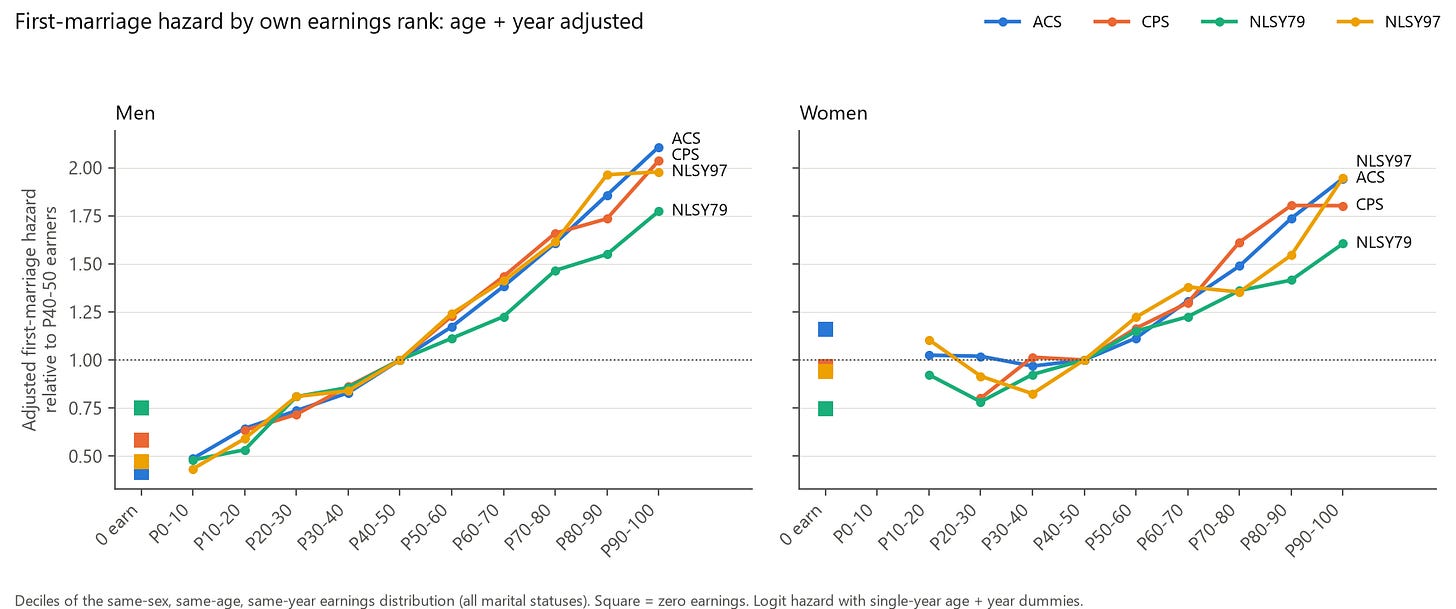
Money makes people marry more. We can see how accumulated lifetime income for age shapes subsequent first-marriage odds in two longitudinal sources (NLSY79, NLSY97), how point-in-time income influences first marriage odds in one longitudinal source (CPS longitudinal rotations), and also in one very large cross sectional one (ACS).
For men, the income-first-marriage gradient is ludicrously strong. Compared to men at the median lifetime accumulated earnings rank for their age (P40-P50), men in the top 10% are ~TWICE as likely to get married in a given year. Likewise, odds drop by half down to the bottom 10%. Thus, across the income spectrum, there is a 400% variance in odds of marriage based on earnings, for men. Comparing NLSY79 to NLSY97, the importance of earnings for male first marriage odds has risen over time.
The story is not as strong for women… but it’s still obviously pretty strong! There’s basically no penalty for women being poor— marriage odds are similar at the 15th percentile and the 50th for women’s earnings. But being a high-earning woman is a solid pathway to love. Women’s odds of a first marriage are, again, between 50% and 100% more for top-10% earning women vs. median women. And again, this got stronger between NLSY79 and NLSY97.
It’s not just that “women want providers.” No. Income in marriage is not just about gender roles. Money in love is about making sure you build Family, Inc. with a suitable co-founder. Even if women become SAHMs after marriage, their premarital earnings are a good signal to a husband that if it came down to it and the family needed it, she could help keep the company running in lean times.
Here’s the gradients within age:
Again, you can see that the effects are bigger for men, but within every age group, earning more predicts better odds at a first marriage.
So here’s that paywall we discussed.
Popular Products
-
 Pure Essential Oils for Diffuser and ...
$60.99$41.78 -
 Lash Lifting Lotion Sachets for Perm ...
$65.99$45.78 -
 Cherry Blossom Face Peeling & Brighte...
$13.99$6.78 -
 Personalized PU Leather Wallet with P...
$35.99$24.78 -
 Rose Flower Pendant Necklace for Wome...
$34.99$23.78