6 Exercises That Build Bone Density: Saturday Action Plan
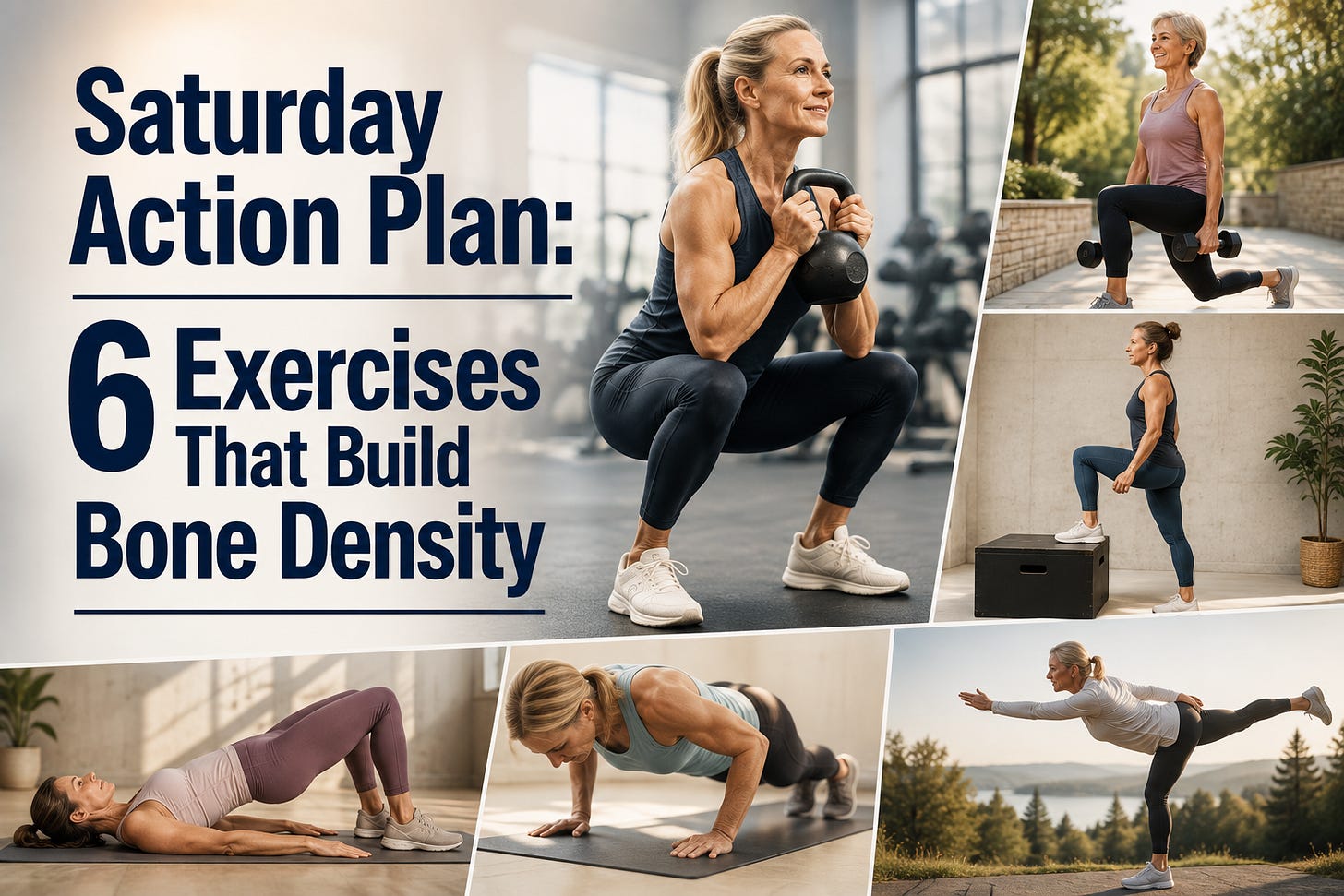
I love bones… I should; I am an Orthopedic Surgeon. I see the potentially awful effects of bone density loss every day in my office. We are going to once again review and demonstrate 6 key bone-building exercises. Falls are going to happen… but you’ll stay independent longer if you don't break something from a low-energy, ground-level fall… One way to reduce fracture risk is to build bone density. Let’s do this.
1 in 3 women and 1 in 5 men will develop osteoporosis.
Women will spend more time in a hospital for osteoporosis-related fractures than for breast cancer and heart disease combined. 1 in 5 people who fracture their hip ( Men and Women) die within a year, and 50% are never functionally independent again. Those are very sobering statistics.
My point being… Regardless of your sex, your bone density matters. A lot.
You should start building bone density early and keep building. It’s much harder to play catch-up. But it’s never too late to start. Even if you already have osteoporosis. For women, especially, you will be in a far better position if you begin these exercises before you enter menopause. But… they are safe for people with osteoporosis, as long as you have guidance.
Not enough people have DEXA scans to determine their bone density. Most people find out they have osteoporosis the same way they find out they have a lot of things in medicine: something breaks. A wrist fracture after a minor fall. A vertebra fracture after lifting something that shouldn’t have been a problem. A hip fracture that changes your life in a moment.
Your skeleton is living tissue, constantly remodeling itself in response to the demands you place on it. Bone is not inert. Skeletal biology is responsive and will always respond, regardless of your age. Most people in their 40s and early 50s don't load their skeletons anywhere near the threshold needed to maintain bone density, let alone build it, and most have no idea.
ICYMI:
I wrote a long post discussing bone biology, why we lose bone density, and other reasons why our bones are awesome. You can read it here.
There is a downloadable guide at the end to take to the gym with you.
Why Your 10-Pound Dumbbell Is Not Enough
Bone responds to mechanical load. This is Wolff’s Law. Your osteoblasts, the cells that build new bone, activate with strain, and below a certain threshold, they simply don't activate. Above it, they lay down new material. Your skeleton is always looking for a specific signal.
If you’re not interested in the science behind these recommendtions you can skip down to the 6 Exercises section below.
This force or strain threshold matters. Research shows that to stimulate new bone formation, the skeleton needs to experience ground reaction forces of roughly 3 to 4 times your body weight. No, this is not the weight you need to lift. It is the total force your skeleton absorbs during an activity, and the difference between activities can be dramatic.
There’s a huge difference between activities that maintain bone density and those that convince our body to build or increase bone density. This article reviews exercises that build new bone. If you are osteopenic or have osteoporosis, you need to build new bone.
Walking produces about 1.2 times your body weight, which is healthy but nowhere near sufficient to build bone. Jogging produces about 2 to 2.5 times the force, which helps slow loss, but still falls short at most skeletal sites. Jumping produces 4 to 6 times body weight and is above the threshold, giving your osteoblasts the signal they need.
Heavy resistance training at 70 to 85 percent of your one-rep maximum (I’ll explain) produces the necessary force for the spine and hip, which is why heavy resistance training is the cornerstone of nearly every evidence-based bone-building protocol.
Your 10-pound dumbbell curl does not come close to any of those thresholds. Neither does the rebounder your neighbor swears by, because the mat absorbs the impact and reduces the ground reaction force to something closer to walking. It is a useful balance tool and has real value for fall prevention. But it will not build bone.
You do not need to do a large volume of high-load work to get the signal to start building. You need enough, done consistently, over time.
The Liftmor Study
The LIFTMOR trial, published in the Journal of Bone and Mineral Research in 2018, is a landmark study in this space. Watson and colleagues randomized postmenopausal women with low bone mass to either a high-intensity resistance-and-impact training program, called HiRIT, or a low-intensity home exercise program. The HiRIT group trained twice a week for 30 minutes each session. The exercises were heavy and supervised.
The HiRIT group showed meaningful improvements in lumbar spine and femoral neck bone mineral density. They also improved strength, posture, and functional performance. The low-intensity group showed no meaningful change in bone density.
This is important because many of you with osteoporosis fear heavy weightlifting. Despite heavy loading, jump landings, and training women who already had compromised bone mass, there were no bone stress injuries (fractures) in the HiRIT group.
A well-designed, supervised, and progressively loaded program has a very low risk of causing fractures. Fragility causes fractures, and the fear of loading is itself a risk factor for the fragility that produces them. This is very important. Fear pervades most discussions about exercising people with osteoporosis or osteopenia. That fear leads to less loading and worsening bone loss. The implications and risks of the loss of bone mass are far worse than the risk of fracture from performing these exercises.
The broader literature adds an important point on dosing: 40 to 50 high-impact repetitions per session, two to three times per week, is sufficient to drive measurable improvements in hip and spine bone density. Beyond 50 to 60 impacts per session, benefits plateau, and injury risk begins to climb. More loading is not always better loading.
“I Can’t Lift Heavy — I Have Osteoporosis”
I see this everywhere online, and I understand where it comes from. If your bones are already ‘fragile’, loading them heavily feels like exactly the wrong thing to do. It is an intuitive fear, and it is almost completely backward.
The fear assumes that the bone is so fragile that additional load will break it. The data actually show that the bone became fragile because it was not loaded enough. The solution is not to keep not loading it.
The skeleton does not strengthen through protection. It strengthens through demand.
The LIFTMOR trial enrolled postmenopausal women who already had osteopenia or osteoporosis, women whose bones were already compromised, and put them through a high-intensity resistance and impact program twice a week for eight months. No bone stress injuries or fractures occurred… Only meaningful improvements in bone density, strength, and function.
The risk calculation is fairly straightforward. A hip fracture in an older adult carries a one-year mortality rate of roughly 25 percent. Half of those who survive never walk independently again. That is the cost of fragility. The risk of a well-supervised, progressively loaded strength program is a muscle strain or a bruise.
These are not equivalent risks, and treating them as equivalent, as avoidance does, is too risky. It is a decision to accept the larger risk in order to avoid the smaller one.
Lift heavy enough to matter. Progress gradually. Get a professional to guide you on how to perform the exercises and progress them.
The 6 Exercises To Build Bone Density
The LIFTMOR protocol uses five barbell lifts and one impact exercise. Together they load the sites most at risk in osteoporosis, the lumbar spine, the femoral neck, and the wrist, while also building the strength, balance, and coordination that reduce fall risk.
I will show demonstration videos… BUT—if you are new to them, have someone teach you and supervise you! As I mentioned, the Liftmor protocol uses 80-85% of the weight you can do once. That’s a heavy lift. You need proper training to do them correctly and avoid injuries.
This is for informational and educational purposes only and is not a substitute for professional medical advice, diagnosis, or treatment. This program involves heavy loading and impact work. If you have osteoporosis, osteopenia, a history of fragility fracture, or any condition affecting bone strength, get clearance from your physician and consider working with a physical therapist or trained professional before starting. Participation is voluntary and at your own risk.
1. Deadlift
The deadlift loads the posterior chain, spine, hips, and femoral neck with significant axial force. It is one of the most effective exercises for spinal bone density. Technique matters here more than almost anywhere else. Learn it well before loading it heavily.
2. Back Squat
The squat loads the lumbar spine and the hip simultaneously, and it trains lower-body strength that helps protect the hip during a fall. The bar position on the upper back creates the compressive spinal load that drives osteogenesis at that site.
3. Overhead Press
The overhead press loads the spine through axial compression while also training the shoulder girdle and upper back. Posture and spinal extension are improved. For women who are losing height due to vertebral changes, this matters. These can be done with dumbbells, too.
4. Bench Press (or Incline Press)
The bench press loads the upper body and trains the pressing musculature that helps break a fall with the arms. It also contributes to wrist loading, one of the most common sites of osteoporotic fractures.
5. Chin-Up or Supported Row
Pull strength is chronically undertrained and critically important. The chin-up or a heavy-supported row loads the spine through traction and builds the back musculature that maintains upright posture as the years pass.
6. Drop Landing (Box Jump Landing)
This is the impact component. Stepping off a low box, 8-12 inches, and landing with control generates a ground reaction force of 4 to 6 times body weight. This is the signal the bone needs, and no amount of walking or light resistance work provides. The key is control on landing, soft knees, hips back, absorbing the force rather than collapsing into it.
What Weight to Use, and How to Find Your Starting Point
The LIFTMOR protocol used loads at 80-85% of one-rep maximum (1RM). You do not need to test a true one-rep max to get started. Find a weight you can lift for 5 repetitions with good form, but not 6. That is approximately 85-87% of your 1RM. If you can do 8 repetitions before form breaks down, you are at roughly 80 percent. Use that as your working range and build from there.
How to Start, and How to Progress
Again, please work with a professional to learn these exercises well.
Weeks 1 to 4: Foundation
Bodyweight and light barbell work. Learn the movement patterns. Establish hip hinge mechanics, squat depth, and overhead positioning. Add low box step-downs, 2 sets of 10, twice per week.
Weeks 4 to 8: Introduction to Load
Begin adding weight to each lift, aiming for 3 sets of 5 repetitions at a weight that is challenging but technically clean. Add drop landings from a low step, 3 sets of 10, twice per week.
Weeks 8 and Beyond: Progressive Overload
Add weight to the bar when you can complete all sets with solid form. Aim for 2 sessions per week, 30 to 45 minutes each, following the LIFTMOR structure. Keep drop landings at 40-50 total reps per session. Progress the box height gradually.
The program does not need to be complicated. Two sessions per week, six movements, progressive loading over months, and the consistency to keep showing up determine the outcome more than anything else.
A Note on Professional Guidance
If you have osteopenia or osteoporosis, or if you have never trained with heavy barbells, start with a physical therapist or certified strength coach who understands bone health. The program is not dangerous when properly taught and progressively loaded. It can be dangerous when ego overrides technique. A few sessions to establish form are worth considerably more than months of training with poor mechanics.
If you are healthy and have been lifting for years, you are probably already doing most of this. The question is whether you are loading it heavily enough. Lightweight movement, repeated many times, does not provide the signal your skeleton needs. Heavy weight moved well, a few times, twice a week, does.
Your bones are listening. Give them something worth responding to.
For the full science behind bone loading, Wolff’s Law, ground reaction forces, nutrition, hormones, and what the rebounder and vibration plate research actually shows, read my earlier deep-dive here: Osteoporosis Prevention and Treatment.
Disclaimer: This is for informational and educational purposes only and is not a substitute for professional medical advice, diagnosis, or treatment. Always consult your physician before beginning a new exercise program, particularly if you have a history of fracture, osteoporosis, or other musculoskeletal conditions. Use a professional to guide you through the Liftmor protocol.
For subscribers: Below is a downloadable guide you can bring to the gym or share with the professional guiding you.
Popular Products
-
 Classic Oversized Teddy Bear
$23.78 -
 Gem's Ballet Natural Garnet Gemstone ...
$171.56$85.78 -
 Butt Lifting Body Shaper Shorts
$95.56$47.78 -
 Slimming Waist Trainer & Thigh Trimmer
$67.56$33.78 -
 Realistic Fake Poop Prank Toys
$99.56$49.78