Building Combadge: A Star Trek-inspired Wearable Ai Communicator On Raspberry Pi 5 And Qnx 80 + Video
Introduction:
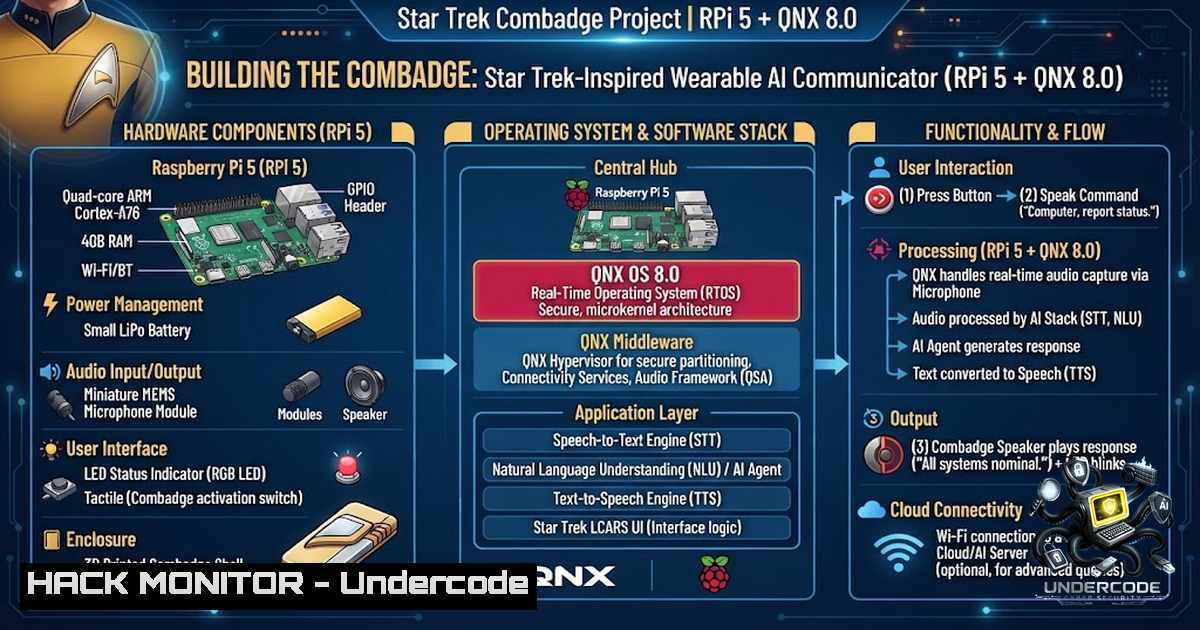
The intersection of embedded systems, real-time operating systems, and multimodal artificial intelligence has unlocked unprecedented possibilities for wearable technology. This article examines the architectural design, hardware-software integration, and custom user-space driver development behind “Combadge,” an award-winning Star Trek-inspired AI communicator built during Hack the North 2026.
Learning Objectives & Secrets:
Objective 1: Master the integration of multimodal AI models (OpenAI GPT-Live and GPT-6 Astra) with real-time hardware-software architectures.
Objective 2 secret tips: Leverage QNX microkernel architecture to isolate user-space driver crashes, ensuring system-wide stability during aggressive debugging and testing.
Objective 3 secret tips: Bypass missing default peripheral support by writing custom user-space drivers (such as Bluetooth and audio pipelines) when standard OS packages are unavailable.
You Should Know:
1. Hardware Integration and Wearable Computing
Step‑by‑step guide explaining what this does and how to use it:
Wearable devices require meticulous hardware-software co-design. In this project, LilyPad e-textile components were integrated directly into fabric using conductive thread to link sensors and actuators to a central processing unit.
Component Selection: Raspberry Pi 5 serves as the main computing unit, paired with a miniature camera, capacitive touch sensor, LEDs, and haptic feedback motors.
Physical Assembly: Sew the LilyPad capacitive touch sensor and haptic driver onto the garment substrate, ensuring secure connections via conductive thread without causing short circuits across power rails.
GPIO Pin Verification (Linux/QNX): Use command-line utilities to verify pin states and peripheral responsiveness.
 Check GPIO chip details and pin status on Linux/Raspberry Pi
gpiodetect
gpioinfo 0
Integration Test: Validate touch input triggers LED feedback and initiates the wake-word or double-tap listener daemon.
2. Custom User-Space Bluetooth and Audio Driver Development
Step‑by‑step guide explaining what this does and how to use it:
When operating on specialized real-time operating systems (RTOS) like QNX 8.0 where standard Bluetooth support for specific hardware is absent, developers must implement custom user-space protocols.
Driver Architecture: Isolate audio and radio stacks into user-space processes leveraging QNX microkernel message passing.
Custom Stream Handling: Route raw pulse-code modulation (PCM) audio buffers past traditional blocked audio stacks directly into the real-time AI inference pipeline.
Configuration and Debugging: Monitor user-space process faults and restart policies in QNX to prevent fatal kernel panics.
 View running processes and isolate user-space drivers in QNX
pidin ar
 Restart a failing user-space driver process manually during development
slay -9 bluetooth_driver && ./bluetooth_driver &
- Multimodal AI Integration with GPT-Live and GPT-6 Astra
Step‑by‑step guide explaining what this does and how to use it:
Connecting real-time hardware inputs to advanced language models requires asynchronous streaming APIs and robust tool-use frameworks.Real-Time Voice Interface: Implement OpenAI GPT-Live for ultra-low latency bidirectional audio streaming.
Reasoning and Tool Orchestration: Route complex intents through GPT-6 Astra to manage external integrations including Browserbase, Composio, Shopify, and Twilio.
API Security and Authentication: Store API credentials securely in encrypted environment variables or hardware secure enclaves.
 Securely export API keys for runtime tool integrations
export OPENAI_API_KEY="your_secure_api_key_here"
export COMPOSIO_API_KEY="your_composio_key_here"
export TWILIO_AUTH_TOKEN="your_twilio_token_here"
Execution Test: Run the client daemon to verify end-to-end tool calling across web browsing and telephony endpoints.
4. Cloud Hardening and API Security Protocols
Step‑by‑step guide explaining what this does and how to use it:
Wearable AI communicators interact with sensitive user data, emails, calendars, and external e-commerce platforms. Securing API keys and transmission channels is paramount.
Transport Layer Security (TLS): Ensure all external calls to Browserbase and Shopify use TLS 1.3 encryption.
Least Privilege Access: Restrict Composio and Twilio tokens to single-purpose operational scopes.
Network Traffic Inspection:
 Inspect secure WebSocket and HTTPS traffic originating from the wearable device
sudo tcpdump -i wlan0 -1n -s0 -v port 443
5. Vulnerability Exploitation Mitigation in Embedded RTOS
Step‑by‑step guide explaining what this does and how to use it:
Embedded devices are frequent targets for remote code execution and buffer overflow attacks. QNX microkernel architecture provides inherent mitigation by separating services.
Process Isolation: Ensure all third-party libraries run outside kernel space.
Memory Protection: Enable Address Space Layout Randomization (ASLR) and non-executable stack flags during compilation.
 Compile custom C/C++ user-space drivers with security flags enabled in QNX/GCC
qcc -Vgcc_ntoaarch64le -pie -fstack-protector-strong -Wl,-z,relro,-z,now -o combadge_driver main.c
- Automated Testing and CI/CD for Edge AI Devices
Step‑by‑step guide explaining what this does and how to use it:
Rapid prototyping under hackathon constraints requires streamlined deployment scripts to push updates to edge hardware.Remote Deployment Script: Use secure shell (SSH) and secure copy (SCP) to push compiled binaries to the Raspberry Pi running QNX.
 Deploy compiled binary to target QNX device over SSH
scp combadge_driver root@192.168.1.50:/usr/bin/
ssh root@192.168.1.50 "chmod +x /usr/bin/combadge_driver && combadge_driver"
What Undercode Say:
Key Takeaway 1: Microkernel operating systems like QNX successfully isolate user-space driver failures, preventing catastrophic system crashes during aggressive debugging.
Key Takeaway 2: Combining custom user-space Bluetooth implementations with multimodal AI models bridges the gap between legacy hardware limitations and futuristic interaction paradigms.
The engineering effort behind Combadge demonstrates how rapid hardware-software co-design can overcome severe infrastructural roadblocks—such as missing OS-level peripheral support and maintenance downtime. By leveraging e-textiles, microkernel fault isolation, and state-of-the-art AI tool orchestrators, the team successfully transformed a sci-fi concept into a functional, award-winning wearable prototype.
Prediction:
+1 The integration of microkernel RTOS architectures with real-time multimodal AI models will become the gold standard for robust edge and wearable computing devices.
+1 User-space driver isolation will significantly reduce system downtime in mission-critical IoT and embedded environments.
 Related Video (78% Match):
 Let’s Practice For Free:
 Live Courses & Certifications:
Join Undercode Academy for Verified Certifications
 Request a Custom Project:
Secure, high-velocity infrastructure and disruptive technological engineering. Contact our engineering team for high-tier development and proprietary systems:
projects@undercode.co.uk
 Smart Architecture |
 Secure by Design |
 Trusted by Thousands
IT/Security Reporter URL:
Reported By: https://lnkd.in/p/d9Y-TqBh – Hackers Feeds
Extra Hub: Undercode MoN
Basic Verification: Pass 
 JOIN OUR CYBER WORLD [ CVE News • HackMonitor • UndercodeNews ]
 Whatsapp
 Follow UndercodeTesting & Stay Tuned:
???? formerly Twitter  | @ Threads |
 Linkedin |
 BlueSky
The post Building Combadge: A Star Trek-Inspired Wearable AI Communicator on Raspberry Pi 5 and QNX 80 + Video appeared first on Undercode Testing.
Popular Products
-
 Devil Horn Headband
$25.99$11.78 -
 WiFi Smart Video Doorbell Camera with...
$61.56$30.78 -
 Smart GPS Waterproof Mini Pet Tracker
$59.56$29.78 -
 Unisex Adjustable Back Posture Corrector
$71.56$35.78 -
 Smart Bluetooth Aroma Diffuser
$585.56$292.87