China Looks Beyond Bricks And Mortar, Bets On People
Among the business leaders invited to Premier Li Qiang’s latest economic symposium, one participant stood out: Yu Donglai, founder of supermarket chain Pangdonglai.
Known for its customer service and employee-focused management, Pangdonglai has grown into one of China’s best-known retail brands. The company employs more than 10,000 people and generates annual sales exceeding 20 billion yuan (about 2.8 billion U.S. dollars).
Yu’s invitation carried a broader message than the success of a single retailer. At the symposium, Li called for “coordinated efforts in investing in both physical assets and people,” suggesting China’s next phase of growth will rely increasingly on human capital.
For decades, China’s rapid growth was powered by massive investment in highways, railroads, factories and housing. Today, policymakers are betting that investing in people can become a new source of productivity, consumption and long-term growth.
WHY THE SHIFT
“The returns from traditional investment in physical assets are beginning to diminish,” said Su Jian, director of the National Economic Research Center at Peking University. He warned that relying too heavily on additional capital investment could generate weaker returns while adding to overcapacity and debt risks.
This view is also consistent with broader economic growth theories, which emphasize that sustainable growth depends on balancing investment in human capital, physical capital and natural capital, according to Huang Qunhui, a researcher at the Institute of Economics under the Chinese Academy of Social Sciences.
Against that backdrop, investing in people has evolved from a social policy concept into an economic strategy.
First introduced into China’s top-level policy agenda in 2023, the idea has since appeared in government work reports and major policy meetings.
The message is simple: stronger human capital supports innovation, while better public services reduce households’ financial burdens and encourage spending.
China is not alone in rethinking its growth model.
As populations age and productivity slows, governments around the world are placing greater emphasis on human capital.
Earlier this year, the World Bank expanded its Human Capital Index to measure learning and employment throughout working life, while the OECD has warned that aging could significantly slow income growth unless countries make better use of their existing workforce.
China faces even greater urgency.
The country’s working-age population is projected to shrink by an average of 0.3 percentage points a year during the 2026-2030 period, a faster pace than in the United States, the European Union and Japan.
“As demographic structures keep changing, strengthening the quality of human capital will become increasingly important for sustaining China’s long-term growth,” Huang said.
WHERE IT PAYS OFF
Where can investment in people generate the greatest economic returns?
Experts point to three priorities: boosting consumption by easing households’ financial burdens, strengthening care services across generations, and building a more skilled workforce.
Unlocking consumption
“Uncertainty over future costs, including education, health care and elder care, has made some households more cautious about spending,” said Su from Peking University.
Greater investment in these areas could both raise workers’ skills and incomes and reduce precautionary savings, helping unlock consumption potential, he added.
The thinking is reflected in China’s newly released five-year plan devoted exclusively to consumption. The plan targets retail sales of consumer goods of around 60 trillion yuan by 2030, and identifies services such as health care, culture and tourism as new drivers of consumer spending.
Supporting families across generations
China is now home to nearly 324 million people aged 60 and above -- roughly the size of the entire U.S. population -- making the expansion of quality elder care an urgent policy priority.
“Better care services can improve older adults’ quality of life while enabling more of them to remain healthy, active and engaged in the economy,” said Liu Zhiqin, a researcher at Renmin University of China’s Chongyang Institute for Financial Studies.
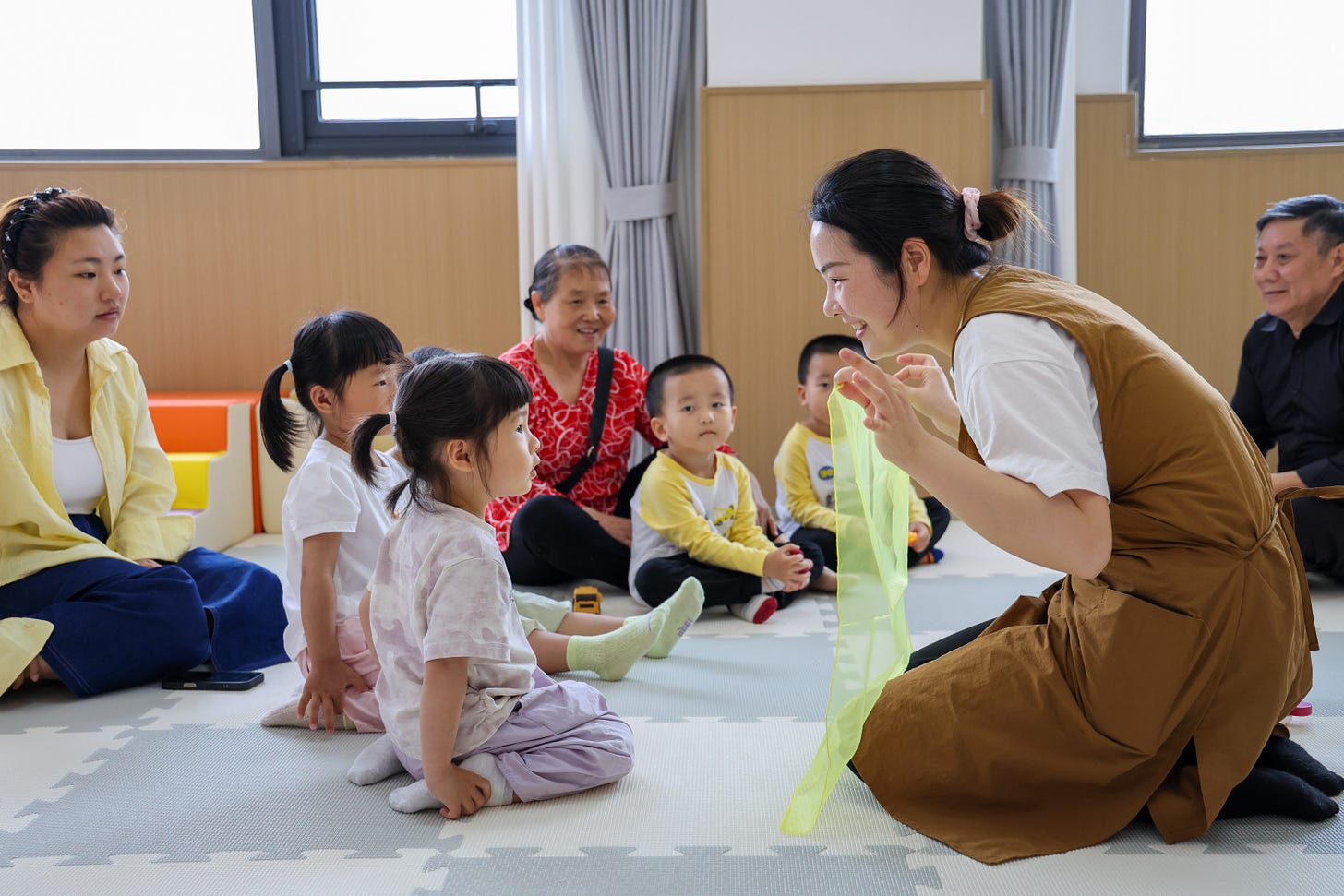
Meanwhile, early childhood is widely regarded as a critical stage for cognitive and skills development, making it one of the most important periods for investment in human capital.
Government spending is already moving in that direction.
During the first half of this year, the central government allocated about 100 billion yuan for a newly introduced childcare subsidy program aimed at reducing the cost of raising children, and earmarked 241 million yuan to support one year of free preschool education. For older adults, it allocated 1.2 trillion yuan in basic pension insurance subsidies to ensure pension payments are made on time and in full.
Building a more skilled workforce
China’s earlier growth model benefited from abundant labor and market scale, but the basis of competitiveness is changing. As global competition shifts from factor advantages to innovation, talent development is becoming increasingly important.
“Technology and equipment can be acquired, but the skilled workforce needed to continuously improve and apply them cannot be easily replaced,” said Liu.
He pointed out that expanding vocational education and professional training will help meet demand in advanced manufacturing, artificial intelligence and other emerging industries.
Over the longer term, he said, China also needs to cultivate more high-end talent to strengthen future competitiveness.
MAKING IT WORK
Yet for a country long accustomed to driving growth through investment in physical assets, human capital investment requires a different policy toolkit.
Infrastructure spending produces tangible assets whose costs, outputs and economic impact can be measured relatively easily. By contrast, investment in people strengthens skills, health and overall well-being, with benefits that often emerge only over time and are harder to attribute to any single project or funding source.
That makes implementation and evaluation far more challenging.
Huang said looking ahead to the next five-year period, China needs to improve the mechanisms that support investment in people. He highlighted:
improving evaluation systems by giving greater weight to indicators such as household income growth, access to public services, support for key groups and long-term development capacity;
directing more resources toward areas where services remain insufficient, particularly childcare and affordable elderly care;
enhancing data coordination across government departments to support better policy decisions.
Thanks for reading Peking Ensight! Subscribe for free to receive new posts and support my work.
Popular Products
-
 Automotive CRP123X OBD2 Scanner Tool
$649.56$324.78 -
 Portable USB Rechargeable Hand Warmer...
$61.56$30.78 -
 Portable Car Jump Starter Booster - 2...
$425.56$212.78 -
 Electric Toothbrush & Water Flosser S...
$43.56$21.78 -
 Foldable Car Trunk Multi-Compartment ...
$329.56$164.78