Falls Are Serious Health Threats. Here’s What To Know.
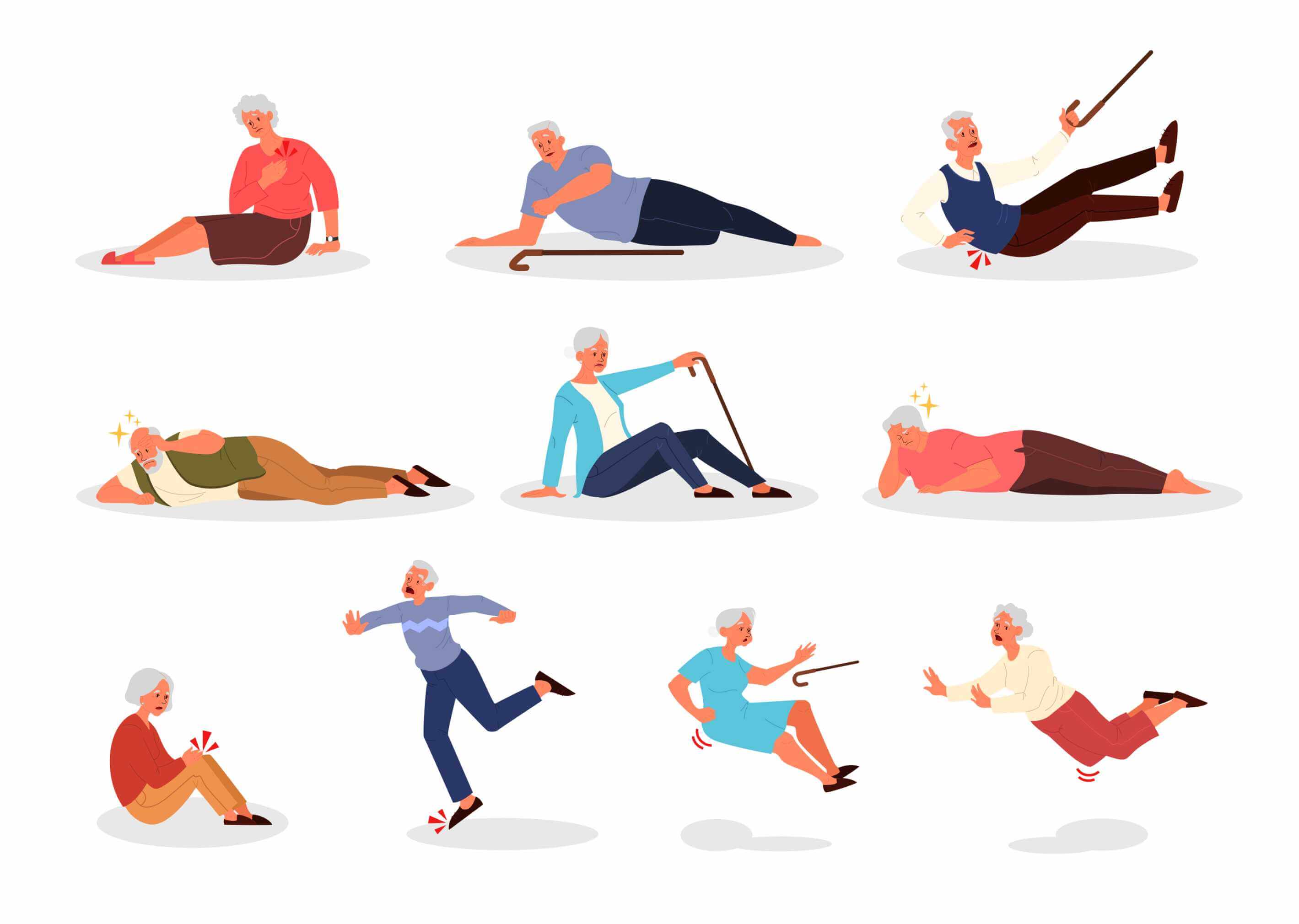
If you’re of a certain age, you’ll remember LifeCall’s hokey TV commercials from the late 1980s: The commercials show various older actors getting help from emergency dispatchers. But the most memorable line is always delivered by a woman lying on the floor, whether next to her bathtub or an upended walker.
“I’ve fallen, and I can’t get up!” she cries out plaintively, only to be reassured by the dispatcher that help is on the way.
It didn’t take long for that line to become a catchphrase, and at the same time a source of fun. It was repeatedly referenced in era sitcoms and movies. It was printed on T-shirts and other merchandise. These days it’s a meme, and is even trademarked by LifeAlert, a LifeCall competitor, after LifeCall went out of business in the early 1990s.
But behind all the mockery, there’s a serious issue, one that hasn’t been resolved in the almost 40 years since the line was first spoken: Falls are one of the top reasons people over 65 die.
According to the Centers for Disease Control, falls killed more than 38,000 seniors in 2021, making it the leading cause of death from injuries in that group that year. Emergency rooms also reported almost 3 million visits from seniors to treat falls.
And that number is only going to increase, considering the huge Baby Boom generation is now mostly old enough to be in the risk zone, a trend referred to as the “Silver Tsunami.”
But, SoCal medical professionals say, seniors shouldn’t resign themselves to falls being inevitable.
“It’s never too late to take care of yourself,” says Dr. John Leong, a geriatrician at Kaiser Permanente in San Bernardino County.
Why are people aged 65 and up so prone to bad injuries from falls?
“Starting in our 30s and 40s, muscle mass goes down,” Leong says. “(About) 1 percent each year after the age of 30. Then it gets faster, almost 2 percent in some cases, after the age of 50.”
Losing muscle mass, particularly in your legs, can lead to weakness, which can lead to losing your balance, which puts you at risk of falling, Leong says.
Weak muscles also weaken our bones, Leong adds, and this combination of weak muscles on weak bones is a condition called osteosarcopenia. That is not to be confused with osteopenia, which refers to the thinning of our bones as we age. Nor is it osteoporosis, when our bones get so thin they crumble. But all three conditions can make injuries from a fall permanently debilitating or fatal.
But wait, there’s more! Vision and hearing loss as you age also increase your fall risk, says Dr. David R. Lee, a geriatrician at UCLA Health and assistant professor at the Geffen School of Medicine.
“Vision is a really important factor. Oftentimes, you don’t see something on the ground, and trip and fall,” Lee says.
Glasses help, but most people develop presbyopia in their 40s and 50s. The condition, the gradual loss of your eyes’ ability to focus on nearby objects, affects near vision, which means you often have to wear different sets of glasses for distance and reading. Bifocals are a solution, but using them can make the ground or a set of stairs blurry if you’re looking through the wrong part of the lens.
Then, there’s hearing loss.
“Hearing can be a really big factor,” Lee says. “We oftentimes take for granted that hearing helps us hear the world in more than 2D. It gives us situational awareness.”
And hearing isn’t the only thing our ears do. The inner part of our ears helps us maintain our balance. We have little crystals in our inner ears called otoconia that regulate that function. But as we age, those crystals can shift, and that can cause vertigo, or dizzy spells. And dizziness can cause falls.
But the natural consequences of aging aren’t the biggest contributors to our fall risk. The drugs we take for everything from hypertension to depression to allergies to chronic pain management are the culprits.
“There’s a number of medications that can cause you to fall, Lee says. “Sometimes it’s the combination.”
The term doctors use to describe those medication combinations is polypharmacy.
“Polypharmacy is one of the biggest causes of falls,” says Leong. “(It can lead to a) 21 percent higher risk of falls, and in some studies up to 75 percent.”
And unfortunately, far too many people taking these meds may not realize they are the cause of their falls. Nor do they think to question their doctors about side effects or dosages.
“A lot of people take their doctor’s word as gospel,” says Kathleen Breda, a nurse practitioner and associate director of Orthopedic Clinical Programs at Cedars-Sinai. “And the key is, a lot of doctors only have so much time when they visit you.”
That precious time, she adds, is usually spent on the primary reason for the appointment, such as managing your illness, and so any concerns about falls caused by meds may remain unaddressed.
Lee agrees.
“Often in primary care, we sometimes forget to ask, Have you fallen in the last six months or the last year, and did you sustain an injury? And often, people don’t remember,” Lee says. “Sometimes falls are not the number one priority in that visit. But I think it’s a really important discussion to have.”
Communicating with your doctor, and advocating for yourself, is key, agrees Leong.
“It’s something to be mindful about,” he says.
Understanding the main causes of falls is only the first step, our three experts agree.
You also have to do something about it.
Weak muscles can be rebuilt with exercise, and stronger muscles can help maintain bone health.
“Motion is lotion,” Breda says.
But some motions are better than others. Running, the experts agree, is too hard on your joints as you get older. Contact sports are not a good idea because of injuries. The simplest way to exercise, Lee says, is often to just take a walk.
And what about water exercise? Aren’t swimming and aqua aerobics easy on the joints and good for cardio?
They are, yes, but it’s not enough, Lee and Breda agree. And Breda goes further.
“Walking doesn’t do it, swimming doesn’t do it,’ she says.
In order to build bone, Breda says, you have to incorporate weights into your exercise routine. And no, that doesn’t mean you’re expected to bench press your own weight anytime soon, or ever. Taking it slow is the best way.
“Weightlifting needs to be built up to,” Breda says, adding that finding a personal trainer to help you design a suitable exercise program is very helpful.
And people with chronic joint conditions, such as arthritis or Ehlers-Danlos syndromes, which make them prone to injuries from weightlifting, shouldn’t despair. They can ask a doctor to refer them to a physical therapist, who is trained to help with special needs.
“Don’t discount physical therapy,” says Kyle Newbry, a physical therapist at UCLA Health. “There’s a lot that physical therapy can do.”
For example, Newbry says, if you have vertigo from your ear crystals shifting, a physical therapist can show you head movements that can make the crystals move back to their proper place. It can take as few as two sessions to resolve the issue.
Newbry and Lee both helped create the falls prevention program at UCLA Health. The program’s mission is to figure out why a patient may be falling, whether it’s from weak muscles and bones, poor hearing and vision, drug side-effects, cognitive decline or other medical issues.
Physical therapy is usually a key part of treatment, Lee and Newbry say, and patients either get an exercise program they can do at home, or go to a physical therapy facility. The program can be as simple as doing exercises in your favorite sturdy chair, preferably one with arms, Lee says.
“It’s the chair rise,” Lee says. “Go from sitting to standing 10 times, three times a day.”
Leong at Kaiser recommends the Otago Exercise Program, which was designed in New Zealand, and involves using a chair in multiple exercises.
But more mobile patients, all the experts say, should consider trying Tai Chi, which is great for balance. That said, Newbry cautions that Tai Chi alone is not enough. You also have to do weight and cardio exercises.
Any other tips?
Don’t be afraid to use assistive devices, whether it’s a cane, hearing aids, or a walker. Not wanting to look old to others is no comfort when you’re in bed recovering from a broken hip.
As for hearing aids, don’t forget to use them! “There’s a lot of evidence that links our memory to our hearing,” Lee says. “Memory gets worse from hearing loss.”
Consider wearing monofocals instead of bi or trifocals when going outside, Lee says. It will make seeing ground obstacles easier.
Do your exercises faithfully. Non-compliance is the biggest obstacle to improvement, Newbry says. If your medical insurance doesn’t cover physical therapy or fall prevention clinics, ask your local community senior center if they have programs. There are also lots of options online.
Drink plenty of water, all the experts say. Take Vitamin D and calcium supplements if recommended by your doctor. Eat lots of protein, particularly if you’re female, says Breda. For that matter, try to eat more, even if aging has lowered your appetite. And preferably, eat healthy, not overly processed food. Dehydration and low blood sugar can make you dizzy, and make you fall.
At home, get rid of throw rugs or other tripping hazards. Tuck away loose electrical cords. Install a nightlight in the bathroom. Nighttime can be particularly fraught for falls, Leong says.
Don’t just talk to your doctor about medication side-effects, be proactive about diagnostic tests, such as bone density scans. Most adults, Breda says, have some osteopenia. There are websites that can tell you your risk of breaking a bone, including one called FRAX, Breda adds. And while women have the most risk of getting osteoporosis, men get it too, Lee says.
More ‘Well and Good’
- This story is part of a collection of stories printed in January 2026.
- Visiting a Los Angeles Death Café to talk about mortality
- At Cedars-Sinai, AI and virtual reality research shows promise for mental health coaching
- What my father-in-law’s illness taught me about being honest about our health
- Sauna services bring the healing heat to Southern California
- Exploring why we want our lives to matter with the author of ‘The Mattering Instinct’
- Read more ‘Well and Good’
- More SCNG Premium content
Developing osteoporosis is not a given if you have osteopenia, all the experts say. There are drugs that can help. Those drugs, along with diet and exercise, can improve your chances of not getting it.
Have a support system if you live alone. A good neighbor, close friend, relatives, and even a system like LifeAlert can be a lifesaver. (Hopefully you won’t need to use that immortal line!)
But unfortunately, at the end of the day, there is no way to guarantee you’ll never, ever fall. Lee says one in three older adults will suffer a fall at some point in their lives.
Says Breda, “Be gentle with yourself. There’s only so much you can do.”
But taking care of yourself in the meantime, our experts agree, is the best way to give yourself the best odds of not letting it be your downfall.
Popular Products
-
 Classic Oversized Teddy Bear
$23.78 -
 Gem's Ballet Natural Garnet Gemstone ...
$171.56$85.78 -
 Butt Lifting Body Shaper Shorts
$95.56$47.78 -
 Slimming Waist Trainer & Thigh Trimmer
$67.56$33.78 -
 Realistic Fake Poop Prank Toys
$99.56$49.78