Inside The Maha Summit
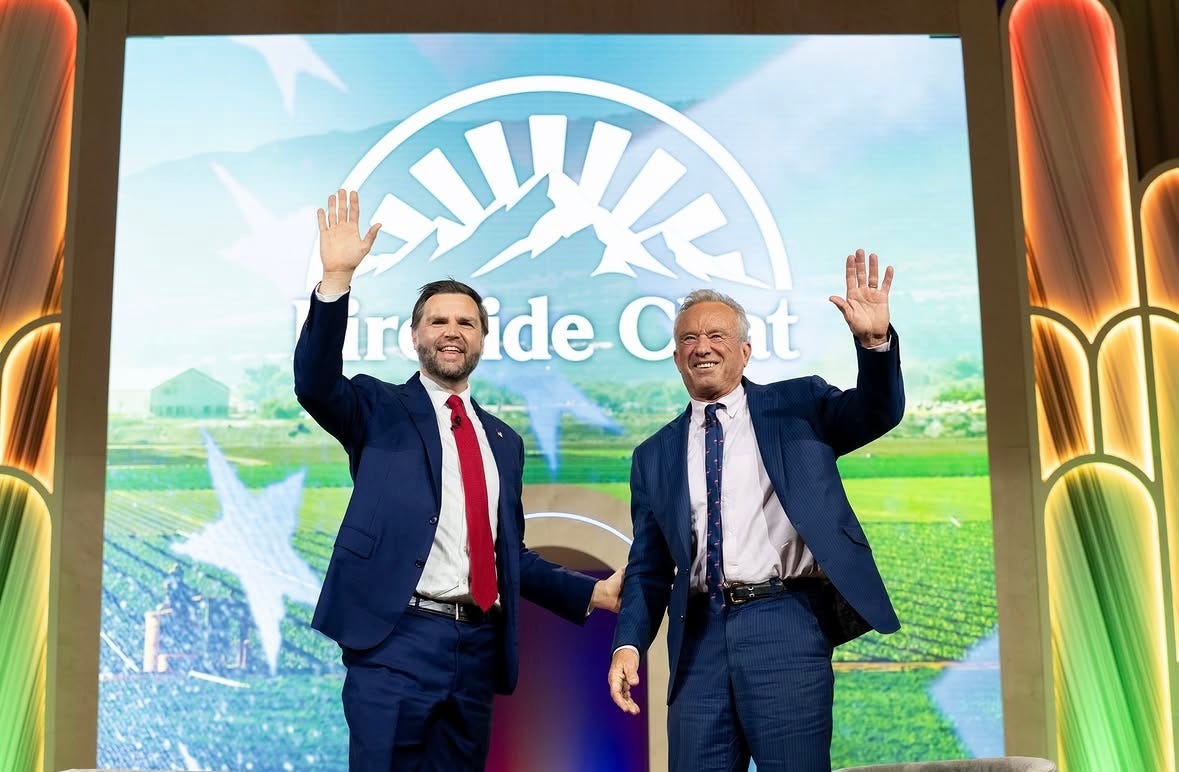
The second annual MAHA Summit took place earlier this week in Washington D.C. The event was also livestreamed, which meant I could tune in to nine hours of health messaging and political talking points.
The summit was hosted by the MAHA Center, a nonprofit that says it did not coordinate with any government entity on the event’s planning, sponsorships, or “any other aspect.” Still, several of the administration’s most prominent health and political figures were featured speakers, including HHS Secretary RFK Jr., CMS Administrator Dr. Oz, Vice President JD Vance, EPA Administrator Lee Zeldin, and HHS advisor Calley Means.
The event opened with MAHA Center President, Tony Lyons, describing the movements origins with “autism moms” and its evolution into what he called the “MAHA revolution.” He said the summit would focus on advancing chronic disease prevention by changing how we talk about public health and rethinking how research is conducted.
But the event hardly touched on public health. Instead, much of the summit seemed to center around the administration’s broader political agenda, with health and wellness repeatedly serving as the frame through which those priorities were presented.
That was reflected in both who was on stage and what dominated the conversation. Despite MAHA’s longstanding criticism of corporate influence in health, the summit featured extensive corporate sponsorship, including Walmart, OpenAI, and Anthropic, while discussions repeatedly returned to politics, tech, and individual approaches to improving health. At the same time, many of the grassroots voices that helped build the movement were notably absent.
And the contradictions of the event were hard to miss.
Before it even began, the summit received backlash for accepting corporate sponsorships, which, of course, runs counter to MAHA’s core principle challenging corporate influence over food, medicine, and health. The MAHA Center accepted sponsorships from dozens of corporations, with contributions reportedly approaching $300,000. Sponsors were offered opportunities to weigh in on the agenda and attend a private dinner with RFK Jr.
The summit also included speakers with financial or professional interests directly related to the topics they were discussing. A session on preventing cancer featured a chiropractor with a lucrative supplement business who promoted turmeric, mushrooms, and other herbal remedies as alternatives to surgery. USDA Secretary Brooke Rollins promoted a regenerative agriculture announcement, while the current Farm Bill proposal would cut funding for regenerative agriculture. Some of the country’s largest health insurance companies led discussions on affordability. A session on “real food” featured executives from Walmart, Sweetgreen, and Steak n’ Shake. And comedian Russell Brand, who is awaiting trial in the UK on charges including three counts of rape and three counts of sexual assault, facilitated a conversation about Medicare reform after opening the session with a joke about consent.
Taken together, the summit was another MAHA event filled with contradictions that were difficult to reconcile. MAHA leaders spoke forcefully about corporate capture while accepting substantial corporate sponsorships for the event. They criticized the influence of powerful industries while giving many of those same industries a prominent role in shaping the conversation. And despite MAHA’s constant focus on conflicts of interest, the summit featured companies and individuals with direct financial interests in the very topics they were discussing.
Inside the MAHA Summit Agenda
The summit agenda covered healthcare innovation, disease prevention, longevity, and ways to improve health. Many speakers repeatedly invoked “public health,” but as the sessions went on, it became clear that the term was often being used as a catch-all for individual health and wellness.
Public health is broader than individual health and wellness. It focuses on the policies, systems, and environments that shape health across entire populations, including for people who may not have the time, access, or knowledge to make certain individual changes. It’s an important distinction that I’ve discussed more here.
Despite this, much of the summit focused on individualized medical interventions, personal treatment plans, and the idea that taking control of your own health is the key to preventing disease. In a session called “Recovery First,” executives from wearable technology companies emphasized tracking individual physiology to determine which interventions would work best for each person. One CEO argued that “what is proven for everyone isn’t proven for you,” and said the answer was to collect more personal data, so interventions could be tailored to the individual. The conversation framed better health primarily as a matter of better individual measurement and optimization, while also promoting the very technologies the speakers’ companies sell.
In another session on longevity, the moderator asked Bryan Johnson, the so-called biohacker who has said he’s attempting to “achieve immortality by 2039,” what policy or regulatory change he would make if he had a “magic wand.” Johnson answered that people should get more sleep and avoid things like screens or late-night snacking. When the moderator pushed him to name an actual regulatory change, Johnson replied that the country did not need more regulation because people could act as “individual agents” and make “good decisions” themselves.
And in a session entitled “The MAHA Athlete,” the panelists spent much of the conversation discussing their own highly individualized recovery routines. Noah Syndergaard talked about what the medical system had missed in his specific injury. When asked what athletes could do to reduce non-contact injuries, Mike Tyson said he invests a significant amount of money in his body and pointed to hyperbaric chambers, blood spinning, and Placenta Cord Protein injections as examples of what he uses to be the best he can be. By the end of the session, multiple panelists had praised hyperbaric chambers as part of their recovery and performance routines. Those chambers can conveniently be purchased through Calley Means’ wellness company website for anywhere from $15,000 to $169,000.
AI, or “super intelligence” as RFK Jr. called it, was another major theme of the summit, which focused overwhelmingly on what AI could do for health, with little discussion of its potential risks. In the final session, RFK Jr. made a surreal comment about AI during a fireside chat with JD Vance where he said, “We’re never, ever again going to be able to be dominated by public officials who tell us, ‘Trust the experts, because every American will be able to check their own medical advice. They’ll also be able to check the advice of public officials. And if somebody tells you, Masks work. Trust the experts, Al may tell you otherwise. If somebody tells you, ‘Social distancing works. Trust the experts, Al may correct that.” And if somebody tells you a vaccine will prevent transmission and infection, or you need to take it to protect your grandmother, Al may say, It actually doesn’t do that.’ So it really has the capacity to dominate us and to free us from medical tyranny.”
Essentially: Don’t trust the experts. Instead, trust an Al chatbot that depends on human expertise, routinely produces confident sounding, false information, and has no inherent ability to determine what is true. What could go wrong?
Alongside the enthusiasm for AI and mischaracterization of public health, speakers perpetuated misinformation and claims about this administration’s role in reducing obesity rates, closing the GRAS loophole, cutting SNAP and Medicaid, removing food dyes from the food supply, and the “transformational impact” of changing the dietary guidelines.
Ultimately, the summit offered a clear picture of what this administration believes will improve Americans’ health, with greater emphasis on individual responsibility and technology and less reliance on scientific and public health institutions.
What this Means for Health
Tony Lyons started the day explaining that the momentum behind MAHA is strong and the MAHA Summit would exist for decades to come. Calley Means echoed that sentiment, saying we are never returning to the way things were before this administration. JD Vance, RFK Jr., and his wife Cheryl Hines closed the nine-hour day with the same message: MAHA is here to stay.
And they apparently already have plans for what comes next. Cheryl Hines announced seven MAHA symposiums through 2027, including a “Healthy Again” music festival celebrating American Health next June and an exclusive three-day MAHA retreat at an “iconic wellness resort” for a small group of invited attendees.
It’s unclear how any of that would actually make Americans healthier. But it is a near-perfect distillation of the version of health MAHA has promoted from the beginning, one where the ability to “optimize” health becomes the standard, and the people facing the greatest barriers to health are left even further behind.
If you found this helpful and are able to support this work, please consider becoming a paid subscriber. Your support helps me keep spending the time it takes to research, write, and share pieces like this, and I’m genuinely grateful for it. Thank you for being here.
Popular Products
-
 Classic Oversized Teddy Bear
$23.78 -
 Gem's Ballet Natural Garnet Gemstone ...
$171.56$85.78 -
 Butt Lifting Body Shaper Shorts
$95.56$47.78 -
 Slimming Waist Trainer & Thigh Trimmer
$67.56$33.78 -
 Realistic Fake Poop Prank Toys
$99.56$49.78