Is Your Push Day Weird? What 580,000 Fitbod Workouts Reveal About Skipped Core Work
We compared more than 580,000 Fitbod push day recommendations with the workouts people actually logged. The biggest gap was core work. It looked different across age groups, training setups and recorded workout lengths.
Key Takeaways
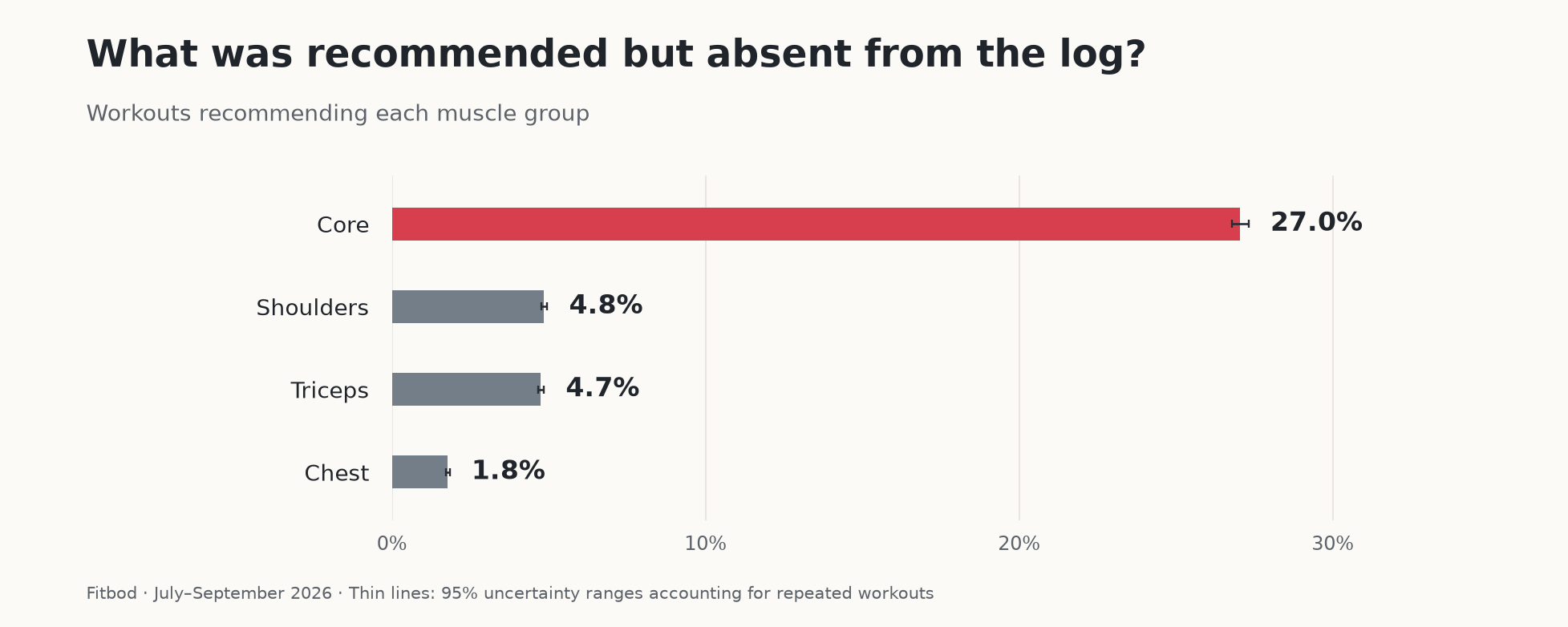
- Core is the most-skipped part of push day. Among Fitbod push workouts that recommended core, 27% logged no core at all. Chest, shoulders and triceps were each missing less than 5% of the time.
- Most lifters keep the push exercises and drop the core. In 85% of the logs missing core, every recommended chest, shoulder and triceps group was still there.
- Core went from 71% of recommendations to 54% of logs. That is a 17-point drop between the plan and the finished workout.
- Younger lifters skip core about twice as often. Recommended core was missing from 33.8% of logs for ages 18–29, compared with 17.2% for ages 60+. The gap held when we compared groups with the same mix of workout lengths and experience levels.
- Men skip core more often than women: 29% of men’s logs vs. 20% of women’s, even though both received core recommendations at the same rate (about 71%).
- Shorter recorded workouts usually meant no core. When a recorded workout was less than half the requested time, 51.1% were missing recommended core. When it ran close to the requested time, 22.3% were.
- Setup matters too. Core was missing more often when machines or cables were available (28.3%) than with free weights only (18.5%), and more often on the Advanced setting (29.0%) than on Beginner (22.2%).
- Adding exercises off the plan was rare. Only 2–3% of push logs included biceps, back or leg work that wasn’t recommended.
- Research suggests direct core work is worth keeping. Pressing and squatting work the lower back, but EMG research shows that exercises like the plank activate the abdominals much more. U.S. physical activity guidelines list the abdomen as one of the major muscle groups to train at least twice a week.
What Is a Push Day?
A push day is a strength workout built around pressing movements: exercises that push weight away from your body. It mainly trains the chest, shoulders and triceps. Typical push day exercises include the bench press, overhead press, incline dumbbell press, dips and triceps extensions. Push days are usually part of a push/pull/legs split, where pull days train the back and biceps and leg days train the lower body.
Many push day programs, including the ones Fitbod generates, also include core exercises such as planks, cable crunches or back extensions. So what does a “normal” push day look like? Does yours include core? A few biceps curls? How close is it to what other lifters actually do?
Fitbod is a strength-training app that plans your workouts for you. It chooses the exercises, sets, reps and weights. That made it possible to compare what the app recommended with what people actually logged on a large scale.
How We Analyzed 581,791 Fitbod Push Workouts
We compared 581,791 Fitbod workout recommendations labeled Push with the workout logs (the saved records of those sessions) from 110,225 people, logged between July and September 2026. For each workout, we checked which muscle groups appeared in both the recommendation and the log, and which appeared in only one of them.
How We Counted Muscle Groups
- Each exercise counts toward its main muscle group. A bench press counts as chest work, for example, even though the shoulders and triceps also help.
- A muscle group counts as present if it has at least one set beyond warm-ups.
- “Core” means abs and lower back.
- Every percentage describes workouts, not people. The uncertainty ranges on the charts account for the same person logging many workouts.
Fitbod Push Day Data at a Glance
| Metric | Result |
|---|---|
| Push recommendations analyzed | 581,791 |
| People in the sample | 110,225 |
| Recommendations that included core | 71% |
| Logs that included core | 54% |
| Core recommended but not logged | 27.0% |
| Shoulders recommended but not logged | 4.8% |
| Triceps recommended but not logged | 4.7% |
| Chest recommended but not logged | 1.8% |
| Core-missing logs that still had every recommended push muscle | 85% |
| Logs adding biceps that weren’t recommended | 2.8% |
| Logs adding back work that wasn’t recommended | 2.1% |
| Logs adding leg work that wasn’t recommended | 2.5% |
Which Muscle Group Do Lifters Skip Most on Push Day?
Core. It isn’t close.
Core Is Missing From More Than 1 in 4 Push Workouts That Recommend It
Core work alongside chest, shoulders and triceps was common in the plan: 71% of push recommendations included it. In the finished logs, that fell to 54%.
To see what went missing, we looked only at recommendations that included each muscle group. 27% of workouts that recommended core logged none. Chest, shoulders and triceps were each missing less than 5% of the time.
Each bar uses workouts that recommended that muscle group: 411,344 for core; 435,412 for shoulders; 562,140 for triceps; 577,463 for chest.
Chest, Shoulders and Triceps Almost Always Make It Into the Log
Even when core was missing, 85% of those logs still contained every push muscle the app had recommended. Lifters weren’t abandoning their workouts. They kept the pressing and dropped the core.
Do Lifters Add Exercises That Weren’t Recommended?
Rarely. When the recommendation had no biceps exercise, only 2.8% of logs included one. The figures were 2.1% for back and 2.5% for legs. So if your push day includes a few curls the app didn’t suggest, that’s unusual. If it’s missing the core work, you have plenty of company.
What We Can and Can’t Tell From the Data
These comparisons show what made it into the log. They don’t show why something is missing. A missing muscle group could mean someone swapped an exercise, skipped it, finished early or edited the log later. With only the recommendation and the final log to go on, we can’t tell which of these happened.
Why Does Core Training Matter on Push Day?
Core work is the easiest part of push day to drop. That doesn’t make it optional. Here’s what the research and guidelines say.
Major health guidelines include the core. The U.S. Physical Activity Guidelines for Americans recommend muscle-strengthening activity that involves all major muscle groups on two or more days a week. The CDC lists those groups as the legs, hips, back, chest, abdomen, shoulders and arms.
Your main lifts don’t fully replace direct ab work. In an electromyography (EMG) study by Comfort, Pearson and Mather in the Journal of Strength and Conditioning Research, the front squat activated the lower back (erector spinae) as much as a back-extension-style “superman” exercise. The prone bridge (plank), however, produced significantly greater rectus abdominis activity than any of the dynamic lifts tested, including the military press. Overhead pressing and squatting work your lower back, but your abs still benefit from direct work.
The core’s main job is to resist motion. Spine biomechanist Stuart McGill argues that core muscles mainly stiffen the torso and resist movement, which helps transfer force from the hips and legs to the arms. That’s why bracing exercises like planks, side planks and anti-rotation presses are core training staples.
Heavy free-weight lifts are the base. Direct core work adds to them. The Canadian Society for Exercise Physiology position stand by Behm and colleagues recommends ground-based free-weight lifts as the foundation of core training for both athletes and non-athletes. It treats targeted core and instability exercises as useful additions, especially for general fitness and back health.
The evidence that core training boosts sports performance is mixed. A review in Sports Medicine by Hibbs and colleagues found that core programs reliably improve core strength and stability, but few studies show that those gains translate into better sports performance. The best-supported reasons to keep core work are general strength, everyday function and, as the next section shows, balance and fall prevention as you age. Faster sprint times are a weaker argument.
Does Age Affect Whether Lifters Skip Core?
Yes. Younger lifters skipped core about twice as often as the oldest group. Among push workouts that recommended core, 34% of logs from ages 18–29 had none, compared with 17% for ages 60 and over. Each age group in between fell in order from youngest to oldest.
Workouts that recommended core, grouped by profile age. From youngest to oldest: 81,593; 147,006; 104,983; 39,082; and 9,617 workouts.
The Age Gap Holds After Accounting for Workout Length and Experience
You might expect younger lifters to skip core because they choose shorter workouts or more advanced settings. That doesn’t explain it. When we compared age groups with the same mix of requested durations and experience levels, the youngest-to-oldest gap stayed almost the same: 34% vs. 17%.
Older Lifters Also Add More Leg Work
A smaller core gap didn’t mean older lifters followed every part of the plan more closely. Their push logs were also more likely to include leg work that wasn’t recommended: 5.0% for ages 60+, compared with 1.8% for ages 18–29.
Why Core Strength Matters More With Age
Older lifters may have good reason to protect their core work. A systematic review by Granacher and colleagues in Sports Medicine found that trunk muscle strength is associated with static and dynamic balance, functional performance and fall risk in older adults. It also found preliminary evidence that core strength training improves those outcomes. The Physical Activity Guidelines also recommend that older adults include balance training alongside strength and aerobic work. Our data shows what lifters did, not why. Still, the pattern lines up with that evidence.
Do Women and Men Skip Core at Different Rates?
Yes. Women and men received core in about 71% of push recommendations. But among those recommendations, core was missing from 20% of women’s logs and 29% of men’s.
Leg work showed the opposite pattern. When no leg work was recommended, it showed up in 5.0% of women’s logs and 2.0% of men’s.
Both differences held when we compared women and men with the same mix of ages and requested durations. These comparisons use adult profiles recorded as female or male.
How Do Equipment and Experience Level Affect Skipped Core Work?
Both the equipment available and the experience setting made a difference.
Each percentage uses workouts that recommended core. Equipment refers to what was listed as available for the recommendation. Experience is the selected Fitbod setting.
Machines and Cables vs. Free Weights Only
Recommended core was missing from 28.3% of logs when machines or cables were available, compared with 18.5% when only free weights were available. The gap remained after accounting for requested workout length and experience level.
These are the equipment lists people gave Fitbod. They don’t tell us whether someone trained at home or in a commercial gym. One possible explanation, which our data can’t confirm, is that a well-equipped gym offers more pressing options to fill the session, so core work at the end is easier to drop.
Beginner vs. Intermediate vs. Advanced
The experience gap was smaller but consistent. Core was missing from 22.2% of logs on the Beginner setting, 26.8% on Intermediate and 29.0% on Advanced. More experienced lifters were slightly more likely to drop core work.
Does a Shorter Workout Mean Skipped Core?
Often, yes. We compared the duration each person requested with the duration recorded in their log. (The workout timer excludes paused time, so it’s an imperfect measure of time spent exercising.)
When the recorded workout was less than half the requested time, 51% of workouts that recommended core logged none. When the recorded workout was 80% to under 120% of the requested time, only 22% did.
For a 60-minute workout, that means a log under 30 minutes compared with one between 48 and just under 72 minutes.
Workouts that recommended core, with requested durations of 15–180 minutes and logged durations of 5–180 minutes. Group denominators: 30,067; 118,585; 176,929; and 80,800 workouts.
The Pattern Holds Within the Same Person
The pattern also showed up when we compared short and full-length workouts from the same people. So it isn’t just that people who usually log short workouts also tend to skip core. Even so, the timer can’t prove that anyone actually ran out of time.
Why Core Is Usually the First Thing Cut
Core exercises usually come at the end of a workout, and that makes them easy to drop when time runs short. A review on exercise order by Simão and colleagues in Sports Medicine found that an exercise’s position in a session affects how many reps you can perform. Exercises done later in a workout get less of your effort.
This matches a separate Fitbod analysis of what lifters cut when they’re short on time. When consistent Fitbod lifters cut a workout by 50% or more, they dropped 40.5% of their exercises on average, while sets per exercise barely changed. Isolation exercises were cut more often than compound lifts (47% vs. 36%). Lifters usually cut whole exercises, and core exercises at the end of a push day are an easy target.
How to Keep Core Work in Your Push Day
If your push day logs look like the 27%, here are some ways to keep core work from disappearing:
1. Move one core exercise earlier.
If core always comes last, it’s always the first thing to go. Doing a plank or Pallof press between your first and second pressing exercises protects it from an early finish.
2. Pair core with pressing.
Core and pressing exercises use mostly different muscles, so you can alternate them, for example a set of incline presses followed by a set of hanging knee raises. This adds almost no time to the workout.
3. Keep it small when time is short.
Even 2 hard sets of one core exercise is better than none. Weekly volume drives results: a meta-analysis by Schoenfeld and colleagues found a dose-response relationship between weekly sets and muscle growth. Small sessions add up over a week.
4. Choose exercises that match the core’s job.
Bracing exercises like planks, side planks, dead bugs, Pallof presses and carries train the core’s main job of resisting movement, as McGill describes. Add dynamic exercises like cable crunches or ab wheel rollouts for strength through a range of motion.
5. Set your duration to match the time you actually have.
If you regularly finish push day in 35 minutes, set Fitbod to 35 minutes. The algorithm will build a workout that fits, instead of one you have to cut short at the gym.
6. Keep track of where your core work happens.
If you train core on leg or pull days instead, that still counts. What matters is that your abs and lower back get trained at least twice a week.
Frequently Asked Questions About Push Day
- What muscles does a push day work? A push day mainly trains the chest, shoulders (especially the front delts) and triceps with pressing movements like the bench press, overhead press and dips. Many programs, including Fitbod’s, also add core work for the abs and lower back.
- Should I train core on push day? You don’t have to train core on push day specifically, but you should train it at least twice a week. Push day is a good place for it, because pressing and core exercises use mostly different muscles, so they compete less for recovery. In our data, 71% of Fitbod push recommendations included core.
- Is it normal to skip core at the end of a workout? Yes, very normal. Among Fitbod push workouts that recommended core, 27% logged none, and that rose to 51% when the recorded workout was less than half the requested time. Common doesn’t mean ideal, though. If it happens every week, your core is probably getting less training than you think.
- Do compound lifts like the bench press and overhead press train your core? Partly. Heavy free-weight lifts make your trunk muscles work to keep you stable, and the CSEP position stand treats them as the foundation of core training. But EMG research shows that exercises like the plank activate the rectus abdominis much more than squats or the military press. Direct core work still adds something your main lifts don’t.
- Why do younger lifters skip core more than older lifters? Our data can’t say why. We only see what was logged. In Fitbod push workouts, recommended core was missing from 33.8% of logs for ages 18–29 compared with 17.2% for ages 60+, even after accounting for workout length and experience. One possibility is that older lifters value core strength for balance and fall prevention, which research links to trunk strength.
Final Thoughts: What a “Normal” Push Day Actually Looks Like
Based on more than half a million Fitbod workouts, a typical logged push day is reliable on pressing and unreliable on core. Chest work almost always got done (missing just 1.8% of the time), and shoulders and triceps were missing less than 5% of the time. Core was missing in more than a quarter of workouts that recommended it. Most of those lifters still did every recommended pressing muscle. They didn’t skip the workout. They skipped the core work at the end. If that sounds like your push day, it isn’t weird. It’s the most common way the plan and the log differ.
Common doesn’t mean harmless, though. Several patterns in the data suggest when core work gets dropped and why:
- Time pressure is the biggest factor. Core was missing from about half of workouts that ran less than half the requested time, compared with about a fifth of workouts that ran close to plan. This held within the same people, so it reflects what happens on a short day, not just the kind of person who trains short. Exercise-order research explains why: whatever comes last in a session gets the least effort, and on push day that’s usually core.
- More options can mean more dropped core. Lifters with machines and cables available, and those on the Advanced setting, dropped core more often. A well-equipped gym and a demanding program both make it easy to fill a session with pressing.
- Age and sex differences hold up after adjustment. Lifters 60 and older skipped core about half as often as lifters 18–29, and women skipped it less often than men. Both gaps remained after we matched for workout length and other factors. These groups also added more unplanned leg work. That suggests they’re building workouts around their own priorities, not just following the plan more closely.
What should you take from that? The research gives clear reasons to keep core work. U.S. guidelines list the abdomen as a major muscle group to train at least twice a week. Heavy compound lifts work your trunk, but they don’t fully replace direct ab work. And trunk strength becomes more important with age, when it’s linked to balance and fall risk. The evidence that core training makes you a better athlete is weaker than many fitness trends suggest. Keep core work for general strength, everyday movement and healthy aging, not because it will add pounds to your bench press.
The practical fix is simple. Don’t save core for last. Pair it with your pressing sets, move one core exercise earlier in the workout, or set your workout length to the time you actually have so the plan fits. If you’d rather not think about any of this mid-workout, Fitbod can handle it. Set a duration you can actually stick to, and the app will build a push day that includes your core work.
Popular Products
-
 Put Me Down Funny Toilet Seat Sticker
$33.56$16.78 -
 Stainless Steel Tongue Scrapers
$33.56$16.78 -
 Stylish Blue Light Blocking Glasses
$85.56$42.78 -
 Adjustable Ankle Tension Rope
$53.56$26.78 -
 Electronic Bidet Toilet Seat
$981.56$490.78