Navigating The Caribbean Threat Landscape: Qilin Ransomware, Whatsapp Vector Exploits, And Critical Infrastructure Defense + Video
Introduction:
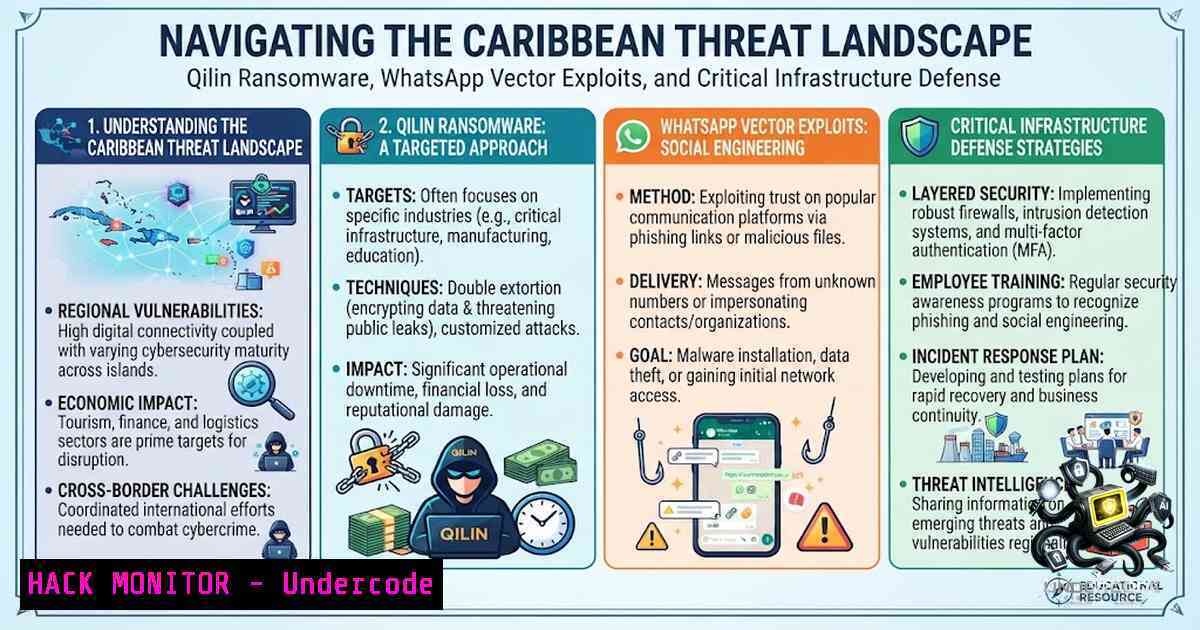
The Caribbean cybersecurity landscape faces an unprecedented escalation in sophisticated cyberattacks, exemplified by the recent Qilin ransomware breach targeting critical corporate entities in Trinidad and Tobago. As threat actors leverage advanced initial access vectors—ranging from infostealer-harvested Microsoft 365 credentials to weaponized messaging app malware campaigns—regional security teams must urgently modernize their defensive postures. This article provides a comprehensive technical breakdown of these emerging vectors, along with actionable hardening strategies across cloud infrastructure, endpoints, and identity management.
Learning Objectives & Secrets:
Analyze the mechanics of Ransomware as a Service (RaaS) operations like Qilin, focusing on double extortion techniques and lateral movement via legitimate administrative tooling (Living off the Land).
Master mitigation strategies against multi-stage VBScript delivery mechanisms, including PowerShell execution restrictions and Windows User Account Control (UAC) enforcement.
Implement proactive cloud hardening controls for Microsoft 365 environments to detect and block infostealer credential theft and unauthorized linked device sessions.
You Should Know:
- Defending Against Qilin Ransomware and M365 Compromise Vectors
The recent breach of Inland and Offshore Contractors by the Qilin ransomware group underscores the vulnerability of regional supply chains and energy sectors to Eastern European RaaS syndicates. Qilin operations typically begin with initial access gained via infostealer malware (such as RedLine or Lumma) harvesting active session cookies and credentials from corporate browsers, followed by exploitation of federated or cloud identities within Microsoft 365. Once inside, attackers bypass perimeter defenses by utilizing legitimate remote monitoring and management (RMM) tools and native administrative utilities like PowerShell, WMIC, and PsExec to execute lateral movement and volume shadow copy deletion.
To detect and mitigate these threats, security administrators must implement rigorous telemetry monitoring, enforce phishing-resistant Multi-Factor Authentication (MFA), and apply strict conditional access policies. Below is a foundational PowerShell script and configuration guide designed to audit M365 sign-in logs for anomalous behavior and harden local endpoint execution policies.
Step‑by‑step guide explaining what this does and how to use it:
Step 1: Connect to Microsoft Graph PowerShell to inspect recent authentication anomalies, impossible travel, and unauthorized legacy authentication protocols.
Step 2: Enforce strict PowerShell Script Block Logging (Event ID 4104) and Transcription via Group Policy to capture obfuscated payloads used by initial access loaders.
Step 3: Isolate high-risk endpoints upon detecting unauthorized execution of living-off-the-land binaries (Lolbins).
 PowerShell Script: Audit M365 Authentication Logs for Anomalous Legacy Auth & Conditional Access Bypasses
 Requires Microsoft.Graph module installed

Import-Module Microsoft.Graph.Reports

Connect-MgGraph -Scopes "AuditLog.Read.All", "Directory.Read.All"

Write-Host "[] Fetching recent risky sign-ins and authentication logs..." -ForegroundColor Cyan
$RiskySignIns = Get-MgAuditLogSignIn -Filter "status/errorCode ne 0" -Top 50

foreach ($signIn in $RiskySignIns) {
[bash]@{
UserPrincipalName = $signIn.UserPrincipalName
IPAddress = $signIn.IpAddress
Location = $signIn.Location.City
AppDisplayName = $signIn.AppDisplayName
ClientAppUsed = $signIn.ClientAppUsed
ErrorCode = $signIn.Status.ErrorCode
FailureReason = $signIn.Status.FailureReason
}
}

Enforce script execution policy hardening locally
Write-Host "[] Setting local execution policy to Restricted / AllSigned..." -ForegroundColor Yellow
Set-ExecutionPolicy AllSigned -Scope LocalMachine -Force
- Neutralizing VBScript Messaging App Malware & Account Hijacking
Recent threat intelligence highlights widespread crimeware campaigns utilizing compromised WhatsApp accounts to distribute malicious VBScript files disguised as invoices or financial documents. When a user executes the script, it unpacks a multi-stage payload that evades basic antivirus detection, abuses Windows Script Host (wscript.exe/cscript.exe), and silently deploys remote access trojans (RATs). Additionally, attackers abuse linked device functionalities to maintain persistent session access without requiring re-authentication.
Step‑by‑step guide explaining what this does and how to use it:
Step 1: Disable default file associations for `.vbs` and `.js` extensions on Windows endpoints to prevent accidental execution of script-based attachments.
Step 2: Configure Software Restriction Policies (SRP) or AppLocker rules to block script execution from user profile directories and temporary folders.
Step 3: Regularly audit active linked devices across communication platforms and enforce strict enterprise communication policies regarding external file downloads.
:: Command Prompt Script: Disable default VBScript file execution by modifying file associations
:: Run as Administrator

assoc .vbs=txtfile
assoc .vbe=txtfile
assoc .js=txtfile
assoc .jse=txtfile

echo [+] Default script associations neutralized. VBS and JS files will now open safely in Notepad.
- Hardening Web Infrastructure Against Bot Attacks and DoS
Regional state agencies and public health infrastructure—such as the Trinidad and Tobago Housing Development Corporation (HDC)—have increasingly become targets for malicious web scraping, credential stuffing, and automated bot attacks. Securing web applications requires implementing robust Web Application Firewalls (WAF), rate limiting, and behavioral analysis to differentiate between legitimate user traffic and automated botnets.
Step‑by‑step guide explaining what this does and how to use it:
Step 1: Deploy a WAF rule set (such as OWASP Core Rule Set) to inspect incoming HTTP/HTTPS traffic for common injection patterns and automated scanning signatures.
Step 2: Implement strict rate limiting on authentication and API endpoints to thwart brute-force and credential stuffing attacks.
Step 3: Monitor web server access logs for high-frequency requests originating from known malicious user agents or IP ranges.
 Bash Script: Analyze Nginx access logs for suspicious high-frequency IP requests indicative of bot attacks
 Usage: bash parse_bots.sh /var/log/nginx/access.log

LOG_FILE=$1

if [ -z "$LOG_FILE" ]; then
echo "[-] Please provide path to access log."
exit 1
fi

echo "[] Top 10 IP addresses making requests..."
awk '{print $1}' "$LOG_FILE" | sort | uniq -c | sort -1r | head -1 10

echo "[] Checking for suspicious User-Agents (scanners/bots)..."
grep -iE "sqlmap|nikto|nmap|masscan|python-requests" "$LOG_FILE" | awk '{print $1}' | sort | uniq -c
- Incident Response and Forensic Readiness for Healthcare Networks
Healthcare and public health sectors face debilitating ransomware risks that can paralyze electronic health records (EHR) and force facilities into manual operations. Maintaining rapid containment capabilities is essential. Security teams must ensure immutable, offsite backups are maintained and that endpoint detection and response (EDR) agents are actively deployed across all clinical workstations.
Step‑by‑step guide explaining what this does and how to use it:
Step 1: Establish isolated VLAN segmentation for medical IoT and critical health infrastructure systems.
Step 2: Utilize live response triage tools to collect process memory, network connections, and autostart artifacts during an active incident.
Step 3: Verify backup integrity through routine, automated restoration drills following the 3-2-1-1 backup rule.
- Securing Cross-Border Supply Chains and Third-Party Risk Management
Third-party vendors and corporate contractors represent critical attack surfaces for threat groups seeking initial footholds into larger energy and telecommunications networks. Comprehensive vendor risk assessments and continuous threat intelligence monitoring are paramount.
Step‑by‑step guide explaining what this does and how to use it:
Step 1: Inventory all third-party software integrations and API connections accessing internal corporate networks.
Step 2: Require vendors to adhere to standardized security frameworks such as ISO/IEC 27001 and NIST SP 800-53.
Step 3: Continuously monitor external attack surfaces for exposed remote desktop protocols (RDP), unpatched VPN appliances, and leaked credentials.
What Undercode Say:
Key Takeaway 1: Regional ransomware campaigns like Qilin rely heavily on initial infostealer activity and compromised cloud credentials to breach high-value corporate and industrial sectors.
Key Takeaway 2: Multi-stage social engineering via messaging apps and malicious scripts demands rigorous endpoint hardening, script restriction, and user verification protocols.
The convergence of targeted ransomware syndicates, infostealer distribution campaigns, and automated web infrastructure probing across the Caribbean highlights an urgent structural vulnerability in regional digital ecosystems. As organizations accelerate digital transformation initiatives within energy, healthcare, and state sectors, perimeter defense alone remains entirely insufficient. The sophistication demonstrated by groups like Qilin in exploiting Microsoft 365 environments and leveraging native administrative tools emphasizes that threat actors are no longer merely breaking in—they are blending in. Without a paradigm shift toward zero-trust architectures, rigorous identity governance, continuous endpoint telemetry monitoring, and active cross-border intelligence sharing, critical infrastructure will remain highly susceptible to disruptive extortion campaigns and operational paralysis.
+1 Anticipated implementation of mandatory national and regional cyber incident reporting standards across Caribbean state and financial entities, driving elevated baseline security investments.
-1 Expected escalation in sophisticated AI-driven social engineering and deepfake-enabled business email compromise (BEC) targeting regional executive leadership over the coming quarters.
 Related Video (80% Match):
 Let’s Practice For Free:
 Live Courses & Certifications:
Join Undercode Academy for Verified Certifications
 Request a Custom Project:
Secure, high-velocity infrastructure and disruptive technological engineering. Contact our engineering team for high-tier development and proprietary systems:
projects@undercode.co.uk
 Smart Architecture |
 Secure by Design |
 Trusted by Thousands
IT/Security Reporter URL:
Reported By: https://lnkd.in/p/dwKUVedv – Hackers Feeds
Extra Hub: Undercode MoN
Basic Verification: Pass 
 JOIN OUR CYBER WORLD [ CVE News • HackMonitor • UndercodeNews ]
 Whatsapp
 Follow UndercodeTesting & Stay Tuned:
???? formerly Twitter  | @ Threads |
 Linkedin |
 BlueSky
The post Navigating the Caribbean Threat Landscape: Qilin Ransomware, WhatsApp Vector Exploits, and Critical Infrastructure Defense + Video appeared first on Undercode Testing.
Popular Products
-
 Electric Toothbrush & Water Flosser S...
$43.56$21.78 -
 Foldable Car Trunk Multi-Compartment ...
$329.56$164.78 -
 Mommy Diaper Backpack with Stroller O...
$111.56$55.78 -
 Ai Dash Cam with Front & Rear HD, GPS...
$295.56$147.78 -
 Smart Auto-Recharge Robot Vacuum Cleaner
$613.56$306.78