Open House At Esperance Fire Station Highlights $420 Million Regional Fire Bond For Voters
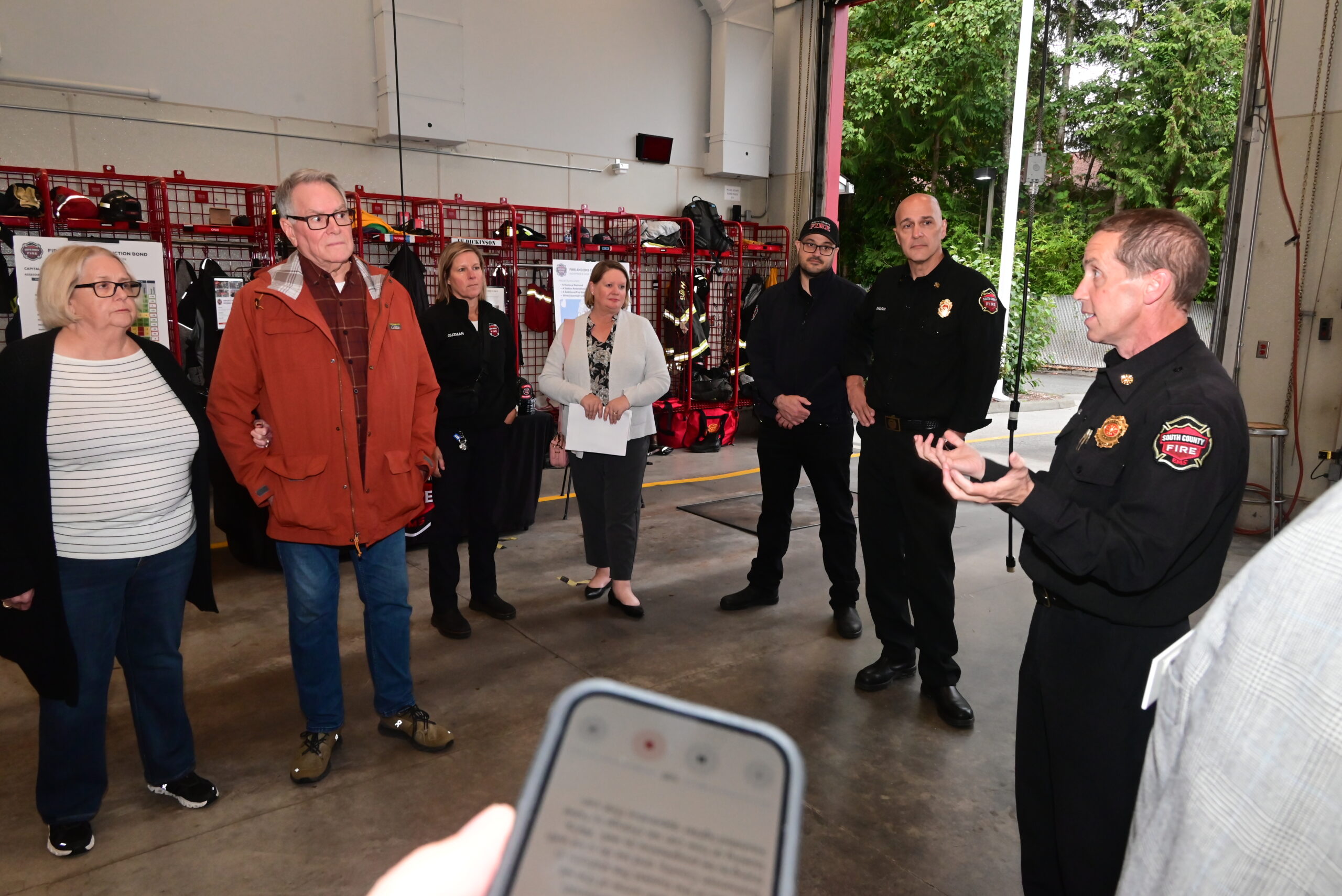
In a Thursday open house at the Esperance Fire Station, representatives from South County Fire’s Regional Fire Authority (RFA) outlined why they believe the November bond is necessary, what it would pay for and how it would affect local taxpayers. Part of the open house included a tour of the aging Esperance station, one of those slated for replacement should voters approve the bond issue.
Fire officials and commissioners are urging voters to consider a proposed $420 million bond measure as an investment in a regional emergency response system that serves nearly 300,000 residents across southwest Snohomish County — not just Edmonds.
It will appear on the November ballot as Proposition 1, and requires a 60% supermajority from voters across the RFA to pass. The RFA includes Brier, Edmonds, Lynnwood, Mill Creek, Mountlake Terrace and unincorporated communities of southwest Snohomish County.
What it would pay for
Christie Veley, communications director for the fire authority, said the bond would fund major facility improvements for fire stations and support buildings throughout the RFA. The RFA operates 15 fire stations and serves nearly 300,000 residents in those areas. Veley said the agency has been studying station conditions and needs for more than a decade. She noted that work on the long-range facilities plan slowed during the pandemic until the board moved last year toward placing a bond on the November ballot and formally approved that step at its June 9 meeting.
“The bond issue would really fund important facilities improvements for fire stations and support facilities across the regional fire authority,” Veley said. “It impacts virtually every community that we serve, from Edmonds to Lynnwood to Brier, Mountlake Terrace, Mill Creek, and unincorporated Snohomish County.”
“We looked at the whole of the regional fire authority because it’s a network of response,” she added. “All the fire stations work together to provide emergency services to our residents, and so we looked at the health of all of our fire stations, and we’ve been doing this for over 10 years now.”
Aging stations and safety concerns
The Esperance Fire Station, where the open house took place, is one of six stations that would be replaced if voters approve the measure (see details of stations targeted for replacement or renovation should the bond issue be approved here).
Built in the early 1990s, the station no longer meets modern safety and space standards, Veley said. One of the biggest issues is the lack of room in the apparatus bay, where engines and ambulances are parked and where firefighters’ protective gear is currently stored.
“The apparatus bay is undersized for the current clearance requirements for fire engines and ambulances,” Veley said. “Because we are lacking space, we also are forced to store firefighter gear here in the apparatus bay, which inevitably exposes it to diesel exhaust [a known carcinogen]. We don’t have another place currently to store that gear.”
Fire Chief Shaughn Maxwell said he is particularly concerned about how the District’s stations would survive a major earthquake.
“As a fire chief, you want to always be there for the community. You want to be reliable,” Maxwell said. “When two-thirds of our stations may not be operational after an earthquake, those are the things fire chiefs think about long term.”
Maxwell also stressed that the RFA operates as a single system, with stations backing each other up across city boundaries. The member cities and communities operate as a unit, not as separate islands.
“It’s a system of fire stations that operate together,” he said. “If maybe one fire station is ready to go, [but] if the other stations can’t back them up, we could run critically short of resources in an emergency.”
Tax fatigue
The bond proposal comes at a time when many residents say they feel overburdened by taxes following a failed city levy, additional city taxes (for example, utilities) and higher property tax bills associated with annexing into the RFA.
Maxwell said he understands these concerns but warned that delaying needed work could drive up costs and prolong safety risks.
“I’m a taxpayer too. I have empathy for that as well,” he said. “We’ve been looking at this for 10 years, and there’s just never a good time. Every year we wait, it costs more. Even if we start today it’ll take a decade till we’re done with most of it, and for some of our stations it could take 20 years. And with costs going up 4 to 5% a year, that’s significant.”
Asked why the board chose one large bond measure instead of a series of smaller, phased requests, Commission Board President Jim Kenny said the projects are planned over a 10-year construction period and reflect districtwide needs.
“This project, it’s a 10-year construction project, so it’s not like it’s all happening in one year,” Kenny said. “This is the total need for the RFA as a whole, and it’s important that we present the voters with the full scope of these needs.”
He added that a single package helps ensure that all communities see benefits, rather than pitting one city’s projects against another’s in separate elections.
“If we do part of it, let’s just say the first part didn’t include a station in Edmonds. It’s like, what do you pick?” Kenny asked. “If we are going to the ballot multiple times, are folks in Edmonds going to support a station in Mill Creek, and will the people in Mill Creek support a station in Edmonds?”
“There’s something for everybody in the full package,” he said. “These are the needs that in total are necessary. So we want to take the full package to the voters because it all needs to be done, and it’s not going to be done quickly.”
“It is important to remember that we’re the largest fire department in Snohomish County. We’re one of the largest departments in the state, and so that is going to result in a higher need for these projects and a higher number of projects,” she said.
What it would cost homeowners
On the financial side, Veley said the average homeowner in the RFA — based on an assessed value of $700,000 — would pay about $11.32 per month, or just under $136 per year, if the bond passes.
Because property values in Edmonds tend to be higher, she used a $1 million home as the example.
“That’s going to be about $194 a year [based on $1 million], per year,” Veley said, which works out to roughly $16 per month.
Residents can check their specific estimated cost using an online calculator.
“You can go to the tax calculator on our website,” Veley said. “There are some values there you can just pick from, or you can actually put in your exact assessed value. There’s even a link to the county assessor’s office if you don’t know your assessed value, and you can look at exactly what it’s estimated to cost your property.”
Communication gaps and voter sentiment
Alicia Crank, an Edmonds resident and applicant for the interim fire commissioner appointment to fill the term of recently resigned commissioner Micah Rowland, said she has been closely following the conversations about annexation, the failed city levy and now the bond measure. She believes there is a disconnect between long-term planning by the RFA and how newer Edmonds taxpayers are experiencing successive cost increases.
Crank said she believes that many residents feel they are being told, in effect, to accept the bond without sufficient acknowledgment of their concerns.
“I think that a lot of people in Edmonds are not feeling heard as part of that,” she said. “It’s like, ‘Oh well, sorry, but this still needs to happen,’ and that doesn’t resonate with people. I don’t think there’s a level of empathy for those that are just coming into this.”
She also argued that the bond has often been framed too narrowly in local discussion.
“I think that there are some missing ingredients in what Edmonds folks might know about,” Crank said. “I think that a lot of Edmonds folks think that this bond measure is just about Edmonds. But it’s bigger than that — it’s about the whole RFA, and I don’t think that’s being communicated effectively.”
Crank acknowledged that she initially viewed the issue as Edmonds-centered until she looked more closely at the full project list.
“Up until like a week ago, I was almost of that same mindset because all the conversation and dialogue has been very Edmonds specific,” she said. “But when you sit down and look at everything and go, ‘Oh wait, they’re doing another one of these in Mill Creek… Oh, this is about everybody.’”
Edmonds residents Gary and Connie Pugh had more specific questions about the range of expenses that the bonds would cover, specifically asking whether the need for new equipment was “being taken into account for the design of the new buildings.” They also asked how long it would take (assuming the bond passes) “to get the money before you could begin ordering architectural drawings and that kind of thing,” and whether there was a way to “mesh this ordering of the equipment and the building of the new facilities, so they come in at a more coordinated time, and you’re not getting equipment that you can’t put somewhere while you’re waiting for a building.”
Chief Maxwell assured them that “all the engines, ambulances and equipment are included in the bond,” adding that the department is already “strategizing on how we could maximize that and be super efficient in the building process.”
Maxwell also noted that the cost of fire apparatus has “almost doubled in the last five years,” with engines approaching $1 million and ladder trucks reaching “two and a half, maybe $3 million,” adding that post‑COVID lead times of three to five years require thinking “five years out into the future” for replacements.
Veley added that bond funds would become available in “the second half of 2027,” and both she and Maxwell emphasized that station upgrades and replacements are prioritized strictly by need.
Asked by Crank whether communities that vote against the bond would be pushed to the bottom of the list, Maxwell stressed that “The plan is the plan. It would make our whole system weaker if we were to reprioritize based on how one of our member communities votes. We serve the entire RFA as a whole.”
Station tour highlights need for critical improvements
As part of the open house, Veley led a tour of the Esperance Fire Station, highlighting both the critical role the regional fire authority plays and the significant facility challenges it faces with aging facilities.
Walking through the apparatus bay, visitors saw how cramped conditions force engines and medic units to park at angles, with broken mirrors and limited clearance illustrating the lack of space. Veley pointed out how diesel exhaust lingers in the bay because the station has only an old filtration system instead of a modern exhaust capture system, while firefighter gear, an extractor for cleaning it and medical oxygen are all stored in the same exposed area.
Inside, the group saw medical supplies stacked to the ceiling, four desks serving five firefighters and only four bedrooms — forcing extra personnel to sleep on a rollaway bed in the workout room. Upstairs, a cozy but aging kitchen and living area underscored the station’s age, and the narrow stairway from sleeping quarters to the equipment bay was noted as a drag on response times. The tour concluded with an explanation of a proposed bond measure that would replace outdated stations like this one, build new stations in high-need areas, and fund seismic and safety upgrades across the system so firefighters can continue responding quickly and safely as the community grows.
‘Let the bosses decide’
Kenny said the board intentionally placed the measure on the November general election ballot in an even-numbered year, when turnout is typically higher, and emphasized that a 60% supermajority is required for passage.
“We’re also doing it at the general election in an even-numbered year, so a large number of people are going to come out,” he said. “We’ll let the bosses [i.e., the voters] decide.”
“Ultimately, it’s the residents, it’s the voters who will decide whether they think these projects are worth it for them,” Veley said. “Our job is to tell them the needs and provide emergency services.”
Learn more about the proposed $420 million bond at South County Fire’s dedicated bond issue website which includes a station-by-station rundown of proposed improvements, a video, an FAQ and more.
Popular Products
-
 Enamel Heart Pendant Necklace
$49.56$24.78 -
 Digital Electronic Smart Door Lock wi...
$211.78$105.89 -
 Automotive CRP123X OBD2 Scanner Tool
$649.56$324.78 -
 Portable USB Rechargeable Hand Warmer...
$61.56$30.78 -
 Portable Car Jump Starter Booster - 2...
$425.56$212.78