The Foster Care Gold Rush, Part 4: Who Was Supposed To Be Watching
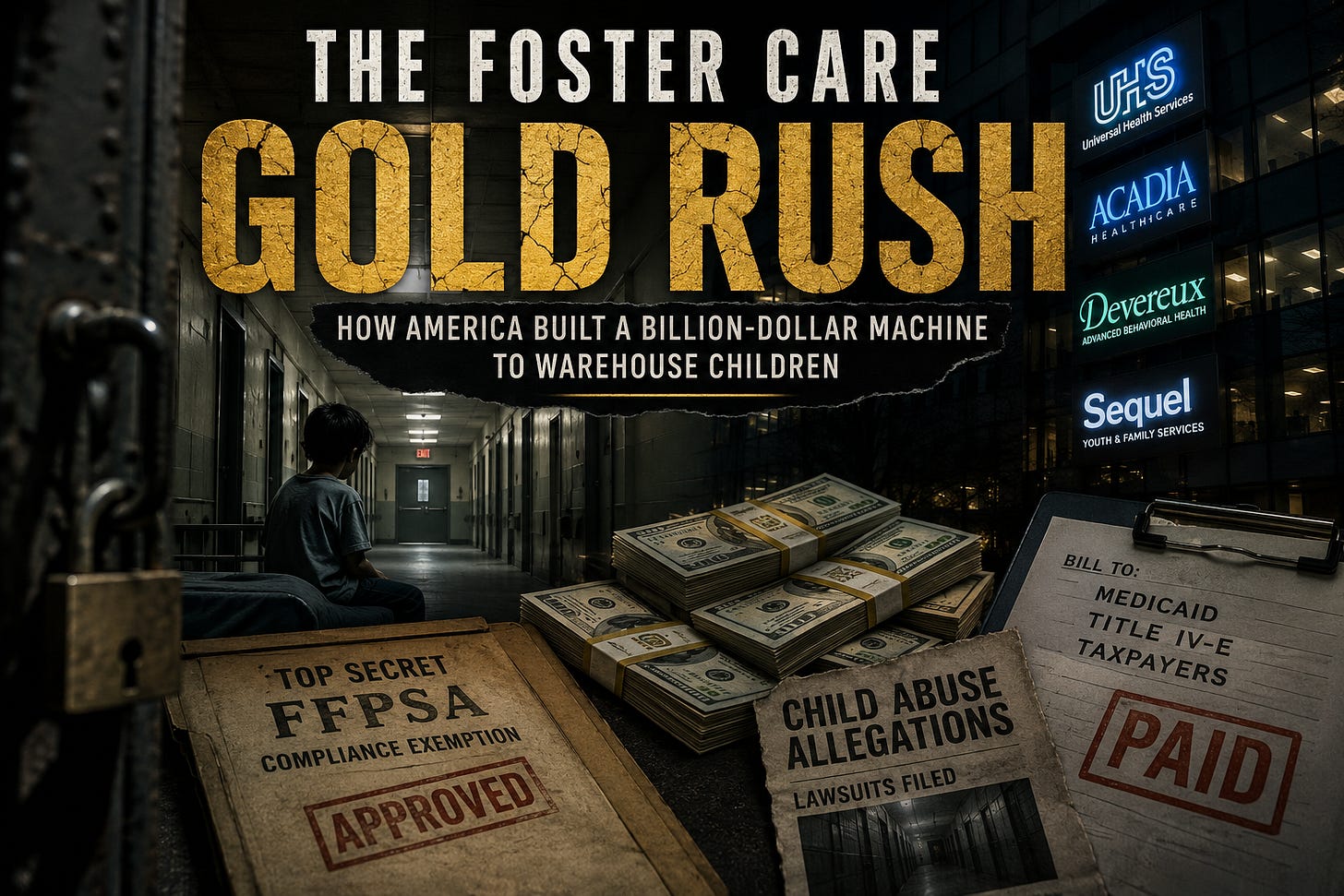
This is Part 4 of a five-part series. Part 1 covered the law that was supposed to end child warehousing. Part 2 followed the money. Part 3 covered what happens to children inside these facilities. Part 4 asks who was supposed to be watching. The complete version of this report is available as the exhaustive report.
Editor’s note: this part was adapted from our May 2026 report and updated in September 2026. One case discussed below has moved. On May 15, 2026, a panel of the U.S. Court of Appeals for the Ninth Circuit rejected an attempt to dismiss Ocean S. v. Los Angeles County, the civil rights case described in the Olmstead section, allowing seven foster youth plaintiffs to proceed against county and state agencies. As of this September 2026 update, the case is moving forward and no trial date has been reported.
The Olmstead Problem Nobody Wants to Touch
The civil rights dimension of this crisis may prove to be one of the most consequential. The Supreme Court’s 1999 decision in Olmstead v. L.C. held that unjustified institutionalization of people with disabilities can constitute discrimination under Title II of the Americans with Disabilities Act. The principle is known as the integration mandate: people with disabilities should receive services in the most integrated setting appropriate when community-based care can reasonably meet their needs.
For foster youth, this mandate has enormous implications. Many children placed in residential treatment centers, psychiatric residential treatment facilities, and other congregate care settings have mental health disabilities or behavioral health diagnoses. If those children could be served safely in family-based or community-based settings with proper supports, then unnecessary institutionalization is not merely bad policy. It may be a civil rights violation.
The Department of Justice has already recognized this theory in litigation involving Los Angeles County and the State of California, where federal attorneys argued that foster youth with mental health disabilities were being unnecessarily institutionalized because the system failed to provide adequate community-based housing and behavioral health services. That argument should send shockwaves through every state child welfare agency in the country. If the failure to build community alternatives results in institutional placement, states cannot simply claim children are too difficult to serve. They may be creating the very conditions that justify segregation.
This is where FFPSA and Olmstead intersect. FFPSA tells states to reduce reliance on congregate care and build prevention and family-based alternatives. Olmstead tells states that unnecessary institutionalization of people with disabilities can be discriminatory. Together, they create a powerful legal and moral framework against foster youth warehousing. Yet enforcement remains weak. More than twenty-five years after Olmstead, foster youth remain among the least protected populations affected by institutionalization.
The enforcement gap is striking. Adult disability institutionalization has received significant litigation, advocacy, and policy attention. Foster youth institutionalization has not received the same sustained federal civil rights pressure, even though the harm profile is severe. Children in foster care often lack political power, stable advocates, consistent legal representation, and media visibility. They are easy for systems to move, label, medicate, and forget.
A serious national response would require the Department of Justice, HHS Office for Civil Rights, CMS, ACF, and state attorneys general to coordinate around the integration mandate. They would need to ask hard questions: Which children in congregate care could be served in the community? Which states lack sufficient alternatives? Which facilities function more like detention than treatment? Which Medicaid dollars are supporting unnecessary institutionalization? Which courts are approving placements without meaningful review? Until those questions are answered, the Olmstead promise remains largely theoretical for foster youth.
Federal Oversight Failed at Every Level
The oversight system surrounding institutional foster care is fragmented by design. The Children’s Bureau approves state Title IV-E plans. State agencies license and monitor facilities. Courts review certain placements. Medicaid agencies process treatment claims. Accrediting bodies assess compliance. HHS OIG audits monitoring systems. CMS oversees Medicaid payment integrity. DOJ may pursue fraud or civil rights enforcement. Each entity sees part of the elephant, but too often no one sees the full animal.
The Children’s Bureau’s role is especially important because state Title IV-E plans are supposed to demonstrate compliance with FFPSA. Yet approval of a plan does not necessarily mean meaningful verification of every facility’s real-world practices. The system relies heavily on state self-certification and documentation. If a state claims facilities meet QRTP requirements, federal approval may proceed without the kind of aggressive independent investigation that would reveal whether treatment quality, staffing, family engagement, and aftercare actually exist.
The HHS Office of Inspector General’s June 2024 findings expose how weak state monitoring can be. Nearly one-third of states could not identify patterns of maltreatment in residential facilities. Some states failed to consistently report whether maltreated children were in residential settings to the national NCANDS database. More than a dozen states did not adequately track repeated abuse at a single facility or across facilities owned by the same company. That is not a minor technical flaw. It means policymakers may not even know where abuse is clustering.
Multi-state operators make this weakness especially dangerous. A company operating facilities across dozens of states can generate complaints, lawsuits, incident reports, and regulatory findings across separate jurisdictions. If states do not share data effectively, a pattern that looks obvious nationally may appear isolated locally. One state may see a facility problem. Another state may see a different facility problem. No one connects the corporate pattern. Meanwhile, the operator continues receiving referrals, contracts, and Medicaid payments.
CMS also plays a central role because Medicaid is one of the largest funding streams supporting psychiatric and residential behavioral health treatment. Yet CMS does not appear to coordinate deeply enough with ACF to cross-reference child welfare placement data against Medicaid billing. That creates a blind spot. A child may be generating Title IV-E-related placement claims in one system and Medicaid treatment claims in another, while no federal entity examines the total cost, duration, medical necessity, facility history, and child outcome in one unified view.
The continued ability of operators to receive Medicaid payments after major fraud settlements raises another question: when does settlement become simply a cost of doing business? UHS paid major False Claims Act settlements and continued operating. Acadia paid a Medicaid fraud settlement and continued operating. Settlements may recover money, but they do not automatically transform the underlying incentive structure. If the revenue stream remains large enough, penalties may deter only the most visible misconduct while leaving the model intact.
Courts are supposed to provide another layer of protection, especially for QRTP placements requiring judicial review. But court oversight depends on time, information, independence, and willingness to challenge agency recommendations. Overloaded family courts are not always equipped to conduct deep facility-level analysis. A judge may receive an assessment, hear that no family placement is available, and approve the residential placement as the least bad option. That may satisfy procedural requirements while failing to protect the child from unnecessary institutionalization.
The oversight failure is therefore not located in one agency. It is systemic. Each institution can claim partial responsibility while the child experiences total custody. The state removed them. The facility controls them. Medicaid pays for them. The court approves them. The accreditor certifies the setting. The federal government reimburses or monitors from a distance. When harm occurs, every entity can point elsewhere. That is how accountability dissolves.
The Child-Specific Exception and the Exemption Machine
FFPSA included exceptions because lawmakers understood that some children may temporarily require specialized settings. In theory, the child-specific exception was a narrow safety valve for unusual cases where a child’s needs could not be met in a family setting or QRTP-compliant environment. In practice, narrow safety valves can become wide escape hatches when systems are under pressure.
The child-specific exception allows states to justify continued placement based on an individualized assessment. That sounds reasonable until one asks who performs the assessment, what alternatives were actually available, how often judges reject the recommendation, and whether federal auditors later test the justification. If the same agencies that rely on congregate care also help produce the documentation supporting congregate placement, the risk of circular reasoning is obvious. The system says the child needs the placement because the system lacks an alternative, then treats the absence of an alternative as evidence the placement is necessary.
The law also requires states to prevent inappropriate diagnoses from being used to justify QRTP placement. That safeguard exists because Congress anticipated a dangerous possibility: children could be labeled or diagnosed in ways that make institutional placement easier to defend. But a safeguard written into a plan is not the same as enforcement. Without robust auditing, diagnostic review, prescribing oversight, and outcome tracking, the protection may exist mainly on paper.
The sex trafficking exemption presents another troubling pathway. FFPSA allows continued federal reimbursement for certain settings serving youth who are victims of sex trafficking or at risk of becoming victims. Protecting trafficking survivors is a legitimate and urgent goal. But broad language can be exploited. The research brief notes that HHS provided limited detailed guidance on when to apply this exemption, states interpreted it differently, and some designated most or all congregate care settings as serving youth at risk of trafficking. If true, that converts a protective exemption into a funding strategy.
The danger is that exemptions can reduce oversight rather than increase protection. QRTPs at least carry specific standards and review requirements. If a facility avoids QRTP classification by fitting into another exemption category, children may remain in nonfamily settings with less federal scrutiny. The result is perverse: an exemption meant to protect especially vulnerable youth may help keep them in institutional settings with weaker accountability.
Other reclassification strategies further complicate the picture. States can shift youth into supervised independent living categories, rely more heavily on state and local funding, increase Medicaid billing for treatment, or send children to out-of-state facilities where regulatory conditions differ. Each maneuver may be legally defensible in isolation. Taken together, they suggest a system highly skilled at preserving congregate care capacity despite congressional intent.
This is why the phrase “loophole” may actually understate the problem. A loophole sounds accidental. What appears here is closer to an exemption machine: multiple legal, financial, and administrative pathways that allow institutional placement to continue while formal compliance is maintained. The machine does not need one perfect loophole. It needs enough partial pathways to keep beds filled and bills paid.
The Foster Care Population Declined, but Institutionalization Did Not
One of the most misleading narratives in child welfare reform is that declining foster care numbers automatically mean children are safer or systems are less institutional. National foster care population data shows the number of children in care declined after its 2018 peak. On the surface, that sounds like progress. Fewer children in foster care could mean better prevention, fewer removals, or improved family support. But the congregate care data complicates that story.
The GAO found that many states did not see corresponding reductions in congregate care. More than half reported that the percentage of children in congregate care had increased or stayed the same. This means the foster care population may have become smaller but more concentrated among children classified as high need, behaviorally complex, or difficult to place. Those children are precisely the ones most likely to be sent into residential treatment centers, psychiatric facilities, and group settings.
This creates a dangerous policy trap. As foster care numbers decline, states may celebrate success while the children who remain in care experience more intensive institutional control. The public hears that fewer children are in foster care, but does not hear that a stubborn share of children are still being warehoused, held longer, shipped farther, or placed in emergency stopgaps. Averages conceal severity. Population decline conceals concentration.
Step-down placement shortages intensify the trap. States reported widespread difficulty finding lower levels of care for children leaving congregate settings. If a child stabilizes in a facility but no therapeutic foster home, kinship placement, community program, or family reunification option exists, the child may remain institutionalized longer than clinically necessary. Longer stays generate more billing. Longer stays also deepen disconnection from normal adolescence, family bonds, and community life.
This is how emergency infrastructure becomes permanent infrastructure. A state begins by using congregate care because there is no immediate alternative. The facility network expands or remains financially viable because children continue to need placements. Courts and agencies become accustomed to the option. Contractors build operations around the demand. Medicaid and state funds sustain the model. Over time, the system treats institutional capacity as indispensable, even while officially claiming it wants to reduce it.
The hardest truth is that many states may now be dependent on the very placements federal law intended to discourage. Without enough community-based services, therapeutic foster homes, family preservation programs, crisis stabilization options, and aftercare supports, agencies fall back on beds. Beds are tangible. Beds are available. Beds can be contracted. Beds solve tonight’s emergency, even if they create tomorrow’s trauma.
Thanks for reading! This post is public so feel free to share it.
Coming in Part 5
Part 5 closes the series. It asks why reform keeps failing, what real accountability would actually require, and the question at the center of all of this: did that child need an institution, or did the institution need that child?
What You Can Do
Oversight only works when someone outside the agency asks for the record. Every step below is a request an ordinary person is entitled to make.
Read the inspector general’s own summary. The HHS Office of Inspector General report is OEI-07-22-00530, “Many States Lack Information To Monitor Maltreatment in Residential Facilities for Children in Foster Care,” published June 2024. The findings and recommendations sit at the top of the page, in plain language, in under a page.
Ask whether your state is one of them. Email your state child welfare agency’s public information office and ask three things: does the state track maltreatment patterns by facility, does it track patterns across facilities owned by the same company, and does it report residential setting information to the national NCANDS database. The inspector general found many states could not do these things. Your state’s answer is worth having in writing.
Ask how often exemptions are used. Ask the same office how many children are placed under the child-specific exception and how many under the sex trafficking exemption, and how those determinations are made and reviewed. GAO found states interpret that second exemption very differently, and some apply it to nearly all congregate settings.
Watch the guidance. GAO recommended that HHS clarify its guidance to states on when the trafficking exemption applies. That recommendation is public and trackable on the GAO’s website under the report number above. When an agency acts on a recommendation, or fails to for years, that is a real accountability story with a paper trail.
Tell your state legislators what you found. Not a petition, not a slogan. A short, factual email: here is the federal finding, here is what our state told me, here is the gap. State lawmakers write the child welfare budget and can request answers that a private citizen cannot.
If a child is in immediate danger, call 911. To report a missing child or a tip about one, contact law enforcement or the National Center for Missing & Exploited Children at 1-800-THE-LOST (1-800-843-5678). Suspected abuse or neglect of a child in care can be reported to your state’s child abuse hotline and to the state licensing office.
projectmilkcarton.org • t.me/ProjectMilkCarton • X @P_MilkCarton
If you enjoyed this work and feel encouraged by transparency like this, please consider becoming a paid subscriber to Project Milk Carton here
Donate at Project Milk Carton Inc. or at https://t.co/PvtnrODkNz
Your support helps us turn information into action for children and families by:
keeping high-risk and missing children visible
identifying gaps in the systems responsible for protecting them
giving families and communities clear, usable information they can act on
supporting education, outreach, and practical community-based solutions
maintaining the public-data and open source work that makes this accountability possible
building tools and resources designed to help communities protect children before they disappear into a system
Most importantly, please share this article.
Transparency survives when ordinary people help spread information.
Informed communities protect children.
ALL paid subscriptions are 100% tax-deductible.
Project Milk Carton | 501(c)(3) | EIN: 33-1323547
SOURCES FOR PART 4
Federal Government Sources:
GAO-26-107592, “Child Welfare: HHS Should Clarify Guidance on State Spending for Congregate Care” (March 3, 2026), gao.gov
HHS OIG, “Many States Lack Information To Monitor Maltreatment in Residential Facilities for Children in Foster Care” (OEI-07-22-00530, June 2024), oig.hhs.gov
Olmstead v. L.C., 527 U.S. 581 (1999)
DOJ, Statement of Interest in Ocean S., et al. v. Los Angeles County, et al. (C.D. Cal., 23cv06921), filed November 2024, justice.gov
Family First Prevention Services Act, P.L. 115-123, 42 U.S.C. § 672(k)
AFCARS: national foster care population trends
NCANDS: national child welfare fatalities
Journalism and Analysis:
The Imprint, “Foster Youths’ Housing and Mental Health Lawsuit Against LA County Moves Forward” (May 19, 2026), imprintnews.org
NBC News, “States fail to track abuses in foster care facilities housing thousands of children” (June 2024), nbcnews.com
Harvard Law Review, “Community Integration of People with Disabilities a Quarter Century After Olmstead” (January 2025)
Child Welfare Monitor, “Surprise, surprise! Family First has not reduced the use of congregate care!” (March 2026), childwelfaremonitor.org
Popular Products
-
 Classic Oversized Teddy Bear
$23.78 -
 Gem's Ballet Natural Garnet Gemstone ...
$171.56$85.78 -
 Butt Lifting Body Shaper Shorts
$95.56$47.78 -
 Slimming Waist Trainer & Thigh Trimmer
$67.56$33.78 -
 Realistic Fake Poop Prank Toys
$99.56$49.78